There are a number of questions I get asked about being a writer. Inevitably, these include: Have you written anything I’ve heard of? Are you going to be the next J.K.Rowling?

And, sometimes, What do you do all day?

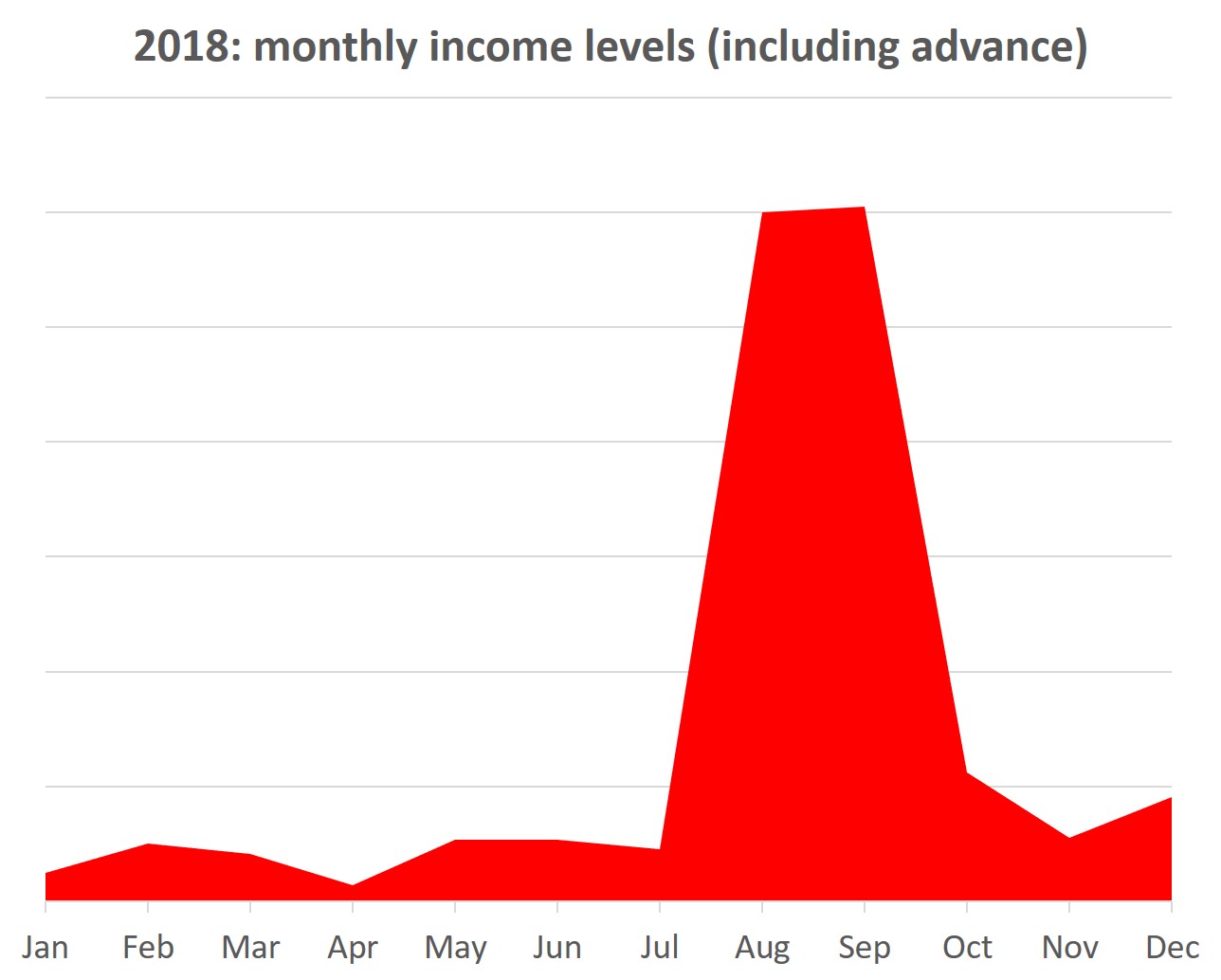
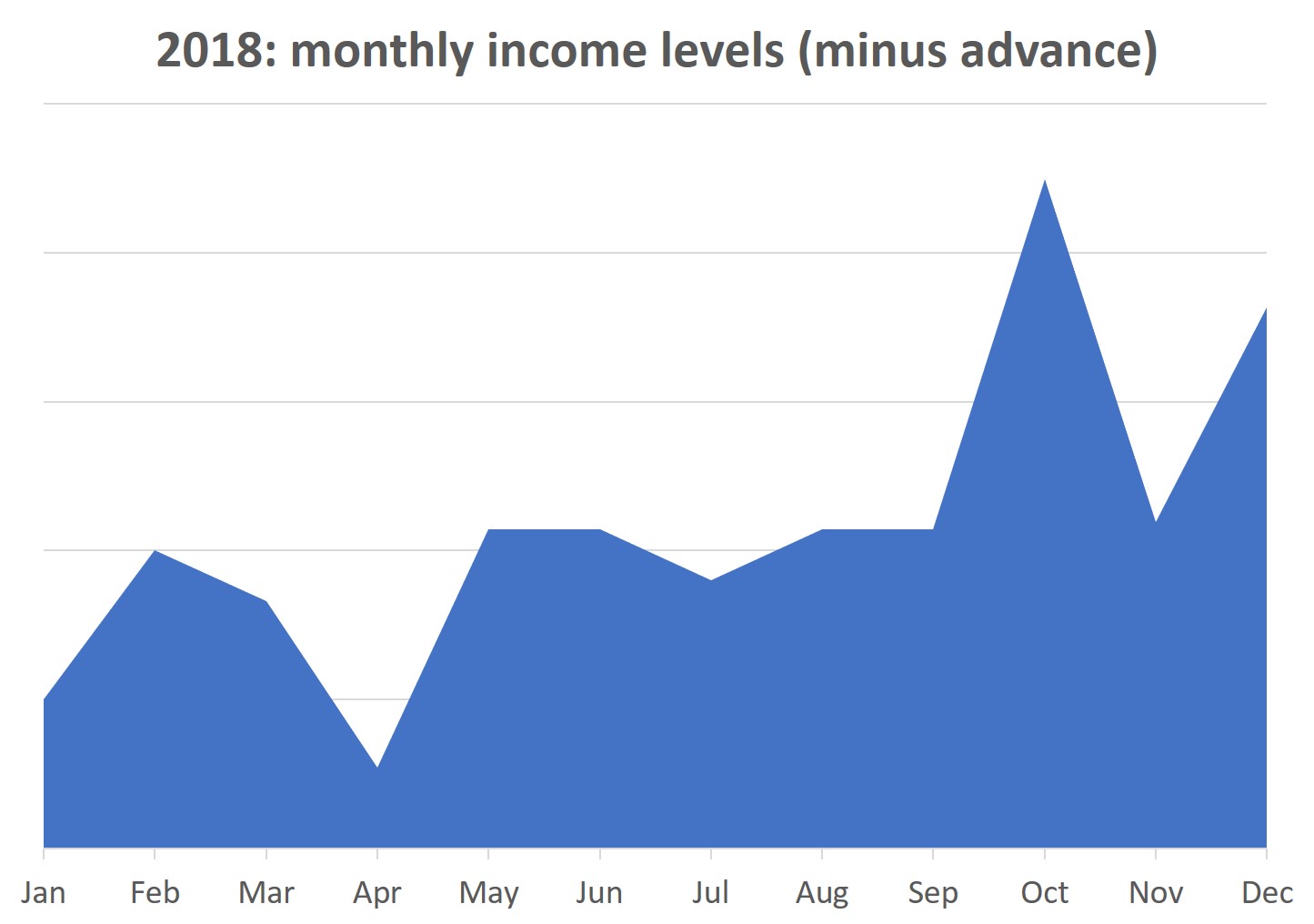
I can’t really answer the first two questions, but I can definitely have a crack at the last one. This question usually comes from people of a generation where working from home is still a largely recent possibility (though not always), and is often asked with a look of concern that I don’t have a ‘proper job’. It’s also quite frequently followed by: But how do you earn a living?

The other way I get asked about my daily routine is more along the lines of, How do you stay motivated? If you don’t have a boss telling you to be at your work station at a certain time, then how do you make yourself get out of bed and do the work?

These are both huge topics in their own right: what constitues the job of being a writer, and how writers can earn a living. I can’t tackle the here; they both deserve their own blog posts.

(I’ve talked a bit about motivation & celebrating success as a writer here, and about a writers’ income here.)

But for now, let’s focus on our initial question: what on earth do I do all day?

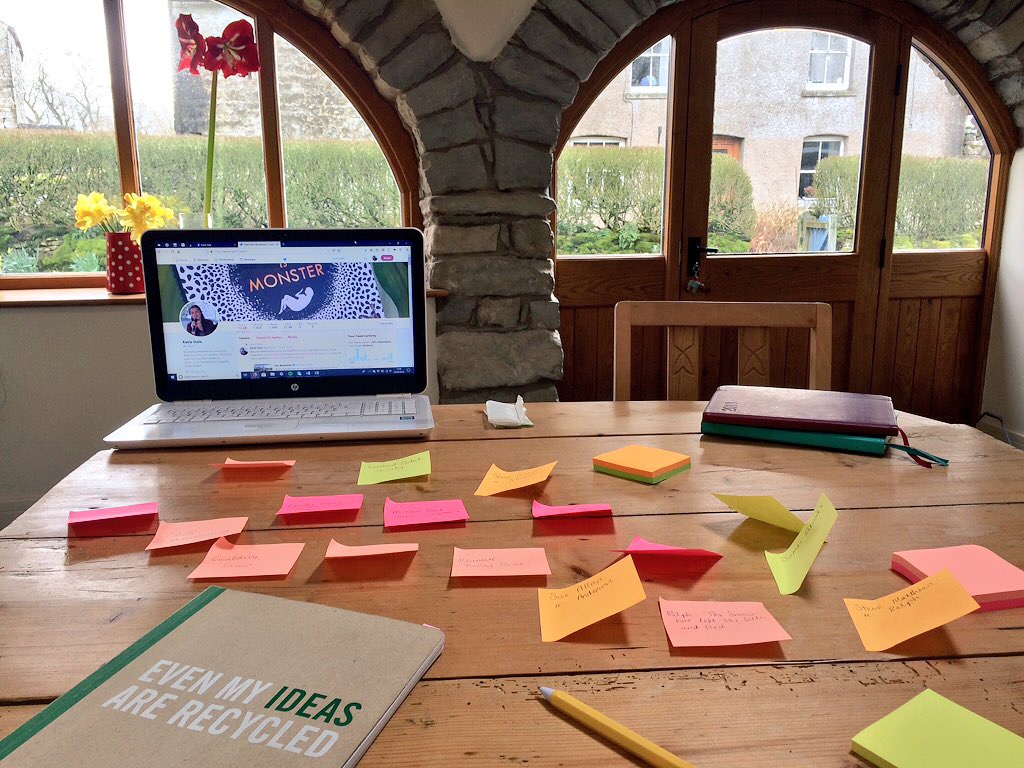
the writing desk

Morning:

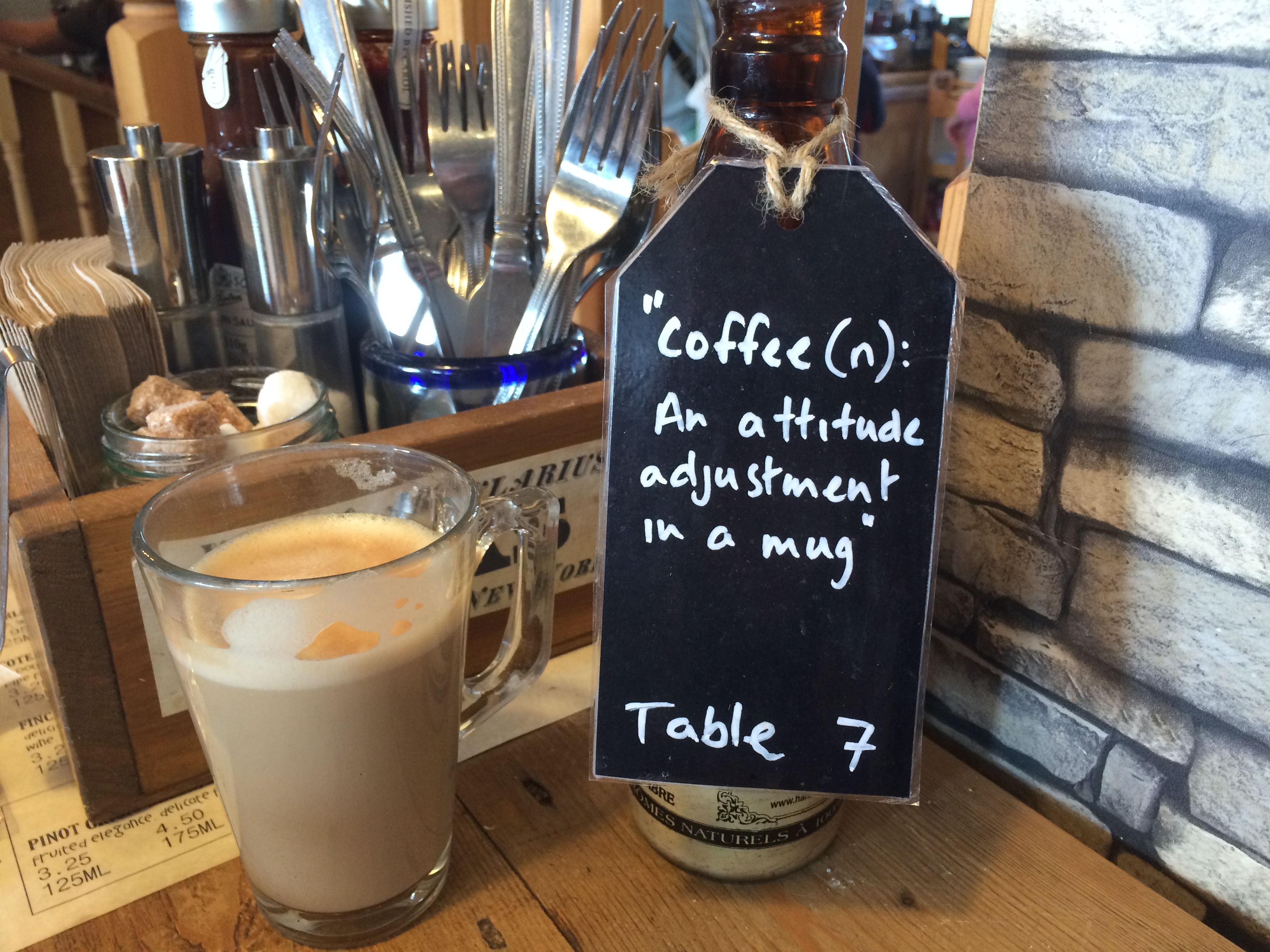
I like to start the day with the most important bits of being a writer: the writing. (Actually, I like to start the day with coffee, but maybe that is the most important bit of being a writer? Then once the coffee’s made and is slowly waking up my brain, I can move onto the actual writerly bits.)

I’m sure many of us have seen that inspirational message that does the rounds on social media from time to time, about how we should fill our time with the important things first and foremost, rather than cluttering it up with the little things that don’t matter. Just in case you haven’t, I’ll paraphrase:

If you take a glass jar and fill it with ping pong balls, the jar will appear full. But then if you take a handful of beads you’ll find that you can still fit them in the jar, because they’ll filter down the gaps. Once the beads are added, the jar will appear full again. But you can still add sand to the jar, as this will trickle between the beads and fill up all the really tiny gaps. But if you’d started with the sand, and then added the beads, you’d find that you wouldn’t have enough room for all the ping pong balls. The message is this: that we should make room for the big things first – in life as well as in jars.

Ok, so I admit it’s fairly corny, but it’s also true. Make room for the important things, and all the little bits and bobs will fill up around them. But if you fill up your time with all the little things, you’ll soon find you run out of time for the important stuff.

Which is why I reserve the mornings for reading, writing and editing. Sometimes I’ll do some of each ot these in a morning, and sometimes I’ll stick to just one. It depends where I am in a project.

What’s really important is that I leave all the admin bits to the…

Afternoon:

The afternoon is sort of a free-for-all. Sometimes I’ll carry on with whatever I’ve been doing in the morning. Sometimes I’ll switch to all the other stuff that makes the one-woman writing business tick (and if you’re doing it professionally, then it is a business).

What does this include? Everything from emails (don’t we all have to do these?) to submissions to competitions and magazines, to residency or funding applications. Sometimes, I try to get outside to go for a walk or something during the afternoons, to get some fresh air and get my sedentary self moving – but I’ll be honest, this happens far less than I’d like it to.

(Residencies are another matter – when I’m lucky enough to be on a residency, I can step away from all the admin bits, which means the freedom to spend some time thinking / walking / exploring my new surroundings.)

And in the evenings?

My evenings are technically non-work time, where I can read or watch Netflix or whatever, but this rarely actually happens. Often the emails and/or the admin bits drag over, and I find myself switching off my laptop much later than I’d like. This is less than ideal for a number of reasons, but especially because it means that, when I go to bed, my brain is still whirring with everything on my to-do list, and so I don’t sleep as well. So, when I have to get up and write the next day, it isn’t from quite as good a place as I would necessarily like it to be.

One of my new year’s resolutions for 2019 was to keep my evenings work-free. Like most resolutions, I did pretty well in January. But of course, it started to slip. I guess it’s one I need to reinstate.


Caveat: like most day-in-the-life pieces, this is an idealised version of my writing day, and is often discarded in favour of an all-day workshop and / or a frantic rush to meet deadlines. But this is the template I try to fit my other days around, and sometimes – just sometimes – I manage to make it happen.


Imagine. Your best friend has just published their eighth novel. It’s nominated for the Man Booker Prize, which they’ve won before. They’re also an award-winning poet with two Forward Prize-winning poems, and a T S Eliot Prize-winning collection. They get flown all over the world and put up in 5* hotels so they can speak their great wisdom at international literary festivals. Their events sell out within minutes, and their signing queue stretches for a mile and a half. Every time you walk past a bookshop, their covers wink at you from the windows. They’re also the nicest person in the world, and have just been nominated as most beautiful writer of all time. They’ve just been nominated for a Nobel Prize. The village book club thinks your books are kind of interesting, but nobody writes quite like your best friend.

Don’t worry, I’m not having an emotional crisis. This best friend is fictional.

But we all know what it’s like to see other people having more success than ourselves. Even the most famous writers know what this is like. It can just be a bit difficult to remember that when you’re wallowing in the depths of your own rejections.

So how do you keep your spirits up, when it feels like everyone around you is way more successful than you are?

the writing desk - February 2018

Redefine your idea of success.

We’re so used to talking about success as the opposite of rejection. Did your poem get rejected from that magazine, or was it successful? I know – I do this as well. In all honesty, I’m going to keep doing it here.

But let’s start reshaping our idea of what ‘rejection’ means. I’ve talked a bit about this before, but rejection doesn’t have to be a negative thing. After all, with every ‘thanks but no thanks’ that comes back, you free up your poem / story / whatever to send it out to a different journal or competition. In some ways, every rejection increases your chance of acceptance somewhere else.

But rejection can also help you grow as a writer. It can sometimes take months for that rejection to come through – months in which you’ve been reading, writing, honing your craft. So when the poem comes back with a ‘no thanks’ letter, it’s a chance to take another look at it, and see whether you could improve it. After all, your poetic eye could easily be sharper than it was a couple of months ago.

Even if you look at your original submission and decide it doesn’t need another edit, it can be useful to make some sort of ritual out of receiving a rejection. For instance, I have a spreadsheet where I document all my submissions. When I get a response, I get to colour in the corresponding box in the spreadsheet. It’s a small thing, but it carries the same sense of satisfaction as crossing something off a list.

writing prompt - Katie Hale

Watch what you submit to.

Quite often we talk about submissions in terms of numbers. I know; I’ve done this as well. Last year, I aimed to submit to 100 things over the course of the year. I didn’t quite make it, but that wasn’t really the point; the point was to force myself to put my work out there, and to submit to things I might not otherwise go for. And it worked – last year was hugely successful in terms of my writing career.

But as an approach, it doesn’t work for everyone. If you find you’re getting down about the number of rejections you’re receiving, or if you’re short on time to submit to things, then absolutely narrow your focus. Submit to fewer things, but make them the ones that really fit your work. Make each submission as good as it can possibly be. Submit to things where you have a higher chance of success (so if you’ve only been writing a couple of months, maybe go for the local poetry competition rather than the National Poetry Prize).

I’m not saying you won’t still get rejections if you do this, but it might decrease the ratio slightly. After all, we’re all human. We all need a confidence boost from time to time.

And speaking of confidence boosts…

Celebrate the little things.

This is particularly important for novelists, but it also applies to other kinds of writers as well.

As a novelist, you tend not to get to submit your novel to people till pretty late on in the game. As in, you’ll usually have written a full first draft, and then edited it as much as you can, maybe have workshopped bits of it with your writing group, and then edited it some more. All this before you start querying it with agents, or sending to presses that accept unsolicited submissions, or whatever route you decide to go down.

This can take years. That’s a long time without a confidence boost. Find smaller milestones.

I recently went to the Bronte Festival of Women’s Writing in Haworth, and the excellent Claire Malcolm from New Writing North was there, talking about identifying creative milestones.

I knew what mine was. ‘To finish my second novel,’ I thought smugly.

Reader, I haven’t even started writing my second novel yet. It took me a moment before I realised what a stupidly big milestone that is. It’s like learning to read, and your first milestone being to read Ulysses. It’s too big. There are way too many other steps to get through first.

So I’ve come up with new milestones. They may change along the way, but for now they’re:

  • Start drafting. (I spend a lot of time in the planning & note-making stages of writing, so the day I actually sit down to start drafting the book is an important milestone.)
  • 10,000 words of a rough draft.
  • 20,000 words of a rough draft.
  • 30,000 words of a rough draft.
  • 40,000 words of a rough draft.
  • 50,000 words of a rough draft.
  • Finishing a rough first draft, and writing ‘THE END’ in big smug letters on the last page.
  • Completing a workable second draft.
  • Sending off the manuscript to my agent.

Instead of one big goal, these are the smaller milestones I’m going to celebrate along the way.

Writing poetry in a cafe in Grasmere

No really. Actually celebrate.

It’s all very well knowing what your personal goals are, and feeling that small sense of satisfaction when you achieve them, but why not actively celebrate them?

One technique I’ve seen a few writers sharing on twitter is the gift-to-self technique. This involves buying yourself a bunch of treats before you start writing, and wrapping them up with labels on the front, telling you when you get to open them.

For example: at 10k words you get a bar of chocolate. At 40k you might get a new pen. When you finish the first draft it could be a bottle of bubbly.

It’s up to you what these gifts are – whatever you think is going to motivate you. It doesn’t even have to be a physical gift. Maybe you’re going to go for a walk somewhere you love after you’ve reached 30k. Or you’ll booked a spa day for the day after you submit to your agent. (Or send it off for querying – whatever stage you’re at.)

I’m planning to be away for most of my milestones, at writing residencies, so I’m going to have to be a bit creative with my rewards. I might not even plan them in advance – just promise myself that I’ll physically celebrate each milestone when it comes around, in whatever way feels right for wherever I am at the time.

Share your successes.

When you celebrate, you don’t have to celebrate alone. I live on my own. I don’t have someone to announce my news to when they get home from work, and to share a glass of bubbly with. If I want to tell people, sometimes it has to be on social media. Sometimes telling someone else about something is the only way to make it feel real. Being proud of your achievements is not the same as boasting.

I repeat: being proud of your achievements is not the same as boasting.

One of my constant sayings, that sums up a lot of my creative ethos, is that as writers, we’re colleagues, not competitors. We should be proud of one another’s achievements. Congratulate other writers on their successes. Give them the opportunity to congratulate you on yours.

If you want to tweet about it, tweet about it. If you want to share it on facebook, or instagram, or snapchat, do. If you want to put it in big fancy letters on your website, go for it. By all means include it in your bio.

Even aside from wanting to celebrate (which is enough of a reason for sharing on its own), sharing your good news gets you onto the radar of other people in the writing community / book industry / arts world etc. And who knows? It may even lead to future opportunities.

writing prompt - Katie Hale

Celebrate the down times too.

For a long time, I didn’t like talking about success on social media. I thought it made me sound big-headed. ‘Oh, look at me, I’ve had a poem accepted into a magazine, aren’t I clever?’ And sure, there’s definitely a way that constantly talking about your own successes can get on people’s nerves. If all anyone ever hears from you is how well you’ve done, then soon you’re going to feel like that fictional best friend at the start of this post.

But social media (and life in general) is multi-faceted and complex. If we only talk about one thing, it gets boring. So we also use it to share opportunities for other writers, to talk about books we like, to engage with politics.

And we can use it to be honest about our rejections.

(Side note: there are ways of talking about rejection without tweeting ‘X magazine rejected my poem and now I feel bitter about it’, and essentially encouraging all your friends in a pile-on against said magazine. A good start is not to name the publication / organisation / whatever that rejected to. After all, they’ll have their reasons, and naming in this context can often sound a bit like shaming, even if that isn’t the way it’s intended.)

Talking publicly about rejection might feel counter-intuitive. After all, isn’t this just another way of announcing to the world that someone somewhere thought your work wasn’t good enough? But honestly, everyone gets rejections. The most famous writers in the world get rejections. Talking about it is just a way to share the truth about what it’s like to be a writer.

If I see a writer I admire talking about their experiences of being rejected, or struggling to meet a deadline, or finding a scene particularly difficult to write, I actually find it heartening. Not in some cruel schadenfreude way, but in the sense of solidarity. Writing can be incredibly solitary, and it can be good to be reminded that I’m not the only one finding it hard.

This beautiful tricksy obsessive mess called creativity? We’re in it together. Let’s celebrate that.

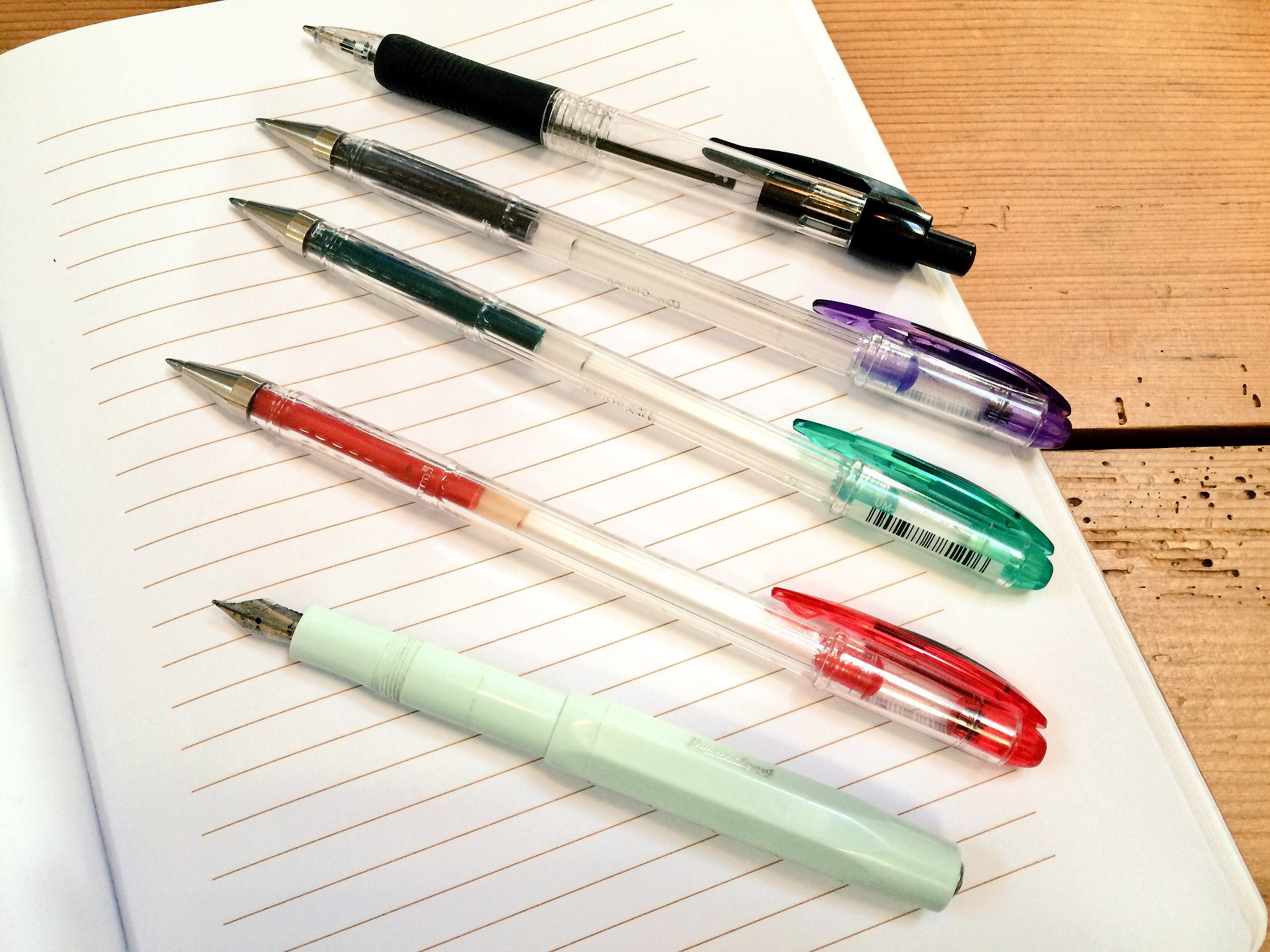
Eleven years since I left school, and September still feels like back-to-school month. I feel as though I should be out buying new pens and novelty rubbers and things. I guess I did start a new notebook this month, so maybe that counts?

After festival-season in August, September has been a month of quiet work. I quite like months like this from time to time: a chance to get back on top of the admin, and quietly work away at the writing. Not too many events. The odd workshop. A chance to think.

That said, this month hasn’t been entirely without festivals. Last week I went to the Bronte Festival of Women’s Writing in Haworth, with three other Cumbrian writers. It was a lovely festival: big enough that there was a really interesting range of speakers, but small enough that it was possible to go to everything. It also felt incredibly honest, with writers, editors, agents and booksellers sharing their experiences in a way that felt generous and encouraging.

One thing I took away from the weekend (other than a horrid cold – I guess that’s what happens when you visit the 19th century?) was to remember all the things I used to know. When you’re starting out as a writer, people will often tell you that you need to practise self-care, that you need to spend time focusing on craft and not to rush, that you need to celebrate smaller milestones along the way. But I’d forgotten a lot of that. My next milestone was ‘finish writing the second novel’. (Side-note: I haven’t even started writing the second novel yet.) That’s too much. A novel’s big; if I don’t get to celebrate success until I’ve finished the thing, then that’s a long time to wait. A person can get pretty down in that time. My decision? To set myself some markers in the interim. When I get to 10k words, for example, I’ll take a moment to be proud of that achievement. It’s about motivation. I may write a blog post about this in the future.

And speaking of successes, I haven’t been taking enough time to celebrate them lately, so here are a few that have happened over the past couple of months:

KSP residency: The Katharine Susannah Prichard Writers’ Centre is in Perth. Perth Australia, that is. And I’ve been invited to be their Emerging Writer in Residency in April 2020. Going to pack my strappy tops and flip flops! (Sorry, singlets & thongs.)

Gladstone’s Library Writer in Residence: Next May, I’m heading over the border into Wales, to spend a month writing at Gladstone’s Library. This is something I’m particularly excited about – partly because I’ve looked at pictures of the library, and it looks like the dream place to sit and draft a novel. But also because I’ve heard glowing recommendations, both for the library itself, and for their scones! Expect me to be significantly larger by next summer…

University of Canberra Poetry Prize longlisting: Another one with an Australian theme – I recently learned that I’ve been longlisted for the University of Canberra Vice Chancellor’s Poetry Prize, which is announced at the end of October. Last year I managed to make the shortlist, so keeping my fingers crossed for this year. Either way, though, it’s a huge prize, so just to make the longlist is a fantastic affirmation.

Mslexia: And finally, this month I achieved a decade-long ambition, and got a poem into the most recent issue of Mslexia. It’s always lovely when a publication likes your work enough to print it, but there’s something particularly special about it when it’s a publication you’ve been aiming towards ever since you start to write poetry.

In the interest of balance, I should also say that I’ve received 17 rejections so far this year, out of 22 things I’ve heard back from. It isn’t all cause for celebration – which of course makes it doubly important to celebrate the good news when it does come along.

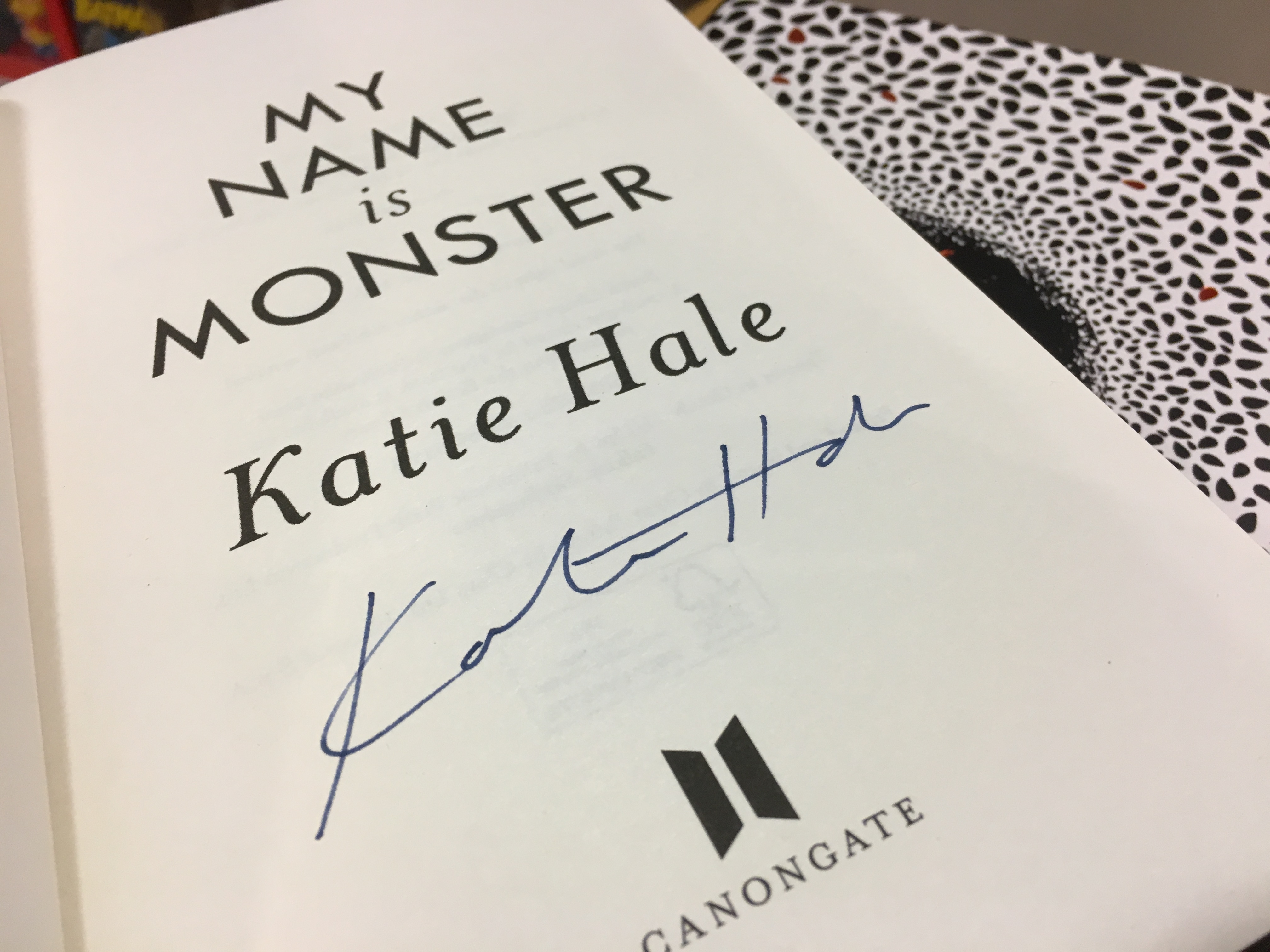
And, last but not least, the next couple of weeks are your last chance to vote for My Name is Monster in the Edinburgh First Book Award. It’s run on public vote, and voting only takes a moment, so please do click through and support!

The Month in Books:

It’s been a slightly slower reading month than last month. I sometimes find it works like that, at least for me: that reading, like writing, comes in waves. Perhaps that means that next month I’ll read absolutely loads? Still, if you’re only going to read four books in a month, these are a pretty good four to choose:

  • Walt Whitman Poems (Everyman’s Library Pocket Poets)
  • The Amber Spyglass, by Philip Pullman
  • The Island Child, by Molly Aitken
  • Black Car Burning, by Helen Mort

The Month in Pictures:

Summer’s pretty much over, and the nights are drawing in.

I always find this time of year vaguely comforting. Maybe it’s something to do with getting to light the fire now and again in the evenings, or digging the warm jumpers out of the bottom of the drawer, but I often feel very content on the cusp of autumn. And often very productive, too – possibly because I still associate it with beginnings and the start of a new school year, or because it’s a time when I end up harvesting a lot of vegetables from the garden. Or maybe just because the hectic summer is over and September tends to be a slightly quieter month: one for getting back into a routine before the year rushes too quickly towards its end.

Whatever the reason, I love it.

A Few Good Things:

Edinburgh Book Festival:

Following on from the epic library / bookshop tour of My Name is Monster straight after it came out, I’m now into a more leisurely spattering of book festivals, averaging at around one a month for the rest of the year. I said ‘average’, because this month there were two.

The first was Edinburgh Book Festival: a wonderful festival, which, in its own words, ‘welcomes around 900 authors from over 60 countries in more than 800 events for adults and children each year’. This year, two of those events were mine – or at least, partially mine.

The first was a discussion of My Name is Monster, chaired by novelist Angela Meyer, and followed by a book signing. The second was a special recording of Open Book with Mariella Frostrup, which aired on Radio 4 the following Sunday, and which you can listen to here. The programme was a discussion of what young people are reading and writing – and covered both YA fiction and millennial writers & readers. With such a broad topic, I felt like we barely even scratched the surface – and I don’t think I was the only one on the panel who felt we could have gone on discussing it for hours! (And a couple of us did just that afterwards on the benches in the authors’ area. So you know, if anyone fancies commissioning me to write an opinion piece on it…)

As well as the events, the festival also runs the First Book Award, which is awarded to a debut novel whose author appears at that year’s festival, and which is decided by public vote.

Vote for My Name is Monster here!

Tidelines

August’s other festival was a much smaller affair: Tidelines Festival, in Grange-over-Sands.

A new festival this year, Tidelines is a two-day festival run by Thornleigh Hotel in Grange. I was invited to give a talk about My Name is Monster in the evening, followed by a signing. But I also spent a good chunk of the day there, listening to the other talks and soaking up the atmosphere.

Also at the festival were some of the Dove Cottage Young Poets, running an open mic and busking with typewriter poetry: poetry written quickly on request to anyone willing to make a donation. Matt Sowerby also debuted his incredible one-man poetry show, about young people in politics, climate change, and mental health, which had the entire audience utterly rapt. If you see him performing anywhere near you, go and see it!

Writing

I’ve actually got back to writing this month. After a much-needed post-book tour break, I’ve started writing poetry again. Honestly, I couldn’t not. I know it’s a cliche, but it’s true: I felt that itch to write, and I couldn’t ignore it.

Occasionally, I go through phases where I wonder what my life would be like if I weren’t writing – if I just chanelled those energies into something else instead. Blogging, for example, or travelling, or orchestrating arts projects to facilitate other people’s creativity. These are all things I do anyway, but things that I try and force to take second place in my life to writing. For a while, though, I let them come out on top. After all, you can’t write all the time.

A Few Thoughts On: The Writers’ Productivity

In doing this, I got my answer: if I stopped writing altogether, I’d only start again. Either that or be totally unsatisfied all of the time.

What is it that makes me constantly yearn to record things, to interpret them, to think my way through the world by putting pen to paper? I don’t really know – but whatever it is, it’s definitely there. And finally, this month, I gave in to it. And I wrote.

The Month in Books:

I’ve read a lot more this month than I did in July. Partly because I’ve had a lot of free evenings, which I’ve been using to curl up on the sofa and read. I’ve also been snatching those rare sunny moments to sit with a book in the garden – not to mention the train journey up to Edinburgh and back (including a packed out train where the only available seat was on the floor, but never mind).

Surprisingly (at least, to me), I’ve been reading a lot of Young Adult fiction this month. I wanted to read books by Patrice Lawrence & William Sutcliffe before appearing on Open Book with them, so that explains three of the YA novels, but I’ve also been rereading Anthony Horowitz (for pure escapism that doesn’t involve a screen) and Philip Pullman (in advance of The Secret Commonwealth coming out soon, not to mention the BBC adaptation of His Dark Materials). I love reading YA, because I love the way it can be well written and ‘literary’ without sacrificing story or character, and because of the way it doesn’t pull its punches where you might expect it to. Honestly, it isn’t something I read often enough.

  • Skeleton Key, by Anthony Horowitz
  • Never Say Die, by Anthony Horowitz
  • The Testament of Mary, by Colm Toibin
  • Primers: Volume 4, by Lewis Buxton, Amelia Loulli & Victoria Richards
  • The Gifted, the Talented and Me, by William Sutcliffe
  • Rose, Interrupted, by Patrice Lawrence
  • Dark Matter, by Michelle Paver
  • Until the Flood, by Dael Orlandersmith
  • Orangeboy, by Patrice Lawrence
  • Northern Lights, by Philip Pullman
  • The Subtle Knife, by Philip Pullman
  • Don’t Call Us Dead, by Danez Smith

The Month in Pictures:

Quite often when I go into schools to run writing workshops, I get the children writing about objects. This is useful because it’s something that can be done at any level of confidence or ability in writing, but also because there’s something about having the subject of your poem physically in front of you that makes matters easier; if you get stuck, you can just look a bit more closely at your object.

Of course, I don’t just give the children an object and then let them get on with it. That would be incredibly uninspiring. Instead, I give them prompts – ways of examining their object that they might not have thought of before. Usually, we spend quite a while just getting ideas down on paper before we actually think about the ‘poemness’ of our writing.

NB: While I usually do this as a poetry exercise in schools, it can just as easily be a prose exercise, helping you to practise your description, or to give particular weight to an object within a story.

Choosing an object:

Ok, so what sort of object can you write about?

The simple answer is, of course: anything. When I go into schools, I have a bag of objects that I take in with me, most of which are mundane artefacts you’d find in pretty much any household. These include:

  • a candle
  • a fork
  • a ladle
  • a glove
  • a scarf
  • a top hat
  • a claw hair clip
  • a clothes peg
  • a shell

There’s nothing dramatic or special about any of these objects. The only meaning they have is the meaning that the poet chooses to give them. In many ways, this makes them the perfect subjects for poetry, as they’re essentially blank canvases.

Then again, you could choose something that isn’t a blank canvas at all: an object that has particular emotional or historic significance for you. A wedding ring. Your grandmother’s spoons. A ticket stub from the concert where you had your first kiss. Choosing an object like this, that already has its own story lurking inside it, could also really work, giving the writing added depth, and a sense of an entier life behind it.

Why not try the exercise twice, once with a significant object, and once with something random you’ve picked up from around the house.

5 ways to write about your object:

*

1 – Physicality

This is perhaps the most obvious way of looking at your object, but this means it’s a good palce to start. Begin by putting your object on the table in front of you, and looking at it. Set a timer, and look at it for a whole minute. Try to notice every detail, as though at the end of the minute, someone is going to take the object away and you’re going to have to conjur it entirely from memory. Think about what colour(s) it is. Does it look hard or soft? Big or small? Comfortable to hold or not? Heavy or light? Think about what shapes make it up. What is it made of? Something natural or man-made, delicate or industrial-looking? Does it look shiny or dull?

Once you’ve looked at it for a good long while, pick it up.

Think about what it feels like, how it sits in your hand. Does it make a sound of its own accord? What about when you tap it against a surface? If it’s safe to do so, see how it smells & even tastes. I’m forever telling children to use all of their senses, but it’s worth remembering that as an adult as well.

This is how your object physically occupies space within the world.

*

2 – Uses & Changes

Once you’ve examined its physical properties, exploring it as an artefact in its own right, you can start to think about it in a social context, and within the context of time.

Think about what the object is used for. Does it have a purpose, or is it merely decorative? If it does have a purpose, does it have just one? Maybe it has a primary and secondary use. Maybe it’s an all-purpose gadget. If it’s an ornament with no particular use, then how does it work decoratively? What makes it a piece of decoration?

Then think about how the object might change. For example, a candle can burn, and it can melt (either from being burned, or from being left in the sun). What causes it to change? How does it look / feel / sound / smell / taste in its new form? Is the change reversible? Is it a desired end (such as with the candle), or a problem (such as a fork that might tarnish / bend out of shape, for instance).

From merely being a physical object existing in the world, the object now has context.

*

3 – What is it?

This is a great poetry game (nicked from Liz Berry) to get children thinking metaphorically, without using offputting grammar words, like ‘simile’ or ‘metaphor’. It’s called: it’s not this, it’s that.

Essentially, you’re trying to get back to your inner child, and to use your imagination. We’re not interested in what the object actually is – we’re interested in what it could be.

So, a candle might be a rocket, or a unicorn’s horn, or a wax crayon, or a skyscraper, or a rolling pin. A top hat might be a steering wheel, or a boat, or a drum.

Don’t be afraid to play with the object. Turn it upside down, or back-to-front. Put it on your head. Look through it. Make it move in some way.

It’s not a scarf, it’s a road leading over the horizon.

It’s not a glove, it’s a spider scuttling across a bedroom floor.

And of course, the richer you can make these metaphors, the better.

*

4 – History

From thinking about the object as a general version of its kind (for instance, a fork like any other fork, or a candle like any other candle), now you’re going to think of it as specific.

Every object has a history. Even a brand new one has been bought from somewhere, or given to you as a gift. It has a life before the present moment. Whether it was on the shelf in a supermarket two days ago, or it’s been passed down through the family for generations, think about where this object has been. What journey has it been on? Whose hands has it passed through? Has it changed at all in that process?

Depending on the object, this could be something deeply personal. If you’re writing about your great grandmother’s wedding ring, for instance, then there’s going to be a lot of family stuff going on there. If you’re writing about that friendship necklace you traded with someone when you were seven, who you haven’t seen since you were twelve, then maybe you’ll end up exploring your childhood through the object.

This is the point where your poem opens out, from thinking about the object itself, to thinking about the world beyond – whether through the lens of your own life or otherwise. It’s often (but not necessarily) the point where the poem gains meaning.

And if you’re struggling to think of a historical journey for your object, think about what it’s made from. What’s the history of those materials? Where did they come from? Are they natural or man-made? What was their existence like before they were turned into this object here in front of you? Go as far back as you want. After all, every wooden spoon started out as a seed.

*

5 – Who Am I?

One last little prompt, to take you in a slightly different direction: give your object consciousness.

You don’t have to give it agency, like the toys in Toy Story – but imagine it’s aware of the world around it. What does it see? What does it remember? (This is another way to approach the ‘history’ prompt.) Specifically as this object, does it feel to be held? To be used for whatever purpose it’s used for? What does your object want?

Try writing about the object in first person. What you may find, is that the poem becomes a kind of self-portrait, from the perspective of an everyday household object. If that’s the case, roll with it. If not, treat it as a useful exercise in exploring perspective within a poem.

And good luck!

*

If you’re looking some ways to expand on these prompts, using the language generated here to create something more, with a rich sound-world, check out Five Poetry Prompts: Generating Material for a Poem.

I have some exciting news! And also a (very small, very simple) request.

Next Sunday, I’ll be in Edinburgh, reading from and talking about My Name is Monster at Edinburgh International Book Festival. And, as if this weren’t exciting enough, I’m also up for the festival’s First Book Award!

The Award is decided based on a popular vote, so what I’m asking is very simple: please vote for My Name is Monster to win the award!

It’s really straightforward – there’s an option to leave a short review, but you don’t have to. You just have to register your name & email address, and then click the big button marked ‘VOTE’. What could be simpler?

VOTE HERE

And if you’re still undecided, why not read the first page of My Name is Monster, to help you make up your mind:

*

Extract from My Name is Monster:

When the world is burning, it’s easy to forget about ice.

Easy for most people, that is. I knew nothing but freeze for over a year. I lived with the ice, on the ice, inside it – locked on the island as the rest of the world grew desperate with rage and disease. As the missiles fell and cities were blasted by a thousand-degree heat, I struggled to keep warm.

Frostbite and a chill so keen it cuts right through the heart: that’s the price of survival.

Then what?

After everyone else was dead, I sat by a window for three days watching the glacier creak and break. When I took off my trousers, my skin flaked away and my legs itched. I scratched at the dead skin until I was pink and sore, then I got dressed again.

I thought about the scientists who had vanished into a crevasse twenty years earlier and were never found, how their little bodies would one day tumble out of the glacier’s mouth like babies being born, frozen solid and perfectly preserved in their brightly coloured thermals.

People used to think that ice is white, but it isn’t. There is all kinds of history inside it, waiting to be brought out.

… want to carry on reading? Click here to buy the book.

After the post-publication whirlwind of June, July has slowed down a pace – which I’m hugely grateful for. It’s quite fitting that my only blog post July blog post was about writers’ productivity, and the need to take a break. True, I have been doing the odd bit of writing, but most of that has been in-situ descriptions of Cornish beaches, or jotting down thoughts, or just playing around with forms and ideas. The sort of stuff that will probably never be anything finished, but is just a sort of practice. I think of it like practising scales for a musical instrument: not a finished piece, but necessary for honing skill.

So if I haven’t been writing anything fixed, what have I been doing? What does the writing life involve when there’s no fixed writing project?

Port Eliot Festival

Although my crazy 3 weeks of post-publication book events finished at the end of June, I’m still promoting My Name is Monster, at an average of roughly one festival a month. July’s festival was the wonderful Port Eliot, in Cornwall.

As well as my own event (talking alongside Yara Rodrigues Fowler, author of Stubborn Archivist), I got to enjoy the whole weekend of fantastic literary, music & comedy events. Not to mention the most amazing mussels & chips from a stall by the river. Highlights included: Robin Ince’s impression of Brian Cox as Alan Bennett; Antosh Wojcik’s incredibly moving poetry/drum show, How To Keep Time; fellow WriteNow mentee Elizabeth Jane-Burnett talking about The Grassling; Charlotte Church’s Late Night Pop Dungeon; and hearing Patrick Gale talk about his writing process.

And then, as if that weren’t enough, I decided to stay in Cornwall for a few extra days. The idea was to soak up the sunshine and spend some time sitting on the beach reading books. In reality, there was a violent storm the first night and it poured it down the entire next day – which meant I got soaked on my walk into town, and spent most of the day eating Cornish pasties & looking round the shops & museum instead. Neither of which were bad ways to spend the day, obviously.

The second day was a bit more what I’d had in mind: a 5-mile walk along the coast, past Polridmouth Beach (the inspiration for the beach in Daphne du Maurier’s Rebecca) and along the cliff-tops; followed by an afternoon on Polkerris Beach (snoozing and people-watching as much as reading, really); and a bracing dip in the sea.

Tidelines workshops: ‘the moon’

Speaking of festivals – I’m appearing at Tidelines festival in Grange-over-Sands on 17th August, and in the run-up to this, I ran poetry workshops in two local primary schools: Grange and Cartmel. Tying in the Usborne poetry competition about the moon, and with the 50th anniversary of Apollo 11, these workshops were moon-themed. As always when I run workshops, I was bowled over by some of the things that the children came up with.

One of the exercises I gave them was to create similes & metaphors for their poems (we did this through games, and through imaginative play). Some of my stand-out favourites were:

  • ‘the moon cold as a frog’s skin’
  • ‘earth spinning like a lazy Susan’
  • Neil Armstrong’s footprint as ‘a maths lesson of parallel lines’

Some of the children will be reading their poems at Tidelines on the morning of the 17th – and I can’t wait to hear them again.

Actively not working

Last but not least, I’ve been actively not working. This goes back to what I was talking about in my previous post, about the need to take a break. Sometimes, the brain just needs a rest. The body, too – particularly after a period of non-stop busy-ness. And let’s be honest, the last time I actually stopped and spent long periods just sitting, and being, and doing very little, was probably sometime before Christmas.

And now?

August is still less hectic than previous months have been, but I’m shifting firmly back into productivity mode. For a start, I’ve got a whole heap of admin to get on top of. Not to mention a dangerously tall pile of books on my bedside table, waiting to be read. Then, of course, I could do with getting back into writing mode – even if it is just doing fragments / little bits of observation that never go anywhere.

And I’m appearing at two festivals in August.

The first I’ve already mentioned, which is Tidelines at Grange-over-Sands on 17th August, where I’ll be talking about My Name is Monster and doing a Q&A.

The second is Edinburgh Book Festival, where I’m doing two events:

AFTER THE APOCALYPSE: an author event, talking about My Name is Monster, on Sunday 18th August, and

OPEN BOOK WITH MARIELLA FROSTRUP: a special edition of BBC Radio 4’s Open Book, alongside Michelle Paver, William Sutcliffe & Patrice Lawrence.

You can also VOTE FOR ME for the Book Festival First Book Award!

The month in books:

As I’ve already mentioned, July has been a slow month in a number of ways – and this has included in terms of books. Only 5 of them this month: four (very) contemporary novels, alongside more of a classic from the 60s – Mary McCarthy’s The Group, which was recommended to me by Julia Armfield and which I thoroughly recommened in turn!

  • Remembered, by Yvonne Battle-Felton
  • Starve Acre, by Andrew Michael Hurley
  • Tentacle, by Rita Indiana
  • Stubborn Archivist, by Yara Rodrigues Fowler
  • The Group, by Mary McCarthy

Here’s to a more productive reading month in August.

The month in pictures:

If May felt like the eye of the storm, then June has been full-on hurricane. But, unlike most busy months, it’s mostly been busy with just one thing: the novel.

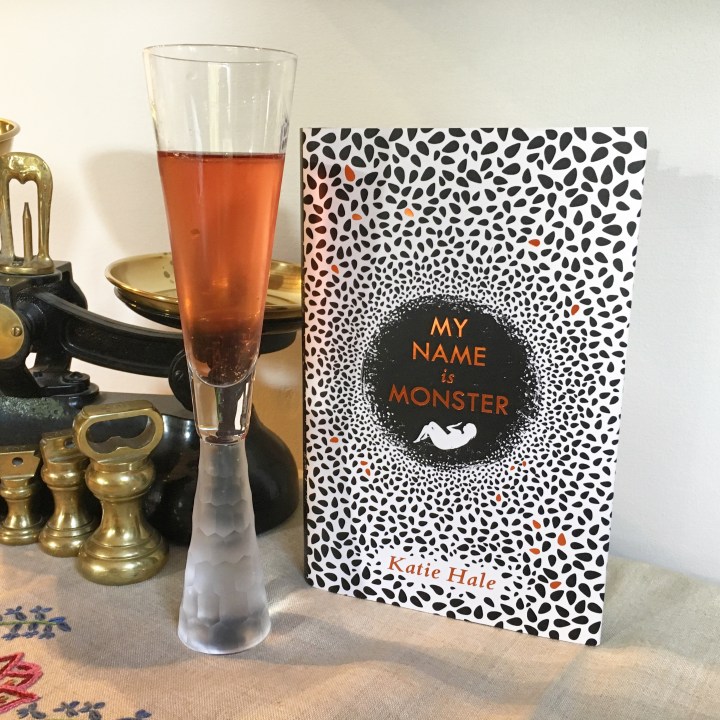
On Thursday 6th June, my debut novel, My Name is Monster, was officially released. If you weren’t aware of that, then either you’re new to this blog (in which case: welcome!) or you simply haven’t been paying attention. I’ve been talking about it a lot.

Understandably, the rest of the month has been pretty solidly dominated by that. I’ve just finished a run of talks and readings in libraries and bookshops – mostly around Cumbria, but also straying as far as Lancaster, and even to ‘that London’.

(Side note: when publishers put you up in a hotel that’s right next to a heap of excellent independent bookshops, it can be a dangerous thing…)

But the month hasn’t all been novel-related.

Tongue & Talk: The Dialect Poets

This month I also made my Radio 4 debut, with an episode of Tongue & Talk: The Dialect Poets. The programme aired on 2nd June, during the Sunday afternoon poetry slot. And, for some reason I’m still not entirely sure about – maybe becaue my parents couldn’t get the house radio working properly? – we ended up parked in my driveway and listening to it in the car.

Poet and novelist Katie Hale explores the legacy of early dialect poets in her native county of Cumbria, to discover if dialect poetry is a way of expressing local identity.

Cumbria has a long history of dialect poetry, beginning with poets like Josiah Relph, Susanna Blamire and Robert Anderson, and continuing right up to the present day. Katie finds out more about some of these historic poets and their contemporary counterparts. She also speaks to Cedric Robinson – the Queen’s Guide to the Sands of Morecambe Bay – and to farmer and writer James Rebanks, trying to understand the connection between dialect, identity and the land itself. How does the place we live in shape who we are and how we choose to express ourselves?

From a ‘writing life’ point of view, this programme is a perfect example of how one project can lead to another. In 2017, I was commissioned to write a poem for National Poetry Day, in conjunction with BBC local radio. The poem had to be about a Cumbrian dialect word: ‘twining’ (moaning / complaining). As a result, the word ‘twining’ then made it into the Oxford English Dictionary, and BBC Radio Cumbria made a video of the poem.

Because the poem was part of a national project (with 12 poets around the country writing dialect-inspired poems), it was well shared and had pretty good SEO. Which meant that when the production company, Made in Manchester, were googling ‘Cumbria dialect poetry’, my name came up.

At the other end, following the programme’s broadcast on Radio 4, the Lakeleand Dialect Society (who I interviewed as part of the programme) was celebrating its 80th birthday. And so, Radio Cumbria had a few of us on to talk about the importance of dialect – and to give the Radio 4 programme a bit of an extra push. One thing leading to another, leading to another. It often surprises me how much of my career ends up working like that. (Maybe I’ll dedicate a full post to it at some point in the future.)

You can listen to the Cumbria episode of Tongue & Talk: The Dialect Poets here, till Monday 8th July.

*

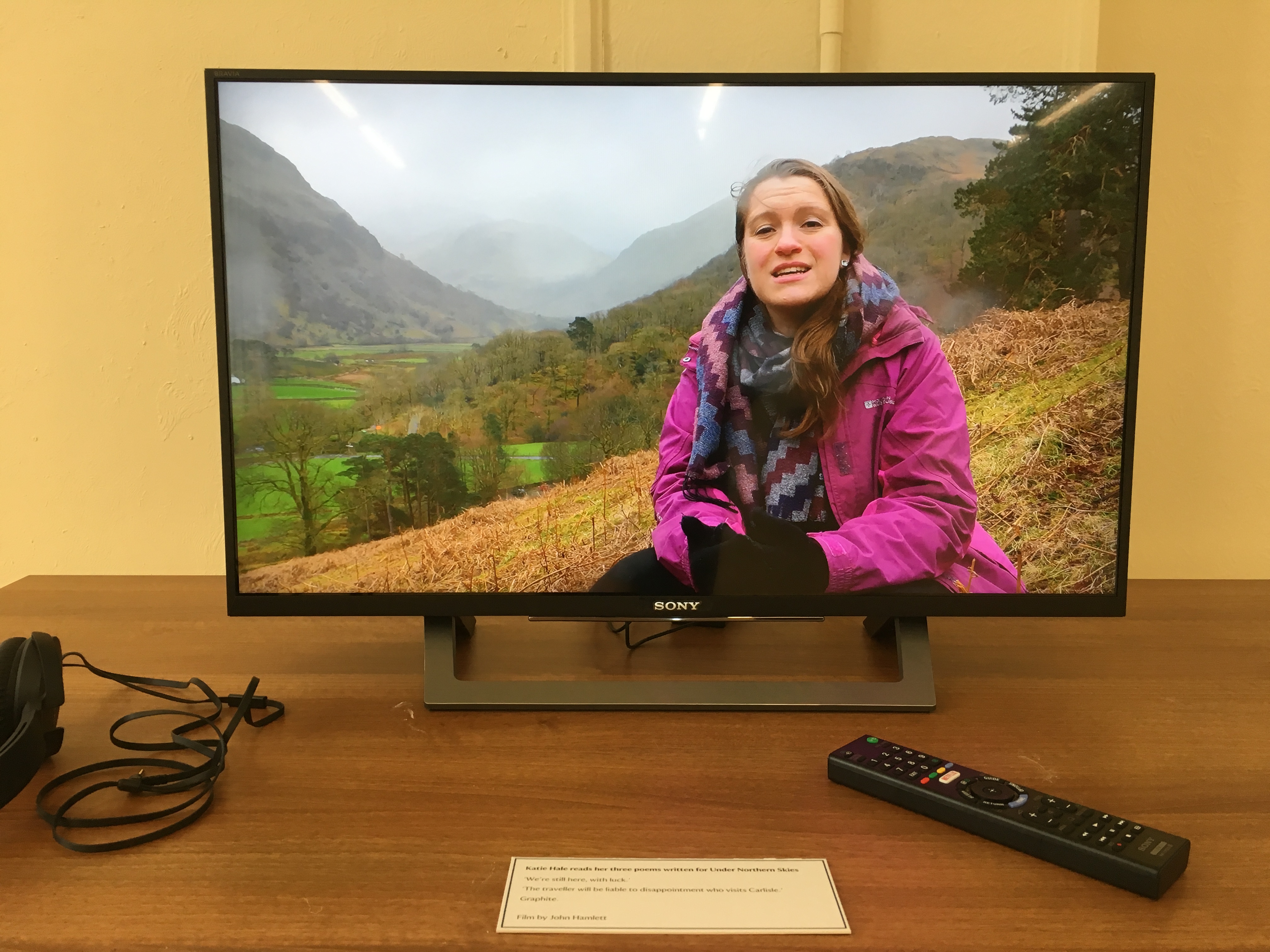
Under Northern Skies

Back in summer 2018, I worked with a group of former miners from Whitehaven on an oral history project, as part of Tables Turned, a three year participation project run by the National Trust and partners, which is all about bringing together community groups, young people, historians, curators and artists in projects that deepen understanding, build new partnerships and inspire creativity.

After meeting the miners and listening to them recount their experiences of working in the mines on Cumbria’s West Coast, I was commissioned by the National Trust to write a poem in response.

Earlier this year, I was commissioned to write two more poems, inspired by the work the National Trust had done with other groups: pupils from Keswick School, and members of Glenmore art group and Glenmore creative writing group. These poems were a mix of original work, and words collaged from the work and conversation of participants.

The result: three poems, each then filmed by John Hamlett, which were played as part of an exhibition alongside artwork from the groups, at Carlisle Old Fire Station.

The month in books:

This month has been a bit slower than last month in the reading department. Blame it on all that dashing about between book events! It’s also been largely fiction-based, rather than my usual attempt at balancing fiction with poetry (and a smattering of non-fiction thrown in). Still, that’s ok. I’m on a bit of a fiction bender at the moment, and I’m sure in a month or so that will flip and I’ll be devouring nothing but poetry.

  • The Last, by Hanna Jameson
  • A Roll of the Dice, by Mona Dash
  • Crudo, by Olivia Laing
  • Ghost Wall, by Sarah Moss
  • Being Haunted, by Jennifer Copley
  • Fen, by Daisy Johnson

The month in pictures:

With all the novel-related talk, it’s been a while since I shared a poem. Not since Easter, in fact. So, with summer (finally) here, I thought I’d share a swimming poem.

Over the past few years, I’ve spent quite a bit of time revisiting places I used to go as a child – including several local swimming pools. On this occasion, I decided to spend about an hour swimming, determined to take a break from the desk life and get some exercise. Instead, I got the idea for the poem about fifteen minutes in, then spent the rest of the time holed up in a changing room cubicle, scribbling away. Oh well. I tried.

The poem is from Assembly Instructions (Southword, 2019).

1999

In the communal changing rooms where old women’s bodies
flapped and scattered droplets like pieces of crystal,
we contorted ourselves behind the bright flags of towels, wished
together for the other pool – the one with lockers and locked doors,

where the air was jungle-thick and cubicles close with damp –
where once I saw your chest raised like a ripple of water.
You whispered look, showed me the first kindling of hair,
and I had to ask does it hurt? so you said feel it – see? soft – like a bird – 

Though you meant only one bird, the sparrow in the old byre,
battering itself bloody against the glass, till your dad
caught it, said girls, said don’t be afraid, and kept it
quaking between his hands for us to stroke.

In the pool, my stomach is too bare, and a man
with ribs like a shelf of dusty Reader’s Digests watches me swim.


If you’ve glanced at this blog any time over the past few months, or if you follow me even vaguely on any social media platform, you’ll likely have noticed that my debut novel came out just over a week ago. ‘What’s that?’ you yell in mock surprise, a sarcastic hand flying to your cheek, ‘A novel? Well why didn’t you say something?’

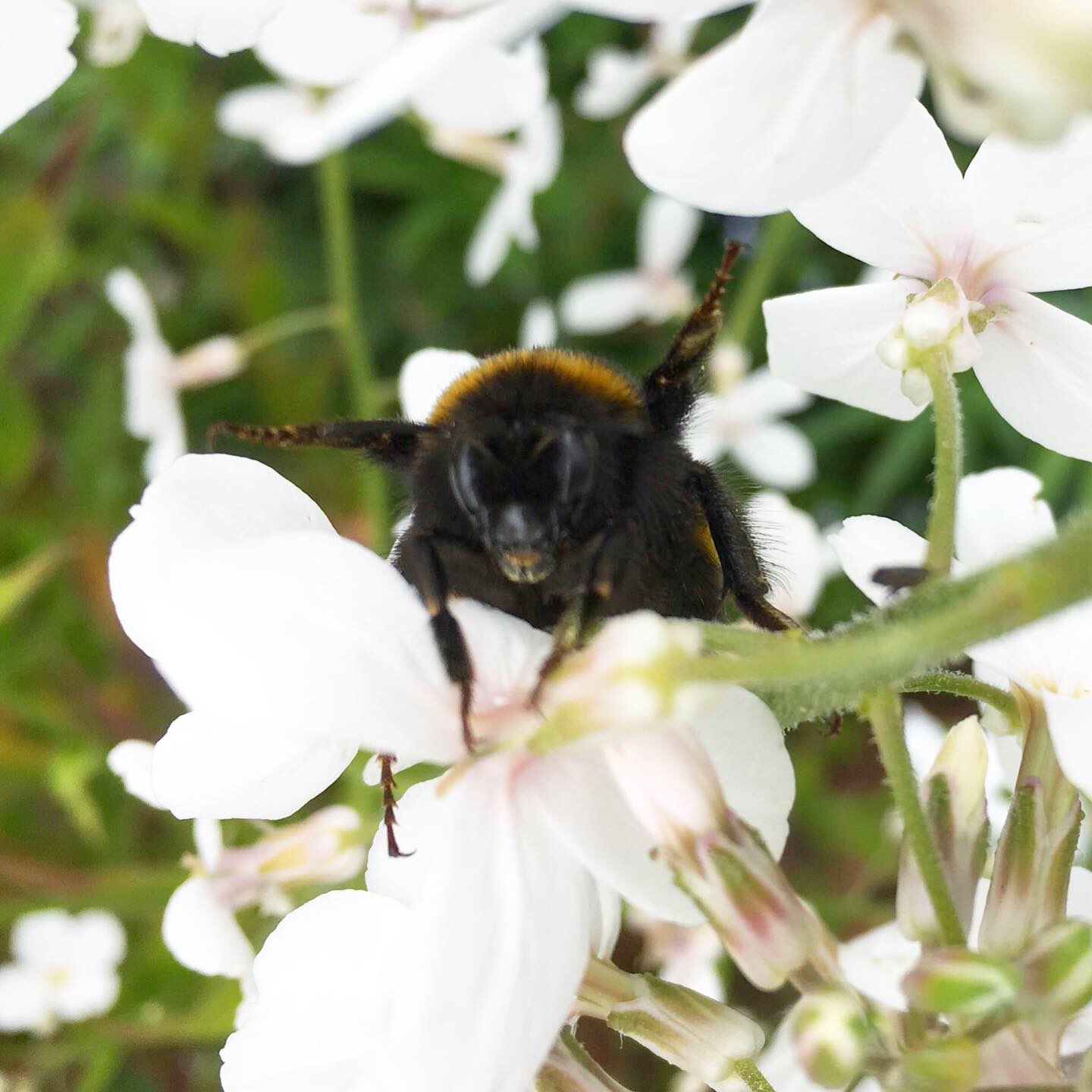
Alright, I get the point. My Name is Monster came out ten days ago, and (with the exception of a photo of a giant bee) I haven’t really talked about much else since.

(Not really relevant to the post, but it was enormous!)

What actually happens when you launch a book?

In some ways, not a lot. One day your book isn’t available to buy in shops; the next day it is. This doesn’t always happen on the day you expect it to, either. Unless your book is embargoed till a specific date (think: queuing up at midnight for Harry Potter and the Deathly Hallows), bookshops tend to just put the copies on the shelves the moment they arrive in stock. This could be a few days before the book’s official release date, so that rather than some momentous arrival, they sort of trickle into the public. I didn’t realise this until it was actually happening, so it was a bit of a surprise when people started sending me pictures of the book out and about in the wild, before its official release date.

Books are a bit like elections, in that they almost always come out on a Thursday. Presumably this is due to some social study about us being more receptive to culture, or more likely to spend money, or just in a better mood in general, towards the end of the week. Who knows? My secondary school concerts were always on a Thursday too.

This means that some writers will wait to have their official launch celebration till the Friday, or the Saturday. Some will have it on the launch day itself. I’m not sure it matters really – I think it’s about what’s most convenient for the writer and the venue.

Usually, a launch will consist of a reading, usually in a bookshop or a library, followed by a signing and maybe some wine. This is what I did on the Thursday that my book came out, at Cakes & Ale: the cafe run by the wonderful independent Carlisle bookshop, Bookends. It was a lovely evening, filled with lovely people, and a nice long signing queue! This, I suppose, was my informal formal bookshop launch, and it was a lovely way to begin the process of sending Monster out into the world.

But I remember reading an article once, a long time ago, where someone said: You can do anything to launch a book. 

So of course, I also channeled my inner royalty, and had a garden party.

Obviously, since this is Cumbria, I planned for the rain, and borrowed a couple of party tents from Morland Choristers’ Camp, as well as a bell tent from touring Shakespeare company, The Three Inch Fools. (Who says being well-connected in the arts doesn’t pay off?) It was lucky I did, as well, because although the morning’s torrential downpour had eased off slightly by the time the party got underway, it was still a bit drizzly throughout the afternoon – not to mention cold!

But, weather aside, it was a joyful event: totally informal (although I did do a couple of readings from the book during the course of the party, and I signed a lot of copies). It was an opportunity to celebrate and to drink plenty of Pimms with plenty of friends. I highly recommend it as a way of launching a debut novel!

So what now?

Although the official launch events are over, I’ve still got plenty of opportunities lined up for talking about the book. Most of these are in Cumbria, but there are also a few a little further afield.

This is what I suppose most people would call a book tour – though I always find that term a bit misleading, because when you talk about being ‘on tour’, I think a lot of people imagine you’re away for long periods of time, staying in hotels every night as you travel from place to place. Whereas for me, I’m spending most nights in my own bed and just driving to each event the same way I’d drive to anywhere I was working on a project.

(Thanks to Will Smith from Sam Read Bookseller in Grasmere for this infographic!)

The exception to this is the London bit of the tour, where of course I will be staying overnight:

19 June:
The Feminist Book Society presents: Motherhood – the last feminist taboo // Waterstones, Tottenham Court Road, London, 6.30pm

20 June:
Writers’ Night: Katie Hale & Hanna Jameson // Foyles, Charing Cross Road, London, 7pm

So how do you organise a book tour?

Like everything else when it comes to publishing a book, it has to be done in advance. You can’t just decide a week before the book comes out that you’d like to do some events. I started talking to Bookends about my launch night back in November, and to Cumbria Library Service in about January. This advanced planning was particularly important for me, because I knew I would be out of the country for about 7 weeks in the lead-up to the book coming out, so I had to be on my toes from the start. (When in doubt, I always make lists – and I made a lot of lists in the months leading up to the launch.)

This is also where those contacts I was talking about earlier can come in handy. I already had a relationship with Bookends: apart from being my local bookshop (or one of them), they supported me with a guest slot at an open mic when my first poetry pamphlet came out, and are jointly responsible for Borderlines Book Festival (along with Cumbria the Library Service & Tullie House Museum & Art Gallery), where I ran a poetry workshop last year. Similarly, I had a contact at the Library Service, through a network we both used to sit on when I was working as a project officer for a literary project a few years ago. These sorts of connections aren’t essential, but it always helps if people know who you are before you ask them for a favour!

As for the other bits of the tour, they just sort of fell into place by themselves. The London events, and the Kendal & Lancaster Waterstones events, were organised for me by my publisher, Canongate. And the event at Sam Read Bookseller also came about through a personal connection: the lovely Will Smith & Polly Atkin, who fed me lots of pasta and jacket potatoes (not at the same time), while I was their neighbour as Poet in Residence at the Wordsworth Trust back in February.

How’s it all going so far?

Busy.

I don’t think I realised quite how much of an emotional and physical toll the stress / pressure / need to always be alert and sound intelligent would take on me. And that’s on top of all the worrying about whether people are going to actually like this book you’ve written.

Luckily, I’m starting from a good place. Not only do I have a healthy smattering of events lined up, but the book itself looks beautiful. The cover design is the work of Canongate artist Gill Heeley, and I think that goes a long way towards how the book has been received at a bookseller level. For instance, most places I’ve seen it, the cover has been face out (so that the front of the book is visible, rather than just the spine), and in some cases it’s even been on freestanding displays or on tables. All of these things increase the prominence of the book in the shop, and push towards it (hopefully) selling more copies. So I’m keeping my fingers crossed that it all continues to go well.

And in the meantime, I have this weekend to catch up on sleep, hoover my kitchen and curl up by the fire with a book – which means that next week, I’ll be raring and ready to try to sound intelligent in book events once again.

10 pieces of advice for launching a book:

  1. Do your preparation in advance. This goes from physical preparation like organising book events, to getting in touch with local press contacts, to writing blog posts etc that will go live on the day. Part of this is about creating some sort of hype around the book, getting people excited, and part is just reducing work for yourself. You want to make things as easy as possible for yourself when the launch day finally comes around. Also bear in mind, you’re going to have to talk about your book a lot, so make sure you know in advance what you’re going to say about it. I worked out my elevator pitch with my publicist back around Christmastime, and I’ve been practising things to say about the book ever since – usually in the car when nobody can hear me!
  2. Take lots of pretty pictures of your book. You’re going to be posting about the book a lot on social media. Whether you’re talking about receptions it’s had, or trying to promote book events, these things always look better if there’s an eyecatching picture to go with them. So make sure you have a stock of these (and maybe keep them in a separate album on your phone / computer for ease), because you don’t want to keep using the same picture every time.
  3. Plan your outfits. This sounds shallow, but deciding what to wear is hard enough even when you’re not stressing about the fact that your book has just been released to the world at large. If you have a selection of outfits that you know you can wear to book events, which you’ve chosen in advance, then it takes the pressure off. Also, these outfits can become part of your ‘look’ as a writer – which I suppose is a way of branding yourself. Maybe I’ll do another post sometime about branding yourself as a writer, as there’s too much to fit into one little corner of this post.
  4. Don’t try to go on a diet in the weeks directly before or after the launch. I know, I know. Even looking at this now it sounds like a stupid idea. Why give myself extra pressure? Besides, when you’re bombing around the county / country doing book events, sometimes you just need to stop on the way back home for late-night chips & gravy.
  5. Don’t try to squeeze writing funding bids in between a full week of book events. Or any particularly stressful work, for that matter. Save your time and energy for promoting your book. And if there are funding applications with deadlines around the same time as your book launch, try to find out about them in advance, so you don’t give yourself a frantic few days of multitasking. That said, don’t forget about the rest of your work life either. Emails don’t just go away just because you have a book out – if anything, they increase. Remember to factor in admin time.
  6. If you have to work on something, make it a creative project. Almost certainly, you write because it’s something you enjoy, because it’s a drive that comes from deep within you and you can’t ignore it, because it’s some sort of unhealthy addiction and there’s a peace to be found in giving in to the urge to write. This might actually be the exact antidote to all that pressure of the book being launched. While you’re writing, you can forget the stress and the hype and the pressure of the book you’ve just launched doing well, and focus instead on the craft of a new project. Lose yourself in something new.
  7. Eat well. Late-night chips & gravy notwithstanding, it’s important to eat well. Don’t skip breakfast. Don’t try to subsist on leftover chocolate cake from launch event number one. Don’t spend every evening valiantly trying to get through the leftover open bottles of wine and prosecco. Honestly.
  8. Get plenty of sleep. Promoting a book is tiring. The physical toll of doing numerous events on consecutive nights is bad enough, but the emotional toll of the stress of it, the worry over how the book will be received, and the mental toll of having to think of intelligent-sounding things to say all the time – all of these add up. Make sure to factor in days off when you can have early nights and lie-ins.
  9. Take time to enjoy it. I’ve talked a lot about the stress and the pressure of launching a book, but obviously it’s also a pretty exciting time. After all, this is something you’ve been working towards for years. For as long as you’ve wanted to be a writer. For a long time, this was your end-goal. Your I’ve-made-it moment. Enjoy it, because it’s going to go quickly, and you don’t want to back on it and realise that you were too stressed to actually savour your own achievement. You’ve produced a book and should be proud of yourself. Take moments to appreciate that.
  10. Give yourself something to look forward to when it’s over. As I said, most likely this was your end-goal for a long time. You’ll be hectically busy, but you’ll also be on an emotional high. But, as every parent-of-a-toddler knows, emotional highs are nearly always followed by an emotional crash. The likelihood is, once your manic couple of weeks are done, you’ll be feeling pretty flat. So give yourself something to look forward to. It could be a holiday. It could be meeting up with friends. It could just be sitting by the fire with a pile of books and an unlimited supply of pizza. Whatever floats your boat.

A Book Launch Week in Pictures:


Almost from the moment my flight landed back from the US, I started gearing up towards the next big event of my writing year. If you’re a regular reader of this blog, you’ve probably already clocked that that big event is the release of my debut novel, My Name is Monster, which officially comes out on Thursday 6th June. The finished copies of the book were actually waiting for me when I got home, looking beautiful and shiny through the jetlagged haze.

Since then, it’s been largely a case of getting ready for them to be released into the world. I went up to Edinburgh and signed 135 copies of the book to be sent to independent bookshops. I’ve been writing blog posts. I’ve been talking to local press about the release, and trying to work out what I’m going to say at the launch, and which section(s) of the book I’m going to read. I’ve been talking about it a lot on social media.

Between that and catching up on 6 weeks’ worth of admin, the actual writing time has been a bit thin on the ground. That’s ok. For one thing, I managed to get a lot of writing done while I was in the States, and for another, being a writer isn’t just about writing.

A few good things:

1 – Open The Door Festival

A couple of weeks ago I attended part of the excellent Open The Door festival at Glasgow Women’s Library. What initially drew me to the festival was that my friend and all-round wonderful woman Jess Orr was involved in organising it, and was going to be interviewing Ali Smith during the event on the Saturday evening. But when I looked into it a bit more deeply, and actually googled the programme for the day, I quickly realised that enjoyment of this festival was going to go way beyond personal connection.

Unlike most festivals, which have an audience sitting and listening to what a writer / speaker has to say, then applauding politely and making their way to the bar, Open The Door operated a bit more like a conference, with a choice of interactive breakout sessions, meaning that the attendees were as much a part of the discussion and development of ideas as the writers and facilitators.

This approach led to a much friendlier sort of festival, and made it much easier for interesting conversations to spring up during the breaks.

2 – Theatre by the Lake

This month, the new trailer for the Theatre by the Lake was released, with words by yours truly. This was something I was commissioned to write several months ago, so by the time it came out it had slipped off my radar slightly. So it was a lovely surprise when the finished video popped up on facebook.


3 – Normal Life

One thing that has really been great this month has been getting back into my normal life after so many weeks away, and particularly getting back into attending my normal writing groups.

There’s something about writing groups – the combination of regular structured creative input and the support of trusted peers – that helps feed the creative process. Going back to my regular poetry group and my regular fiction group felt as much like a homecoming as it did landing at Heathrow airport. And of course, it was great to see all those familiar faces again.

Going to America was incredible, and such a boost for my writing and for the particular project I was researching. But returning to my own writing community was equally wonderful.

The month in books:

As with the writing, the reading has been slightly less this month. And, as with the writing, that’s kind of ok. The trick, I think (I hope), is not letting the lack of reading / writing become a habit. Which, given how much I’m itching to get back to both, I don’t think it will.

It’s been prose-heavy this month – something that often happens when I’m limited for time, as reading becomes more escapism at the end of a long day, rather than a habit of immersing myself in poetry first thing in the morning.

I’ve also read four books by friends this month, which always alters the feel of a month’s reading. Two of these came from the WriteNow scheme: Emma Smith-Barton’s The Million Pieces of Neena Gill, and Nels Abbey’s Think Like a White Man. The others were The Accusation, by Zosia Wand, and salt slow, by Julia Armfield. I can heartily recommend all four of these books. Each occupies a different genre (YA fiction; satirical self-help book; thriller; and literary short stories), and each is an example of blooming good writing in that genre.

salt slow is probably the best book I’ve read so far this year (although Lanny is nudging at it from a very close, and debatable, second place), so I think it’s fair to say that May has been a hugely enjoyable month when it comes to books.

  • The Accusation, by Zosia Wand
  • Why I’m No Longer Talking to White People about Race, by Reni Eddo-Lodge
  • The Million Pieces of Neena Gill, by Emma Smith-Barton
  • Scepticism Inc., by Bo Fowler
  • Lanny, by Max Porter
  • Anatomy of a Soldier, by Harry Parker
  • Natural Mechanical, by J O Morgan
  • Think Like a White Man, by Dr Boule Whytelaw III / Nels Abbey
  • salt slow, by Julia Armfield

The month in pictures:

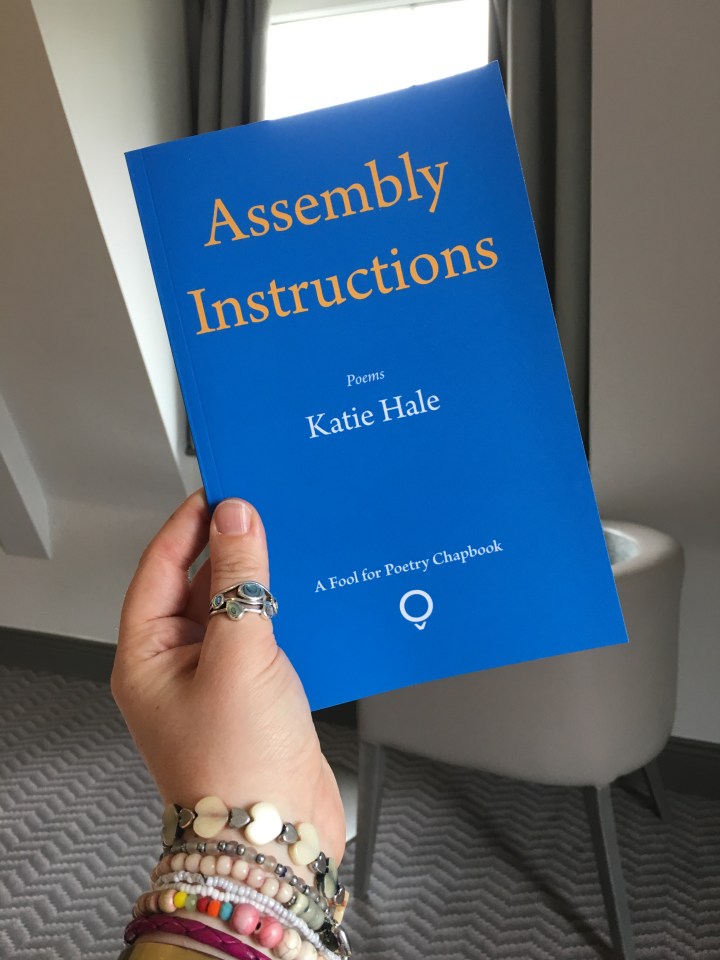
If you follow me on Twitter, you might have noticed me posting photos of a sleek blue chapbook with a bold yellow title. This is my new pamphlet! Hurrah!

Assembly Instructions is published by Southword, after it won the Munster Fool for Poetry Chapbook Competition. It’s a slim & visually stylish volume (thanks, lovely Southword folks!) about how we put ourselves together, and the formative experiences that make us who we are.

AVAILABLE TO BUY HERE

Although it technically came out a couple of weeks ago (and is available on Amazon here, and will soon be available directly from Southword here), I’ve only just got my hands on them. 

This week, I was invited to Cork International Poetry Festival, to launch the pamphlet at a reading. I read in the Grand Parade library, at a free event alongside two other poets, also launching chapbooks: Brenda Spaight and Regina O’Mulveny. Sometimes, I feel as though pamphlets or chapbooks published by the same press, or discovered through the same competition, can have a sort of homogeneity to them – but it was a lovely event, with a really interesting combination of voices, each of which felt very different to each other. 

In fact, it was a lovely festival overall. I almost want to say that everyone should go and enjoy Cork International Poetry Festival – but then if everyone descended on it, it might lose some of that intimate feel that it currently has. Because although the festival is international (and very much so, pulling an impressive list of participants from Ireland, the U.K., the rest of Europe and beyond), it feels like a small, friendly community. A well-kept secret that everybody is sort of in on. During the three days that I was there, I met some lovely people, and discovered some incredible poetry. What a wonderful festival to be a part of! 

*

I was born in the morning

slithered out of the cut in my mother,
a thing no bigger than a bacon rind

and squalling. There was something
of the nymph about you
, she said later,

a dragonfly lifted too soon from the lake.
She watched my birth

in the sheet-metal ceiling,
her other self a storm cloud

brewing at dusk, a small fire
far too far from the beach.

When my mother unfurled her body,
her arms were scrubbed toufh

and she caught me. All through my life
she has rocked my reflection,

as we head for the unchartered deep.

*

‘I was born in the morning’ is taken from Assembly Instructions. It was first published as part of a group of poems shortlisted for the 2018 Manchester Poetry Prize.

image

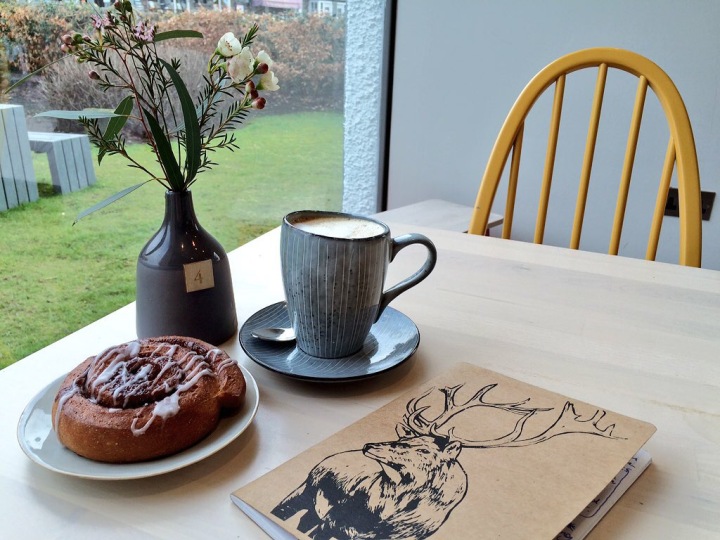
I’m sitting in the back corner of Brew Brothers café in Kendal. It’s just after 5pm on a Friday night. Outside, the street is full of people gearing up for a big night out, or trudging home after a difficult week at work – but in here, it’s warm and bright. There’s a mellow buzz of conversation against the backdrop of music: a mix of people meeting up for post-work coffees, or a pre-dinner glass of wine. One or two other people also have laptops. For me, at this moment in time, there’s just the right level of background stimulus to provide a productive atmosphere.

Writing poetry in a cafe in Grasmere

I haven’t always written in cafes. When I was a student, I found it next to impossible – too easy to be distracted by what was going on around me. But since then, I’ve started to lean towards it more and more. I’m not sure why this is. Maybe something to do with how our brains change as we get older, or the fact I have exponentially more admin than I did as a student, trying to distract me from the creative stuff. I still do the bulk of my writing sitting at my kitchen table – but when your writing space is the same as your living space, sometimes it can be good to take a break.

The seat I’ve chosen in this cafe is significant. It’s in the corner, with a view of the rest of the café. Separate from everyone else, not overlooked, and yet with a view. The other people with laptops have taken up similar seats.

There’s an evolutionary theory that most humans would plump for these sorts of positions, away from the door but with a view of the rest of the room. Prehistorically, it means we were far enough into the cave to be safe and warm, yet able to see the entrance in case a predator should approach. Calm, yet alert.

Like a lot of evolutionary theory, this is probably largely guesswork, but it imitates the state I tend to occupy when I write, halfway between relaxed and on edge. Or, as X-Men: First Class would have it, ‘somewhere between anger and serenity’.

There’s something about being in a café that provides this carefully balanced feeling. But, as with all balances, it can quickly tip one way or the other. I have to be picky not only with the seat I select, but with the café that it’s in. Somewhere with ambient noise, but not too much of it. Somewhere bustling, but not too full. And above all, somewhere with good coffee and cake.

MY TOP 5 CUMBRIAN CAFES FOR WRITING IN

Of course, there are downsides to writing in cafes as well. One is that you’re always dependent on it not getting too busy. Another is that, really, there’s only so much time you can spend in a café, unless you want to spend your money on buying your lunch and a lot of coffees there. (I mean, it’s probably still cheaper than renting an office space if you’re someone who can’t write at home.)

And for some people, any noise while writing is something of an abhorrence. We all have our different practices. The important thing is finding what works for you, or for this particular project, or even for this particular scene or poem or whatever.

Find a place you trust and then try trusting it for a while.

This is one of a number of pieces of advice that I sometimes hand out in creative writing workshops. It comes from the Immaculate Heart College Art Department Rules, written by Sister Corita Kent (though often incorrectly attributed to John Cage). It’s a list of ten ‘rules’, which urge the writer/artist to develop a work ethic, and to engage with the world around them.

Finding a place you trust is rule number one.

It doesn’t matter if it’s a café, a pub, your attic, or a park bench. I think the important thing, for me, is that it’s a place that allows for that feeling of intense focus that comes from being both calm and alert simultaneously. And then, once you’ve found it, you have to trust it.

A couple of years ago, I listened to Liz Lochhead being interviewed on Desert Island Discs. One of the songs she selected was Hoagy Carmichael’s ‘Some Days There Just Ain’t No Fish’ – a 1947 song written by Bob Russell & Carl Sigman.

I’ve used a fishing metaphor on this blog before, when talking about submitting work to magazines & competitions, but it applies equally well to the actual creative process, too. The more often you sit down and try to write – the more often you cast your line – the more likely it is that inspiration will catch.

‘Inspiration exists, but it has to find you working.’ – Picasso

Which is all very well and good, and a useful maxim for forcing yourself to write when you think you’re too tired / hungover / busy / distracted etc etc. But what about when there’s something deeper going on, that’s in some way blocking your creativity?

I’ve talked a little bit before about what I think are the different types of writers’ block: the ‘I don’t really fancy writing at the moment’ type, and the ‘there’s actually something major that I need to deal with in my mental health that is completely prohibiting me from writing’. (Clue: the first one is much easier to solve, and basically just requires discipline; the second one is much more tricky.)

So what do you do if you’re experiencing that second type of creative block? If you’re turning up to the writing desk / kitchen table / cafe / train commute every day with your notebook and pen, and it doesn’t help? If you’ve found a stack of writing exercises to work your way through, but nothing comes out right? If you’ve been keeping a writing routine for weeks, waiting for that inspiration to come and find you working, and yet you still feel blocked?

This is the sort of thing some writers have nightmares about. When I was younger, I used to be one of them – I saw writers’ block as some mythical disease, like a witch’s curse that could descend on me at any time and leave me unable to string a sentence together. But the truth is, as I’ve got older, I’ve learned a bit more about my own brain, and about how my mind works. And I’ve learned that writers’ block isn’t so much a disease as a symptom of something else.

About three years ago, I started to experience some pretty hefty anxiety. I say ‘started to’, but it had sort of been there all along. I just hadn’t been able to recognise it for what it was – partly because I just didn’t know enough about anxiety, or about my own brain, but also because up until then it had always been a kind of low level burn, like the sound of a waterfall, always there in the background and sometimes louder than others, but never enough to make me stop and pay attention for very long. Then, at the start of 2016, there came a flood, and suddenly I was drowning in it.

For six months, I barely wrote anything. I tried. I really, really tried. I’d just left one of my two part-time jobs to give myself more time for writing, but whenever I sat down and tried to write something, it felt like someone had put a cement mixer in my brain.

Eventually, I went to the doctors, and refused the offer of pills (I knew that wasn’t what I wanted, and while they are absolutely the right course for some people, I knew that I wanted talking therapy instead). I was referred for therapy – or rather, I was given a piece of paper with a phone number on it and told to refer myself. I never rang the number.

(This isn’t a blog post about how the NHS, for all its strengths and qualities, is hugely lacking when it comes to supporting mental health – though if it were, I might point out how I told the GP that the very reason it had taken me several months even to go to him was because my anxiety kept preventing me, and so this tactic of asking me to jump through that appointment-making help-seeking hoop again was highly flawed. But that’s another argument.)

After 7-and-a-bit months, I got over my period of anxiety. No, that’s a lie. I didn’t ‘get over it’ (hateful phrase) – but the flood-rush subsided and the waterfall went back to its normal level, and the words began to return. A number of things helped me with this, particularly friends and books. I read an awful lot during that time, and although I didn’t realise it then, this reading was feeding my creativity. I might not have been producing anything, but the creative process was still going on, under the surface, building my understanding of story, of language, of creative thought.

But the real turning point came that summer, when I travelled to America to do an enormous road trip up the west coast with two friends. We spent three weeks on the road (as well as a week or so either side and my friend’s house in Oregon), and it threw me out of myself in exactly the way that my brain needed at the time.

In his book, The Idle Traveller, Dan Kieran talks about travel as the process of forcing your brain to pay attention. When we’re surrounded by the unfamiliar, our survival mode kicks in, and we’re forced to notice everything around us. From an evolutionary standpoint, this is about assessing the new environment for potential dangers, but it also serves the mind creatively. We have to be switched on. We have to exist in the moment, and to really pay attention to what’s around us. In other words, we have to be mindful.

While travelling up the west coast of America, we stopped in San Francisco. Sitting on a bench on Pier 39, sharing fish & chips with the two wonderful friends on either side of me, listening to the buzz of people and seagulls and the distant slap of water against the docks, I burst into tears. They were happy tears. For the first time in over half a year, I felt happy. Completely and utterly happy. I was able to be absolutely 100% in the moment: that almost meditative state that’s so important for mental health and for the creative process.

That evening in our AirBnB, I jotted down a couple of lines for a poem. Back at home a few weeks later, I started writing the poems that will hopefully form my first full-length poetry collection. A couple of months after that, I wrote the first scene of my novel.

So what’s the lesson here? I’m not trying to tell you how to cope with anxiety or any kind of mental ill-health, because all our minds work in different ways, so that’s going to be different for everybody. But what it taught me is that, whenever I feel blocked in my writing (as in, really truly blocked, not just procrastinating because checking twitter is easier), there are things I can do. I can read. I can go for a walk. I can travel. Not necessarily a long way – even a day trip somewhere local will do, as long as it’s somewhere I don’t know well, somewhere that I have to be fully present in.

So I guess the lesson, if there has to be a lesson, is that it’s ok not to be writing all the time. There are so many other things we can do to feed our creativity. Whether we’re writing a poem every day or just giving our minds a fallow period – as long as we’re stimulating our minds, that creative process never really stops.

And although at times you get a messful
Other days are less successful
Some days there just ain’t no fish

I arrive in Grasmere on one of the coldest nights of the year. The stars are already growing crisp and cold in the sky, and the car park is an ice sheet worthy of Torvill and Dean. Cut to three weeks later, and I’m outside in the sunshine overheating in my t-shirt and jeans. My residency at the Wordsworth Trust has been varied to say the least.

I was living on the top floor of one of tall the Victorian houses in Town End, owned by the Wordsworth Trust. (There was some discussion over whether we were calling this my ‘garret’ or my ‘penthouse’, which mostly seemed to depend on how cold the weather was being at the time.) From my bedroom, I could see a sliver of the edge of the lake, and the fells rising beyond. From the bathroom, I could see Dove Cottage itself.

The residency lasted for four weeks, which seemed to go unbelievably quickly – perhaps because there was a lot to fit in during that time. Some of this was work connected with the residency: I ran poetry workshops in 5 schools, gave a poetry reading at the Wordsworth Trust itself, and did two reading / workshop events with other poetry groups connected with the Trust. Then there were the other things, which weren’t a structured part of the residency in the same way, but which I was desperate to fit into my four weeks: the walks, the visits to Grasmere’s wonderful cafes, the many writing-based chats with Polly Atkin & Will Smith (not to mention sampling Will’s delicious baking). And of course, the poetry.

As with most things, before I started the residency, I had a plan. I would write a number of poems during my stay in Grasmere, and read a whole host of poetry collections.

Also as with most things, it didn’t quite work out the way I planned. Some of this was because of all the other things that ended up being factored into the residency weeks, but some of it was also just because I ended up changing my practice once I arrived on site.

Part of the beauty of the residency was the lack of pressure to produce anything. For the first time in a long time, I could just play with poetry, and experiment without having to necessarily complete anything. This might sound counterproductive, but it was actually an enormous creative luxury. I started to think about it like an artist’s sketchbook. Rather than forcing myself to create full watercolours, I could create sketches, ideas and studies for poems.

At the moment, most of these are still sitting in my notebook, waiting for me to do something with them – or not, depending on how each idea grows or diminishes over time. It’s a hugely invigorating feeling, to know that my notebook is positively bristling with keys that could unlock poems. It’s the kind of concentrated exploration that I never normally get time for as an artist.

I may not have come out of the residency with a huge body of poems as I was expecting, but what I gained was something more: a chance to focus on the practice, and to connect with the part of myself that all the poetry stems from.

A few good things:

Frankenstein:

One of the perks of the residency was getting to engage with some of the Wordsworth Trust’s extensive collections. There’s a whole host of incredible things in their archives, but one of the things that most fascinated me was the first edition copy of Frankenstein.

It lives in the Reading Room in the Jerwood Centre at the Wordsworth Trust, behind a glass door with hundreds of other books, in its own little non-descript-looking cardboard box, with FRANKENSTEIN scrawled on the side in pencil. Appearances can be deceiving, however, because not only is this box custom-made to fit the book exactly, but inside is a first edition of what, for me, is one of the most fascinating novels in the English language: Mary Shelley’s Frankenstein.

Getting to hold this – to carefully unwrap it from its cardboard box and then from the older box inside that, and finally to pick up and open one of the volumes – was easily one of the highlights of the residency. My debut novel, My Name is Monster, is in part inspired by Frankenstein. Holding that first edition brought it right into the present for me. It felt as though I were in conversation with Mary Shelley and with the original text across the decades – part of a literary heritage through prose as well as through poetry.

Manchester Poetry Prize shortlisting:

The night before I arrived at the Wordsworth Trust to begin my residency, I spent the evening in Manchester, where I was shortlisted for the Manchester Poetry Prize! It was a really great night, with a reading in a room filled (as you might expect) with incredible writers – on the shortlists, on the judging panel and in the audience. The winner was Molly Underwood, for a truly beautiful selection of poems based around books of the bible. You can read the full shortlist here.

Plough Short Poem Prize:

And continuing the theme of prizes – during my Wordsworth Trust residency, I learned that my poem received 3rd place in the Plough Short Poem Prize, judged by Pascale Petit. You can read the poem here.

The residency month in books:

As with writing, I ended up not reading as many books as I expected to this month. What I did get a chance to do, though, was to read poetry in-depth. I rarely get the time to sit and really pour myself into a collection of poetry: to sit and read a poem, then put the book down and think about it for a while, then to pick the book back up and read another one. This kind of slow, thoughtful, deep reading isn’t generally conducive to the hectic freelance lifestyle. But during a residency, particularly when the weather’s beautiful and you can walk up a hill and stop every few minutes to read a poem? Perfect!

  • Tibor Fischer, The Collector Collector
  • Zaffar Kunial, Us
  • Sally Rooney, Mr Salary
  • Suzannah Evans, Near Future
  • Haruki Murakami, Birthday Girl
  • Markus Zusak, The Book Thief
  • Kaveh Akbar, Calling a Wolf a Wolf

The residency month in pictures:

Recently, I wrote a blog post sharing five fiction prompts, to help you get to know your character. In the interests of balance, I thought I would write a post with some poetry prompts as well.

None of these prompts suggests a subject for a poem, or tells you what to write about. (I may do this kind of prompt post in the future, but I’ll see how it goes.) Instead, each of these prompts is a way of generating material using the language itself.

Language makes up the bricks and mortar of our work. It’s what allows us to build. So, to continue this possibly-a-bit-overplayed analogy: these prompts won’t tell you what kind of house to build, but they will help you create more (and hopefully better) bricks.

Ready? Got your notebook handy?

Then I’ll begin.

Poetry Cairn, Lakes Alive Festival

1 – Freewrite

Different writers use freewriting in different ways, but for me it’s a bit like practising scales on an instrument, or like doing stretches before a race. I tend to freewrite for 5-10 minutes at the start of a writing morning / writing day, just to clear away the cobwebs and warm up the writing muscles. Sometimes, the thing I write becomes the basis for a poem, and sometimes not. I doesn’t really matter either way; the point is the writing of it.

So what is freewriting?

The idea is that you write without thinking too hard about it. You set yourself a timer (3-5 is probably a good amount, particularly if you’re new to freewriting), and you start writing. You don’t stop writing until the timer goes.

It doesn’t really matter what you write, and it certainly isn’t supposed to be a poem, or anything ‘poem shaped’. The aim is to just get words down on the page without worrying whether they’re any good or not. You can’t stop to censor yourself, so you just keep going. If you get stuck, write the first thing that comes into your head – even if that’s ‘I don’t know what to write about’.

The hardest bit about freewriting is working out how to start, so it can be useful to have a stock list of phrases or first lines as a jumping off point. Some of mine are:

  • I want to give you…
  • There was something about…
  • Do you remember…
  • What happened was…
  • That was the day…
  • It tasted of…
  • My body is…

Or another good exercise, when you’re feeling particularly creative, is to come up with a list of 5-10 first lines you could use for poems that you haven’t written yet, and then use them as the starting points for freewrites – one a day until you run out of first lines, and have to come up with another list.

You can use a line from someone else’s poem as a prompt, but of course if the freewrite does turn into a poem in its own right, make sure you change your first line, or credit the original writer.

Freewriting can be useful in two ways: one is to reach past all the day-to-day fluff that clutters our brains so much of the time, and allow you to access the edge of the dream state that exists just below the conscious mind; and the other is that you actually end up writing down all of that day-to-day fluff and clutter, but at least that clears it out of the way ready for you to move onto some other writing afterwards. Either way, you’ll probably come out with some words / phrases / ideas that you weren’t expecting.

*

I bought some fancy coloured gel pens for editing

2 – Phrases Breed Phrases

Sometimes, you write a phrase that won’t let you rest until you’ve written another phrase. I don’t mean those instances where you get so caught on the excitement and inspiration of writing that you can’t bear to put your pen down even though you’re desperate for the loo – though those moments can be very useful as well. Instead, I’m talking about the phrases that demand a certain syntax, which in itself demands that you write more in order for the sentence to work as a grammatically correct sentence.

For example:

Even though the dark was coming in.

is not a complete sentence in its own right. It’s only half of a thought, and as such it leads us asking questions, wanting to know more. It’s an idea that demands to be completed: Even though the dark was coming in… what?

Even though the dark was coming in, I couldn’t leave the silence of the lake.

Now I’m not saying that’s a great line, but it’s certainly fuller than it was a paragraph ago. The syntax of ‘even though’ has forced me to add a second part to the sentence, which suddenly doesn’t just contain the images of darkness and of a drawing nearer, but also contains a lake, a silence, and me as the speaker of the poem. The picture is starting to build.

Good beginnings for this kind of enforced building up of a sentence are:

  • Even though…
  • And if…
  • Because…
  • Before…
  • After…
  • Once…
  • Under…
  • Despite…

Each of these are words you can use to begin a sentence, that force you to take the sentence somewhere new part way along. And if you want to get even more mileage out of your words? Then you can repeat your start words to build up a bigger picture. E.g.

Even though the dark was coming in, I couldn’t leave the silence of the lake.
And even though the air was full of midges, I sat without twitching.
And even though someone was calling me, far away, from across the fields, I pretended not to hear.

These might not all make it into a final poem, but it’s a way of getting words and thoughts on the page.

*

writing prompt - Katie Hale

3 – Repeat Yourself. Repeat Yourself.

Repeating yourself might sound like a cheat’s way of generating material for a poem, but it can actually be incredibly useful in providing a structure and a music to a poem. This can be repeating an entire line, as a kind of chorus returning us to the same idea, or it can be a word or words, woven through the poem like a tapestry.

  • Repeat the start of the sentence (anaphora): e.g. I went down the stairs. I went alone. I went because I wasn’t afraid of the dark.
  • Repeat the end of the sentence (epistrophe): e.g. The room was old. Everything about it felt old. Even the darkness felt old.
  • Repeat the end of one sentence at the start of the next (anadiplosis): e.g. I went down the stairs. The stairs creaked in the dark and the dark swallowed the torch beam.
  • Repeat a single word or its derivatives (polyptoton): e.g. The room was old and dark. In the darkness, I felt my fears darken.
  • Repeat the sentence structure (isocolon): e.g. The room was old and dark. My torch was weak and flickering.

This is a great exercise to use for generating material. Do it with your writing hat on, and leave your editing hat well and truly to the side. Don’t worry about whether you’re repeating things too much – just write and use it as a way to discover thoughts and images you didn’t know were hiding in your brain.

Afterwards (and only afterwards), you can put your editing / shaping hat on, and heed this word of caution: repeating anything has to be handled with great care, particularly in poems, which tend to be short enough that repeating any word anywhere is noticeable and so has to be deliberate. Make sure you’re repeating something for a reason, not just because it’s an easier way of making the page look fuller. Is the repetition adding something to your poem? Meaning? Rhythm? Music? Connection between apparently disparate ideas? You don’t necessarily need to be able to specify exactly what each repetition is adding, but you have to be able to feel it.

*

writing prompt - Katie Hale

4 – A Brave New Word

Words have a wonderful way of suggesting other words – a bit like with the freewriting prompt, or the phrases breeding phrases prompt, above. Those two prompts both work on a syntactical level, and speak to our human need to complete and organise; we have an incomplete sentence, and we force ourselves to finish it. However, this next prompt works in much finer detail, on the level of individual sounds.

The first step is to pick some words you would like to include in your poem. These can be anything, but try to make them words that you like the sound of, and preferably words you wouldn’t normally use in your poetry. For example, for a while I had a tendency to put ‘meagre’ into everything I wrote, so I wouldn’t be allowed to choose ‘meagre’ for this exercise, as it’s already too heavily placed in my active writing vocabulary. We all know those words that we keep coming back to – our own little writing tics that we can’t seem to shake. Stay away from them – for this exercise at least. Find something more unusual to you – a new word you want to try out. Flick through books, if you like. See what kind of vocabulary other writers use. Choose one or two of their words (though not too many from each writer, or it’ll make it too easy to slip into attempting that writer’s voice as well).

My words might be: shotgun, fascinator, primal, staccato, grudge, cormorant, startle

Don’t worry – you don’t necessarily have to put all of those into the same poem. Although you can do, if that’s the sort of challenge you want to set yourself. Instead, you’re going to focus on the sounds. For each word, you’re going to build up a sentence that contains more of the same consonantal sounds.

Let’s take ‘shotgun’. The word ‘shotgun’ contains 4 consonantal sounds: ‘sh’, ‘t’, ‘g’ and ‘n’. So you might want to make a list of words that include those sounds: nag, gin, gaunt, shatter, tosh, shutters, tiger, grain, grant, train, shunt, gauche, hunt

So your sentence could be: The tiger was gaunt and hunting, but the shotgun was a train shunting through the trees, shattering the jungle.

You’ll notice the use of words that weren’t on my original list – particularly ‘trees’ and ‘jungle’. That’s ok. After all, we don’t want a completely homogenous sound world in our poems, and the sentence needs to make sense as well. Having said that, ‘trees’ pretty much belongs in this soundscape anyway, with that ‘t’, and the ‘s’ that sort of speaks to the existing ‘sh’.

And as for ‘jungle’? Well, that definitely belongs.

Why? Consonants have pairings and groupings that give them a similar music. This is easiest to spot in the voiced and unvoiced versions of consonants, such as ‘b’ and ‘p’. Try saying these two letters. You’ll notice that one of them (b) uses your vocal chords, while the other (p) is composed of nothing but air. That’s because they are, in a sense, the same letter, but formed either using or not using the voice.

The same is true of ‘c’ and ‘g’. And ‘t’ and ‘d’. And also ‘ch’ and ‘j’ – which is why I said that ‘jungle’ belongs in the sentence above: ‘j’ belongs in the same sound world as ‘ch’, and ‘ch’ is not a million miles away from ‘sh’ (the only difference being the hard beginning on the ‘ch’ sound as opposed to the ‘sh’).

So what does this mean? Effectively, it just gives you a bigger sound world to play with. Suddenly, the word ‘shotgun’ lets you play with more consonantal sounds: ‘sh’, ‘ch’, ‘j’, ‘t’, ‘d’, g’, ‘c’, ‘k’, ‘ck’, ‘n’ and ‘m’.

So my list of words might include: danger, ticking, marked, shake, dodge, juggernaut, decode, game, knocking, cudgel, untangle, conglomerate, tug, ghost, gamut, mango, teach, crèche, niche, manchego, jumping, imagine, dawn, need, meadow… The list goes on and on.

Some consonantal sounds that go together:

  • b / p
  • c / g / k / ck / qu / x
  • d / t
  • f / v
  • h
  • j / ch / sh
  • l / r / w / y
  • m / n
  • s / z

Play around with these, using the sounds within a single word to create a sentence within the same musical soundworld. Often, this will force you to put words and images together that surprise you – and the added bonus is that it nearly always sounds beautiful and musical.

*

Writing poetry in a cafe in Grasmere

5 – Challenges

This is a technique I use a lot when I’m working in primary schools, as it keeps children on their toes during the writing process, and it gives them something to work towards if they’re struggling for ideas. As with many of the exercises I do with children, I find that it can also be fun and challenging for adults, too. It’s a good exercise to use when you’re freewriting / jotting down ideas for a poem, as a way of forcing yourself to include images you wouldn’t ordinarily have thought of, or a way of taking your thoughts in new directions.

Essentially, you challenge yourself to include something in your poem. You might want to choose 3 of the following, and challenge yourself to include them in your next freewrite / your next poem:

  • an insect
  • some sort of water
  • a landscape feature
  • something made from wood
  • a municipal building
  • a plant
  • something dead
  • something alive
  • some kind of weather
  • an organ (bodily or musical – it’s up to you)
  • a piece of furniture
  • a bird

You can include these in a literal way in your poem (e.g. a grasshopper was announcing the evening), or you can use them to form your imagery (e.g. my heart was a grasshopper in the uncertain grass of my chest).

The trick with all of them is to try to be specific. So if you choose ‘water’ as one of your challenges, don’t actually use the word ‘water’, but something like ‘puddle’ or ‘dripping tap’ or ‘river’. Even better, be specific about the type of puddle, or dripping tap, or river. Is it a clear stream tinkling down the mountainside in summer? Or is it a gushing river, brown, full of silt and swollen with too much rain?

Use these challenges to force yourself to think outside the normal bounds of your creative comfort zone, and to generate imagery.

*

And those are the five. Notebook at the ready – and good luck with your writing!

Let’s not beat about the bush: we live in a time when funding for the arts is getting harder and harder to come by. Libraries are under threat, and creativity is increasingly disappearing from the school curriculum. Having said that, we are also living through an economic boom when it comes to the creative industries. So while on the surface it may feel as though opportunities for writers are few and far between, there are still plenty of opportunities to throw your hat into the ring.

In fact, there are so many opportunities, that last year I aimed to submit 100 applications in a year. I managed 87, which still barely scratched the surface of the opportunities that were available to me.

100 Submissions in a Year: notes on goals and rejection

Of course, most (if not all) of these opportunities are highly competitive. Which means that any writer (no matter how talented, no matter how successful) is going to submit a lot of unsuccessful applications. This isn’t necessarily a comment on the writer’s ability; particularly when judges have a lot of submissions / applications to sift through (literally hundreds or thousands sometimes), all kinds of other factors come into play. What the judge’s individual interests are. What they had for breakfast. Whether they need a wee. What they watched on telly the night before. How recently they argued with their spouse.

Dealing with so-called ‘rejection’

All these things are totally beyond a writer’s control. But does that mean you should stop submitting? Of course not! Because you never know – next time your work might catch the right judge at the perfect moment, and you get a lovely ‘congratulations’ email into your inbox.

So what can I apply for?

The arts world is constantly changing. As I’m sure many of us aware from the doom-and-gloom surrounding arts funding, opportunities and funding streams are disappearing all the time. Then again, new ones are always arriving on the scene as well, to the extent that it can be difficult to keep track of what opportunities are out there.

I’ll write another post sometime about how I manage my submissions, and how I keep track of opportunities I can apply to / applications I’m waiting to hear back on. But for now, I want to focus not so much on the individual opportunities themselves, but on where to look for them.

*

1: Arts Council England

The Arts Council is one of the first places I will look if I’m searching for funding – not just for writing, but for any artform. They have a number of funds you can apply for, but the two main ones are probably their Project Grants (for outward-facing, publicly engaged projects), and their Developing Your Creative Practice Fund (which, as the name suggests, funds artists to develop their creative practice in some way).

Arts Council England (ACE) only funds artists / writers / projects based in England, but there are equivalents if you’re based in other parts of the UK: Creative Scotland / Arts Council of Wales / Arts Council of Northern Ireland.

The Arts Council also runs Arts Jobs and Arts News: a listings service for arts related job offers and industry news. These can be viewed on the Arts Council’s website, or you can sign up to weekly emails and have relevant listings arrive in your inbox on a Sunday afternoon. It’s free, and most England-based arts organisations will list opportunities and jobs on here, so it’s worth signing up to.

As well as providing their own funding streams and listings, the Arts Council has a list of other sources of funding for arts projects. This is by no means an exhaustive list, but it’s a good place to start if you’re looking for a way to fund a project.

Note: a lot of these funds require you to be an organisation to apply. This doesn’t mean that they’re inaccessible for individual artists / writers, though. It just means that whatever your project is, you have to work with an organisation to bring it into being.

*

2 – Regional writing organisations

As well as funding bodies that cover the larger regions (England / Scotland / Wales / Northern Ireland), there are also dedicated writing organisations that cover sections of the UK. Mine is New Writing North. As the name suggests, New Writing North provide opportunities open to the whole of the north of England, including the Northern Writers’ Awards, which awards hundreds of thousands of pounds worth of funding to writers annually.

As well as funding, they also provide publicity opportunities for writers through schemes such as Read Regional, which gets local authors into regional libraries. They send out a weekly e-news sharing opportunities and news from regional writers.

Google your area to find your own regional writing organisation.

*

3 – The British Council

From local to further afield: the British Council works to keep cultural conversations between the UK and other countries. As such, they often have opportunities for artists (including writers) that involve some kind of overseas travel. Some of these are for arts organisations, or for arts professionals who are not artists in their own right, but they also have callouts for artists, and it’s worth checkout out their Arts Opportunities page from time to time.

*

4 – The Society of Authors

The Society of Authors is the writers’ union. They provide all kinds of support for writers, including grants for work in progress, and their annual prizes for both published and unpublished work.

If you’re a member, you also get all kinds of benefits, including legal advice, support with things like contracts, and money off books.

*

5 – NAWE

NAWE stands for National Association of Writers in Education – but even if you don’t work in education in any way, you can still take advantage of The Writers’ Compass, which brings together NAWE’s professional development programme with the advice, listings and opportunities on their website.

One particularly useful part of this is their Events & Opportunities page, where you can filter opportunities by jobs, funding, events, competitions & submissions, mentoring & coaching, and retreats.

*

6 – BBC Writers’ Room

The BBC Writers’ Room is particularly useful if you’re a script-writer, whether that’s for stage, screen or radio – although they do occasionally post opportunities that are open to all types of writers. Even better news is that their policy is only to post opportunities that are free to enter, so you’ll never have to pay an application fee for one of these.

*

7 – ResArtis

If it’s writing residencies you’re searching for, then you could do a lot worse than starting with ResArtis.

The site lists all kinds of residencies, including the sort that lure you in by saying anyone can apply, but then mention that they come with an extortionate residency fee. In these cases, what you’re getting is often the equivalent of an AirBnB, but with a ‘writing retreat’ label on it that pushes the cost up exponentially, so it pays to be careful.

However, they do also list some very well respected residencies, including those that just provide accommodation and time to write, as well as some that pay you to go and live somewhere and work on your creative art. Because the site lists so many residency opportunities, finding the ones that are most appropriate for you does take some filtering. I’d recommend sitting down one evening with a big glass of wine, and exploring what the site has to offer.

Note: unlike with the BBC Writers’ Room, a lot of opportunities posted on here do require an application fee, which is another reason for making sure you’ve read the fine print.

*

8 – The National Poetry Library website

As you’d expect, this one is really for poets. Mostly, I use their website to keep up to date with poetry competitions and upcoming deadlines. It lists competitions for poets at all stages of their writing development, from smaller competitions that seem to cater for emerging writers, to big ones like the National Poetry Competition. As with any listing service, it requires you to decide for yourself which are the most appropriate for you to enter.

The website also has advice for emerging poets, as well as a round-up of the UK’s major and independent poetry publishers, and a list of magazines where you could send your work.

*

9 – Other listings

As well as the National Poetry Library, there are other places that regularly list competitions and submissions opportunities.

  • Creative Writing Ink has a competitions page, with regularly updated listings. As with the Poetry Library, these competitions vary in terms of size and prestige.
  • Dublin-based writer Angela T Carr posts an extensive list of competition & submission opportunities on her website at the start of each month.
  • The Poetry Society runs a number of their own competitions, which they list on their website. They also have an events listing.
  • If you want a good way of finding journals & magazines that publish your sort of writing, look at the acknowledgments sections in poetry collections & short story collections. If a writer who is stylistically similar in some way has had a piece of work accepted by a journal, then there’s a chance the editor might like your writing as well.

*

10 – Google

I know it sounds obvious, but you’d be surprised how often people tell me they hadn’t thought of googling writing opportunities. Every so often, I will spend an evening in front of the fire, googling things like ‘artist in residence opportunities’ or ‘poetry competitions’ or ‘writing residency’, just to search out any of those things that might have slipped through the net of the listings. Sometimes, this will come to nothing, but every so often an opportunity will come to light, which will make it all worth while.

*

Good luck with seeking out those opportunites, and fingers crossed for those emails that start with the word ‘congratulations’!

*

Have I missed anywhere?
If there’s somwhere you go to seek out opportunities,
pop it in the comments below.


Writing is largely a solitary task. Sometimes, we spend so much time wrapped inside our own brains, that it can be useful to get a nudge from someone else.

This post consists of five prompts for writing fiction. The focus: getting to know your character.

Unless we’re writing something that’s largely biographical, we can’t be expected to fully know and understand our characters the moment we sit down to write anything. The connection between author and character is like any relationship: it grows and develops over time. Every time you write, you get to know them a little better. They become a little more real.

The following prompts are not necessarily intended to become part of a novel – although of course they may do. They’re more like dates, or date ideas. Places to take your character so you can gaze into their eyes and get to know them better.

Bookcase bookshop, Carlisle

1 – Twenty questions

The first prompt is basically the first date. It’s about getting to know your character at a fairly surface level – the sorts of things you might find out about another person if you’d only spent an hour or so getting to know them.

The exact questions you ask are up to you, but don’t make them too heavy. Keep it light, for now. Things like, what’s your favourite colour? Or, what type of food do you hate? Do you have any brothers or sisters? Where do you live? Do you prefer books or films? That sort of thing.

Make a list of twenty questions, imagine you’re sitting your character down in front of you, and jot down the answers. Some these answers might be quite banal, and some may open interesting doors. Either way, you’ll have learned enough that, on the next date, you can start to dig deeper.

*

2 – Something your character wears

What we choose to wear says a lot about who we are. Do we dress to impress? Or do we just throw on the first thing we see in the morning. Do we dress carefully, but cultivate a style that looks effortless and unconcerned? Do we spend a lot of money on designer clothes – and if so, is that something we can afford, or something we have to make sacrifices for? Do we take pride in only shopping from charity shops?

If we apply this to a fictional character, it very quickly becomes about more than just surface dressing. A character who spends a lot of time cultivating an eclectic style probably cares a lot what other people think of them, and wants to be seen as individual and independent. Dig a little deeper, and this might arise from a deep insecurity and a fear of being overlooked. A character who puts very little thought into their appearance may be extremely self-confident, and totally unconcerned by what other people think of them. Then again, they may in fact be so isolated that they believe there’s no point in caring about their appearance, as nobody else will. A character who refuses to buy clothes from charity shops may have a fear of being seen as poor, or they may be so admiring of their own body that they want only the most exclusive designer clothing to adorn it.

So what does your character wear?

It might help to focus on one particular item, which exemplifies the type of clothing they tend to wear. It could be their favourite item. It could be the thing they wear most often.

Whatever it is, describe it in as much detail as possible. Describe how it fits your character’s body. How do they feel when they wear it? How did they come to own it? How do other people see it? Get to know your character through what they wear.

*

3 – An object your character owns

In the same way that we can learn a lot about a person by the things they wear, so we can learn things by the objects they own. Particularly, by the objects they hold dear.

Theoretically, we can learn from the everyday objects, such as what sort of bowls and plates and cups they have. Is it antique bone china? Does everything match? Is it plain white crockery from IKEA? If they’re quite clumsy, then they may own the remnants of multiple sets. If they own everyday crockery, alongside a more expensive set that they only use for certain guests, what does that say about the character and how they relate to those around them?

All of these things tell us something about the character. But I want to dig deeper. If we choose the right object, we can find out key details about who this person is. It’s a cliché perhaps, but clichés are clichés for a reason: what object would this character save from a fire?

It has to be an object (it can’t be a loved one or a pet), but other than that, anything goes. Describe the object. What is it? What is it like? What does it mean to them? If it helps (and it may do), write the scene where they save the object from the fire. How desperate are they to rescue it, and what’s driving that desperation?

Again, this scene doesn’t have to make it into the finished novel. This is just a date.

*

4 – Something that happened before they were born

This prompt is all about putting your character in context. Finding out the ingredients that went into the melting pot of their personality. Obviously, a lot of things will have happened before your character was born. What we want is a key event: something that shaped their life, before they even existed.

This could be something straightforward, like their conception – how did their parents meet? Did they know each other well? Was the pregnancy intentional?

Alternatively, it could be something on a more global scale – a political event that shaped the society your character was born into.

Whether it’s something big or small, make it something that affects your character. Something where, had these events been different, your character’s world and probably their personality would have been different too.

*

5 – Put your character in a tricky situation

This final prompt builds on the third one, which had your character desperately saving something from a fire. The theory here is much the same: that we discover a lot about what drives a person in times of peril. Of course, that peril doesn’t always have to be the character’s own.

In this prompt, put your character on a bus full of people. A drunk old man is swaying violently and muttering under his breath, when suddenly he collapses. How does your character respond?

The reason I find this prompt useful is that it not only shows you how your character acts in a crisis, but it also gives an insight into how they act among people they don’t know, and how they behave in a crowd. There’s so much to unpack in a scene like this. It’s probably the most intense date you could ask for.

*

And those are the five! I hope you find them useful. Good luck, and happy writing!

When I was a small child in the early stages of primary school, we learned about jobs – a slightly tricky concept for a child who has very little understanding of money and absolutely no grasp of what an economy is. But I knew that I loved stories and books, and I loved making up little stories of my own. So when I learned that there were people who wrote the books I loved to read, and that writing books was a type of job, I was overjoyed. While most of my classmates were fighting over being vets and tractor drivers, I came home and proudly announced to my mum that I wanted to be an author.

In true down-to-earth motherly fashion, my mum assured me how proud she was that I’d chosen a career (at the tender age of probably about five), but that if I wanted to be an author, I’d need a ‘proper job’ as well. Writing books, she told me, was something most people did on the side. I’d need to find a way to pay the bills.

For a couple of weeks, I thought about this. At that time I’m not sure I had any idea that some jobs paid more than others, so it was a lot to get my head around.

After much consideration, I came back to my mum: ‘I still want to be an author,’ I told her, ‘but I’ve decided what I want my proper job to be as well.’

My mum was all eagerness and congratulations: ‘That’s wonderful! What do you want to be?’

I grinned from ear to ear, ‘I want to be an actress.’

Bookcase bookshop, Carlisle

As adults, we know that some jobs pay more than others. We also know that some jobs pay enough to live off, whereas others do not. And let’s be honest, writing has always had a pretty bad reputation in terms of salary. You’re either J K Rowling, or you’re stuck in a garret somewhere with no heating and only half a heel of mouldy bread. As far as many people believe, there is no in between.

Not true, of course. There are plenty of authors who make a reasonable living from their craft, without become yacht-owning multi-millionaires. Just as there are plenty of authors who make an ok amount of money, but still need to keep another job to make up the rest. As with most careers, there’s a huge range of income levels, and a lot of that depends on the writer: what they write, their level of output, and what else they do alongside the actual writing to keep the wolf from the door.

In this post, I’m going to talk a bit about different ways to make a living as a writer. I’m then going to unpack this, and (with the help of some pie charts and a couple of line graphs) talk about what this looks like in practice in relation to my own income as a writer.

*

Ways to make a living as a writer:

There are many different ways that a writer can make a living. Some of these depend on what you write (for example, poetry can look very different to commercial fiction), and some just on the preferences of the individual writer. Some means of earning an income will be directly related to the writing, and others less so. It’s all about what works for the individual writer.

As I write poetry and fiction, that’s what this post is focusing on. If you write scripts of any kind, or creative non-fiction, your outlets, and therefore your potential income streams, might be slightly different – although many of the following apply across genres.

So how do you earn a living as a writer?

My Name is Monster by Katie Hale - proof copy

1 – From your book:

This is perhaps the most obvious way for a writer to earn money – though many writers probably don’t earn as much from this as you’d think. It’s not uncommon for debut authors to get an advance of £5k, 15% of which goes to the agent. Hardly enough to live on, especially if you’re only publishing a book every few years.

Other ways your book can earn you money are through royalties from book sales (once they exceed what you’ve already been paid in your advance), and through the selling of additional rights, such as film rights or foreign rights. This effort to sell further rights to your book will be done either by the agent or by the publisher, depending on the terms of your contract.

Note: the above applies to fiction / non-fiction. If you’re a poet, you might earn enough for a couple of bottles of wine from selling your book, but I wouldn’t put the deposit on that mansion just yet.

2 – Readings / talks:

Usually once the book is published, an author will do events connected with that book. These could be anything from a reading of a section of the book, to a Q&A about their publication process, to a talk or panel discussion about some theme connected with the work. Often, they’re a combination of aspects of the above.

These opportunities aren’t always paid, but they should be. (See the Society of Authors’ page about where they stand on paying writers for appearances at festivals.) Thankfully, more and more, festivals and organisers seem to be wising up to the fact that this is work, just like any other job, and that authors need paying accordingly.

As you might expect, writers who publish once every few years tend to get more of these talks & readings in the years that they have books published. And, like everything else, certain writers’ work goes in and out of fashion, as do certain ideas. Which means that, while giving talks & readings can be a good way to supplement an income, it isn’t a steady constant.

3 – Workshops / teaching:

Many writers pass on their craft to other writers. This can involve running writing workshops in schools, or for adults – either through festivals, residential writing courses, or self-organised. Many writers also offer mentoring to other aspiring writers (either paid for individually by the mentee, or funded through some sort of arts funding), and / or teach at university level.

However, like any type of teaching, each of these has its own set of skills, which are themselves distinct from the skills you need simply to be a good writer. There are plenty of writers who run workshops because it’s the ‘done thing’, who realise quite quickly that they don’t enjoy it. My advice: if you don’t enjoy it, don’t do it. Your workshop participants will pick up on your lack of enthusiasm, and you won’t be doing yourself (or your participants) any favours.

On the flip side, if you enjoy running workshops, then go for it! There’s huge benefit to anyone in being taught by a skilled writer who’s passionate about passing on the skills of their trade.

4 – Funding:

I mentioned the F-word. Sorry. But there are a number of different ways to access funding as a writer.

One of these is to do a fully funded PhD – which essentially means you get paid to write for around 3 years (which is normally the length of time a funding body will fund you for a doctorate). These aren’t always easy to come by, and you have to be certain you want to dedicate 3 years of your life to doing a PhD, but if you can get one, it’s a great way to make sure the bills are paid and still have plenty of time to focus on writing / studying some aspect of your writing.

You can also find funding to write from other sources, if you don’t fancy doing a PhD. These include things like the Arts Council’s Developing Your Creative Practice grant, which gives artists up to £10k to focus on developing some aspect of their creative practice, and so far seems to have a roughly 1 in 10 acceptance rate, which isn’t bad. The Society of Authors also gives contingency grants and grants for works in progress.

If you want to run another writing-related project, which isn’t just your own writing, then there are funding bodies you can apply to for that as well, including places such as Arts Council England (or Creative Scotland / Arts Council of Wales / Arts Council of Northern Ireland, depending on where you’re based), the Heritage Lottery Fund, the Fenton Arts Trust, and the Jerwood Foundation, to name just a few. Most of these require your project to work with other people, and have some sort of outreach / public impact. Some can be applied for as an individual, and some require you to work with an organisation.

5 – Commissions:

A commission is when somebody (an organisation or another person) pays you to write something for them. This could be anything, and commissions vary in terms of how prescriptive they are. For instance, some give you quite a bit of free reign to interpret the creative brief, whereas others have a very set idea of what they want you to produce.

6 – Residencies:

As with commissions, writer in residence positions can be extremely varied in what they offer. Because this is a post about earning income, I’m going to leave aside talking about the sort of residency where the writer pays to attend, and focus on the more generous sort – some of which will pay the writer a fee, some will pay transport & a small stipend, and some will just provide the free accommodation and maybe a few meals if you’re lucky. It all depends on the individual residency. Even the residencies that don’t directly pay a fee can be a huge financial benefit though – particularly in winter, when the heating bill can be enormous, and you’re effectively living without having to pay bills.

In the same way, different residencies will require different things from the writer. Some will require very little, and will instead allow the writer to write at their own leisure for the duration (which can be anywhere from a week to several months to even a year). Most require some sort of reading of work-in-progress at the very least, and some require engagement with the local community, either through workshops or school visits or talks.

These sorts of residencies can be quite competitive, particularly for the more lucrative / prestigious ones, but the time to write can be invaluable.

7 – Prizes:

Equally competitive (if not more so) are writing prizes. These can be prizes for anything from a single poem, to a collection of poetry, to a short story, to a full novel. As well as the famous ones like the Man Booker Prize or the Costa Prizes, there are the prizes that unpublished writers can enter. Many of these charge a submission fee, though, so some careful calculations need to be made about how many of these to enter (and which ones) if you’re going to make money rather than lose it. And even then, it definitely isn’t a reliable source of income.

8 – Other writing-related work:

I’ve already sort of mentioned this when I was talking about funding a few points up, but there’s plenty of other work a writer can that’s related to their creative practice, but isn’t just writing. Many writers work as editors, either for publishing presses or for independent magazines. Some also hold other jobs within publishing, or work as reviewers. And you know those prizes I was talking about? Most of those are judged by writers, who are (mostly) paid to do so.

9 – Other arts related work:

And if it isn’t work directly linked to writing, then there are other ways to work in the arts. There are arts organisations, theatres, galleries and museums across the country, all of which need people working in them to make them run. A lot of these also offer part-time jobs, which can be ideal if you want to work part-time, and dedicate the rest of your week to your writing. (I’ve spent the past 6 years working part-time in arts administration, on and off.)

10 – Any other work:

Or, if a writer prefers to keep the artistic section of their brain separate from their other job, then there are plenty of other ways to earn money. I know writers who earn their income working in call centres, clearing tables and pulling pints. As long as it allows them to write, and to pay the big red bills when they come through the letterbox.

*

Ok – so what does all of this look like in real life?

The term for this type of living seems to be ‘portfolio career’ – which sounds much more impressive than saying I do ‘bits and bobs’. More accurate, too, because I often find that the various aspects of my career inform one another. For instance, experiences in the workshops sometimes feed into my own writing, and connections made through my arts administration roles have led to commission opportunities and appearances at festivals.

So how did I earn my income last year?

I’ve broken my income down into sections: earnings from commissions; earnings from running workshops (for young people and for adults); income from competition wins; earnings from readings / talks etc; money from my advance on my novel; income from other arts-related work (mostly, but not limited to, arts administration roles).

For 2018, the proportions are as follows:

As becomes clear very quickly from looking at this pie chart, over half of my income last year came from the advance from my novel. That makes sense. Depending on your publisher, an advance is usually paid in 3 or 4 installments. Mine is paid in 3, and because of various things to do with timings, I just so happened to get the first 2 installments in consecutive months last year. But, as I mentioned earlier, unless you’re publishing a book a year, you’re not going to get regular advance payments, which makes this year a slightly special one – and means that 2018’s income is highly skewed because of it.

(Since advances are usually negligible to non-existent for poetry, this is more of a feature of income streams for novelists and non-fiction writers.)

So let’s take that advance out of the equation, to try to get a more useful sense of proportions:

What we’re left with is a much more honest illustration of this type of portfolio career: just under half coming from workshops; around a third from other arts-related work; a reasonable chunk from commissions; and a smattering from competitions and readings.

CAVEAT: These proportions are specific not only to my career, but to this very particular year of my career. For example, the 2% for readings / talks is because I only appeared at one festival in 2018. This isn’t particularly surprising, when you think that the only book I had out was my pamphlet, which had come out the previous year (and I’d already done quite a number of events for it in 2017. If I do another pie chart at the end of 2019, when I have a poetry chapbook and a novel coming out, it’ll probably have different proportions here.

(Not included in these figures is the grant I received from the Arts Council’s Developing Your Creative Practice fund, as all of the work that will pay for is happening this year, and so I haven’t yet allowed myself to treat it as income.)

So how does this variation play out throughout the year? If a writer’s earnings can vary so much from one year to the next, what do they look like from month to month?

Again, these levels are skewed because of the novel advance. If you compare this graph to the first pie chart, we can see that I received 63% of my 2018 income in two consecutive months. But, as I said, this is kind of an anomaly – at least for me.

If we show the monthly income without including the advance, those August and September plot points look a little less drastic – though hopefully the varying of levels of income throughout the year is still apparent:
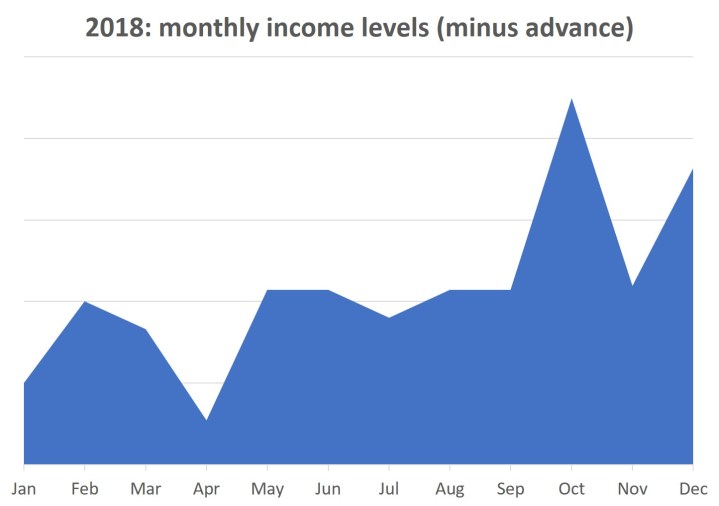
Even without the anomalous skew of the advance affecting the shape of the graph, April was a tough month. If every month was an April, then I’d definitely have had my electricity cut off by now. But then, April in 2018 contained Easter, along with all its attendant bank holidays, not to mention the school holidays. So suddenly this dip starts to make a lot of sense.

But if we look at the overall picture of the graph, rather than just month-by-month, my income has (generally speaking) improved as the year has progressed. Certainly I earned more in the second part of the year than I did in the first. I’m attributing this to the general progression that my career has undergone this year, rather than to some sort of shift in availability of work in the earlier to the later months.

But whatever the reason, it certainly shows that a writer’s income is far from reliable. It’s sporadic to say the least, and generally requires not only a willingness to juggle a portfolio of different income streams, but an ability to save for the leaner times as well.


January gets its name from Janus, the Roman god with two heads. One head for looking forwards, the other head for looking back. Because of this, he’s the god of doorways, gates and transitions. Hence, January: the door of the year, when we look back at how the year before has gone, and forward to what the new one will bring.

It’s true I’ve spent a little bit of time looking back this month. A few weeks ago I wrote a blog post about the submissions and applications I made in 2018, and how I fared with them. I also spent some time editing a poetry sequence that I had begun the year before. But mostly, I’ve spent this month looking forward.

And what am I looking forward to? Well, a few things, as it happens.

One of these is, of course, the publication of My Name is Monster in June. Summer months always sound such a long way off in January, when there’s ice on the road and I’m wearing about fifty layers just to sit at my kitchen table. But it’s going to come round unbelievably quickly, so I’ve already started preparing for it, organising launch events and planning readings etc. But more on that as and when the dates are confirmed.

I’m also looking forwards to a poetry-based project, Gretna. Part of a trilogy of theatre pieces exploring the borderlands between England and Scotland, Gretna gives a taster of a new collaboration between myself, Théâtre Volière and Lori Watson. For this project, I’ve been researching the history of women in and around Gretna Green, and writing a poem sequence in response. These poems will then be used to create a theatre piece, Gretna, which will then be presented at Ye Olde Mitre in London on 23rd & 24th March.

The third forward-looking thing I’ve been working on this month is actually kind of a secret. Well, not so much a secret as something I’m keeping close to my chest for now, and will talk a bit more about on here when I’m further into it. For now, I’ll just say that it’s a new project, and that it involves me roaming round Cumbria with a very fluffy piece of recording equipment!

Work-wise, that’s pretty much been the sum of my January. I spent the first few days of the new year crashed out ill on the sofa – which was partly to do with a horrendous bug that seemed to be going around, and partly because I’d been pretty much non-stop on the go for several months, and I think it was my body’s way of telling me to take a break.

I’ll be honest – I probably don’t take enough breaks. And, looking forward to my schedule for the first half of this year, 2019 isn’t shaping up to be particularly restful, either. Even holidays aren’t exactly relaxing, because I tend to want to see and do everything. (I went to Prague & Budapest for 6 days this month, with my friend Jessi, which was an incredible and inspiring and beautiful trip – but also very busy trying to wander round and see as much as possible!) So this year, I want to try and snatch some breaks, as and when I can. And if it’s nothing more than taking the full weekend off now and again, then so be it – it’s still better than nothing. After all, by the time the book launch comes around in June, I’m going to need those energy reserves.

The month in books:

My main 2019 resolution is to carve out more time for reading. Looking back, I know that I sacrificed a lot of reading time last year in favour of things like admin. Now, admin is undeniably important, as it’s what gets things done – but it doesn’t feed me creatively. Admin drains the creative tank, whereas reading fills it up again. So, looking forward (thanks, Janus), I resolved to do something about it. I resolved to force myself to make time for reading.

I probably still haven’t read as much as I’d have liked to this month, but let’s face it, when will I ever? It’s a start, and a habit I hope to build on in the months to come:

  • The Book of Strange New Things, by Michel Faber
  • American Sonnets for My Past and Future Assassin, by Terence Hayes
  • Fup, by Jim Dodge
  • Seven Brief Lessons on Physics, by Carlo Rovelli
  • Everything, Everything, by Nicola Yoon
  • Poems of a Molecatcher’s Daughter, by Geraldine Green
  • Selected Poems of Susanna Blamire, ed. Christopher Hugh Maycock
  • Eleanor Oliphant is Completely Fine, by Gail Honeyman

The month in pictures:

‘Yes, but what do you actually do all day?’

I keep hearing this from people, most of whom probably imagine that I spend my days loafing about in an oversized white shirt, drinking coffee and penning the occasional deep & meaningful couplet. While this isn’t 100% incorrect (at least, I do spend most of the day drinking coffee), there’s actually a lot more to writing, and to being a writer.

I’m going to separate those two things out here, because so often they get lumped together, and in my opinion, they’re actually slightly different things. There’s writing. Then there’s being a writer.

So what’s the difference?

Well, writing is the act of sitting at the computer or notebook or even vintage typewriter, and forcing yourself to get those words on the page. Being a writer is all the other stuff that comes along with that, so that your work doesn’t just stay on that computer or typewriter or foolscap paper.

A lot of people who are starting out, who dream of being the next J K Rowling, tend to wish they could skip the ‘writing’ stage and get straight to ‘being a writer’ – though this is often because they believe the oversized-white-shirt-wearing, coffee-drinking, inspirational-loafing myth. The writers who know what’s really involved are the ones who want to push aside all the ‘being a writer’ stuff and get back to the more wholesome business of ‘writing’.

the writing desk - February 2018

So what does ‘being a writer’ really involve?

The 3 main things a writer needs to do (the ‘essential skills’ on the job description, if you like) are:

Write:

This goes without saying, I suppose, but it’s important to remember that you can’t be a writer if you don’t write anything. It’s all very well owning a rack of flouncy white shirts and a feather quill, but it’s the words on the page that are at the forefront of the job. They’re your product.

Imagine a biscuit factory. It’s got a killer marketing campaign, a red-hot accounts department, wonderful managerial staff… In fact, everything it does is first class. Except it never makes any biscuits. Well, no, not quite never. I mean, it made a biscuit once. Or rather, it mixed up the cookie dough, but then never got round to baking it. But still, it loves to talk at parties about how it’s a really really great biscuit factory.

It just doesn’t work, does it? If the biscuit factory doesn’t make biscuits, then it has no product, and nothing else really matters. (If talking about poetry / fiction / any other form of writing as a ‘product’ offends you, then I’m sorry. But this post is about the business of being a writer, and any business needs a product, no matter how soulful and erudite that product may be.)

Read:

Following closely behind writing is reading. Though really, I should say that reading comes before writing, rather than after it. Because the reading, as I’m sure we all know, informs the writing. To continue the biscuit factory metaphor: you need to have tasted biscuits before to know what they’re supposed to look like; you need to have seen a biscuit recipe to know what normally goes into them; you need to know what other biscuit factories are making if you want to make something that’s truly your own.

I’ll admit that reading is often the first thing to be sacrificed when I’m struggling for time – something I’m really determined to work on this year. But it’s amazing how many people think they can skip over the reading bit. I was once chatting to a guy before a poetry open mic night, and during the conversation I asked him who his favourite poets were. With a look of greatest derision, he replied that he didn’t read poetry, because it would cramp his writing style and he wanted to remain individual. Needless to say, his poetry was not individual, but instead was universally bad. (This was also the guy who, later that evening, told me my poetry was ‘unfeminine’, and that I should write about ‘nice things like flowers and rabbits instead’ – and then later proceeded to aggressively heckle a poet who was performing a more political piece. But that’s another story.)

Edit:

This is another absolute must for writers: once you’ve read plenty of books, and you’ve written your own creative work (whether it’s a haiku or a 100,000-word novel), you need to edit it. For some reason, this is another step that people sometimes think they can skip, as if the words they first scribble onto the page or bash away on the keyboard are somehow divine and Must. Not. Be. Tampered. With.

I don’t know whether this is because we’re lazy, and once we’ve written ‘The End’ we just want it to be over. Maybe we’re all just too eager to move onto the next thing. Or perhaps we’ve convinced ourselves into believing in the sacred moment of inspiration as some sort of untouchable perfect truth. Whatever reason, it’s almost always completely and utterly wrong. The work needs editing. Writing is a craft as well as an art, and a piece of writing needs to be crafted.

This doesn’t just mean checking for spelling and punctuation errors, either. It means rewriting. It means reworking, as if the poem/story/whatever is a piece of clay and you have to mould it into the shape it ought to fit. Sometimes it’s like a house that needs tearing down and building back up again, with the same bricks all present, but just a different architecture. Editing is a skill in and of itself – and it doesn’t stop once you hand in the manuscript to your agent / editor and get it accepted. The editing goes on and on, usually for months.

*

I bought some fancy coloured gel pens for editing

These are my three absolute essentials to being a writer. The ‘necessary skills’ on the job description. The rest of it sort of depends on what sort of writer you want to be, and how you want to run your business. But here are a few common ‘desirable skills’, which can definitely help you on your way to being a writer:

Emails: Ok, I know it’s obvious, and I know it isn’t particular to writers. But it’s worth mentioning, if only because it takes up so much blooming time. Whatever business you’re running, dealing with emails is an important and time-consuming aspect of the job. It’s just the world we currently live in. And being a writer is no different.

Submissions: If you want people to read your work, you’re going to have to make some sort of effort to get it out there. Of course, one method of doing this is going down the self-publishing route, but I’m going to leave that to one side for this post – partly because it isn’t my field of expertise, but mainly because once you’re self-publishing, you’re not just being a writer: you’re also being an editor, a copyeditor, a proofreader, a designer, a marketing person, a sales rep, and a whole host of other things besides. So looking at the more traditional route: submitting your work. This can be as big and momentous as submitting a novel to agents, or as frequent as submitting poems to journals or competitions. Either way, the skill set is the same: research your options and opportunities; tailor your submission to the recipient; create some sort of system so you know which pieces you’ve sent to whom, and when; try not to get too disheartened if / when it comes back as a no.

Applications: In the next column over to submissions is applications. This is about looking for those other opportunities for you as a writer, which you can apply to – such as funding opportunities, residencies, and any freelance work that might be up your street. (Rather than submitting your new type of biscuit to a ‘biscuit of the year’ competition, you’re looking for a council grant to help you build that new wing of the biscuit factory. That sort of thing.) There’s no rule that says you have to do this, but if you get a grant to buy you time to write, then that’s got to be a good thing. After all, if you’re thinking of your writing as a business, then you need to find a way to make that business pay. (I’ll talk about other ways to earn a living from writing in another post.) But warning: depending on the application, these can be incredibly time-consuming, which means lots of time writing applications, less time writing the real creative stuff.

Marketing: Again, there’s no rule that says you have to do this as a writer, but more and more, it’s expected that writers will assist in marketing their own book. As well as the book, however, writers often find they have to market themselves as people. Luckily, there’s no set way of marketing yourself, or your book, which largely means you can tailor it to what you feel comfortable doing. If you love making YouTube videos, then great, you can start a book vlog. If you hate the idea of filming yourself, but you’d love to go out and run events in local bookshops, then that’s also great.

Blogging & social media: This is probably really a part of the ‘marketing’ point above, but it’s such a major thing that I think it deserves its own subheading. Often with these things, you’re not marketing a specific book (or one particular type of biscuit), but you’re marketing yourself as a whole brand. And you’re doing this not by shouting into the twitter-void in the hope that someone somewhere will hear your echoes. You’re doing this by connecting with people: with your readership, with fellow writers, with other people in the literary industry. All too often I see writers tweeting things like ‘Buy my book!’ followed by a link and 9-10 hashtags. Once or twice this is fine, but when this is the only thing a writer ever seems to tweet, then you have to question why you’re following that person. After all, if you had a choice between eavesdropping on, or even engaging in, an interesting conversation, or standing beside the man in the sandwichboard continuously yelling about some promotion or other, I can guess which one you’re most likely to pick.

Talks / Panels / Readings: Again, the days where writers wrote a book, came out for a signing or two the week it was published, then returned to their garret to work on the sequel are long gone. It’s very common for writers to give readings of their work, or to be expected to talk on subjects related to their book – either individually or as part of a panel discussion. This isn’t just a case of showing up and rattling something off, either. Like anything else, all these appearances require preparation. The ability to prepare for these, and then to perform well in them, is another skill in the writer’s job description.

Writing (again): As well as working on your own creative projects, as a writer you might also be expected to write articles and commissioned pieces. This is much in the same vein as giving talks or appearing on panels, except that it’s written down and published, instead of spoken live.

Workshops / Teaching / Project Management: And lastly, there are all the ways that a writer can make money, which are indirectly related to writing, but not writing itself. Many writers teach, or run workshops, or mentor other writers. Or they manage writing-related projects, or work for literature-based organisations. All these things have their own job descriptions, but I wanted to make a nod to them here, just to illustrate the sheer variety of skills required to ‘be a writer’, beyond just the skill of ‘writing.

*

Good luck – and keep writing!

It’s a thing any writer will be familiar with: the too-thin envelope in the post, containing that single slip of photocopied paper; the email that starts ‘thank you for submitting/applying/sending’ and continues shortly after with ‘unfortunately’; or just the billowing silence until time runs out and you realise that acknowledgment is never going to come.

It happens all the time. Last week, I wrote a post about the number of rejections I received in 2018 (54, in case you’re wondering), and on how this related to other outcomes for my submissions. This week, I’m less interested in the mathematics, and more interested in the psychology of it all. After all, nobody likes to feel rejected, but if it’s going to happen a lot (which, if you’re a writer, it almost certainly is), then you need to find a way of dealing with it.

Social media addiction - Katie Hale, Cumbrian poet, writer and artist

1 – Own it.

One way to cope with those pesky rejection letters is to own your own rejection. We’ve all heard stories of writers who paper their downstairs loo with rejection letters. I’ve heard that Lulu now even offers a service where they’ll print your rejection letters on toilet paper for you, so you can quite literally flush them away. Charming. Personally, I keep all of my responses from journals / magazines etc in two folders in my desk drawer: one for rejections, one for acceptances. My aim is for the acceptance folder to one day outgrow the rejection folder, but even if it doesn’t, that isn’t really the point. The main point is that the very act of filing the letter gives me (and that rejection) a sense of purpose.
NB: In a world where most rejections come in the form of emails rather than snail mail, you can either print each email out in order to file it, or create a colour-coded spreadsheet, where you can colour the squares on the table once a submission is returned to you, successful or otherwise.

Writing poetry with a cup of tea. Katie Hale, Cumbrian poet / writer etc
Poetry & a cuppa

2 – Reject ‘rejection’.

This thought is all about framing – along the lines of nobody beeing able to make you feel inferior without your consent (thanks, Eleanor Roosevelt). Basically, if you don’t think of it as ‘rejection’, then maybe it will hurt less. Think of it instead as fishing. You keep casting your line out, and you keep reeling it in. Sometimes there’s a wriggling fish hooked on the end, but most times it’s empty. That’s ok, though. This is just another opportunity for you to add fresh bait.

typewriter - Katie Hale

3 – Keep lots of irons in the fire.

And speaking of fresh bait… Always have multiple submissions that you’re waiting to hear back from. If you pin all your hopes on one submission, and it comes back as a no, then you’re going to be understandably devastated. If you’ve always got a number of things you’re waiting on, it’s not going to be such a big deal if one of them comes back as a no.

4 – And keep working.

If you’re going to sustain this level of sending out work, then it stands to reason that you need to keep creating work to send out. Which is a good thing, because really, the writing is the most important part. It’s why we do all this other stuff, like sending off poems to magazines and submitting funding applications. If you remember that the writing is key, and the rest is, essentially, all just guff, then whenever a rejection comes in, you can just pull back to the writing.

5 – Celebrate your successes.

It’s one thing owning your rejection, but the things you really want to own are your successes. So tell people. Be rightly proud of your achievements. This doesn’t mean you have to kick modesty to the curb, but don’t high your light under a bushel either. If you’ve achieved something, give yourself credit for it. And while you’re giving yourself credit, why not give yourself cake, or a bubble bath, or a new pen or something – some little treat to reward yourself. If you were a banker or a stock broker or something high-flying, you might get a bonus when you performed particularly well. Think of that coffee & walnut cake as your writerly equivalent of a 6-figure banker’s bonus.

*

Good luck! And whatever your coping method: keep writing, and keep putting your work out there.

Back at the start of last year, I resolved to put my work out there 100 times over the course of 12 months. This meant I was aiming for 100 submissions and applications over the course of 2018.

The submissions and applications could be for anything, as long as it was writing- or arts-related. This meant arts job applications, funding bids, residency applications, magazine submissions and competition entries were all fair game.

The aim was never really to succeed in all of these things, or even to succeed in as many as possible (although I did hope that this might be a pleasant side-effect). Instead, it was about getting my work out and getting my name known. It was about forging connections. It was also about creating some sort of transparency around just how difficult it is to make it as a writer, and how often a thanks-but-no-thanks response is all we get to show for our troubles.

So how did I do?

Well for a start-off, I didn’t quite manage 100 – although I did come pretty close. I managed 87 submissions / applications / entries. Of these, the majority were to competitions, closely followed by residencies.

Total submissions during 2018: 87

The breakdown of these 87 submissions:

  • Competition entries: 41
  • Residency applications: 26
  • Submissions to journals / anthologies: 8
  • Funding applications: 6
  • Job applications: 6

Or, for those of you who like things in percentages and pie charts:
2018 submission types

It might not have been the 100 submissions I was originally aiming for, but I think 87 provides a large enough pool of data to get some sort of idea of statistics for positive returns on submissions.

As you might expect, some months I submitted more things than others. January was by far and away the most productive month – which makes sense, when you think about it. January is generally when we’re best at sticking to all our new resolutions, only for them to taper off when February comes around. Plus, January has all of that lovely time in the first few days of the year, when you’re just lazing around after Christmas, looking for some time to fill with an application or two.

2018 submissions by month

As for the end of the year – well, there was a pretty good reason for making fewer applications towards the end of the year: namely, that by then I’d had enough successes that my diary was starting to look pretty full! Which, as far as I’m concerned, makes the whole endeavour a success in and of itself.

So how many successes does it take to count the year as a success?

Well, here’s my breakdown of responses to my 2018 submissions / applications etc:

  • Success: 12
  • Partial success*: 5
  • Rejection: 54
  • Still waiting for news: 16

* ‘Partial success’ I defined as anything that was a positive outcome, but without receiving a full prize. For example, ‘commended’ in competitions, or submissions that were a ‘no’ but then led on to something else.

2018 submission results

What do all these graphs & numbers mean?

Well, you can see from the pie chart above that the outcome of these submissions was overwhelmingly rejection: the big yellow segment. (Though if you want to think more positively, there’s a great article here from Aki Schilz at The Literary Consultancy, on redefining creative success, and the problems with using the word ‘rejection’.)

So what proportion of these submissions resulted in some sort of success, full or partial? So far, 17 out of 87 – or around 19.5%. That’s roughly 1 in 5, which actually isn’t bad odds. Maybe, then, it’s all about how we frame things.

For instance, if I told you that I received 54 rejections last year, it’d sound pretty pitiable. You’d be all ready to bemoan the unfortunate life of the oft-rejected writer, and honestly, who can blame you? That’s more than one rejection per week, which officially means that in 2018 I received rejections more often than I remembered to put the bins out.

But then, when I say that 1 in every 5 of my applications / submissions was successful… Well, that sounds much better. Suddenly, being a writer sounds frankly quite a bouyant lifestyle.

The problem? These acceptances & rejections don’t spread themselves out in a nice easy pattern. You don’t get 4 rejections one month, followed by a nice acceptance, followed by another 4 rejections the following month, but then another acceptance to perk your spirits up. Instead, they come in waves. Which means you might get an unbelievable frenzy of 3 or 4 acceptances back-to-back, making you feel you’re on top of the world – but you might have really needed that frenzy after several months of wall-to-wall rejections.

I’ll write more about dealing with these periods of rejection in a future post, because I think that it deserves much more space than I can give it here. For now, I just want to say: take heart. This post has always been about providing transparency about just how much so-called ‘rejection’ a writer has to take, and why it isn’t all book launches and prizegivings. If you’re receiving lots of thanks-but-no-thanks responses, then don’t worry. You’re not the only one.

Ok, so what do all these numbers actually mean?

Honestly? They don’t really mean anything. I know, I know – I’ve made you sit through a whole blog post (well done if you made it this far without scrolling!) and now I’m telling you it was all worthless? Well, sort of, but not quite.

Because the numbers are an accurate representation of acceptance:rejection ratios (1:4), and they are an indication of just how many rejections a writer can receive in a year. But every writer’s ratio is going to be different, depending on where they are in their career, on what sort of things they’re submitting to, on how hard they work on their craft or on the applications themselves. In the same way, the number of rejections each writer receives is going to be different, depending on how often they’re sending work out or submitting applications. These are only my numbers for one particular year.

And the plot twist at the end of the post?

These graphs and charts and numbers are only part of the picture. As well as the things I actively applied to / submitted for, there are the successes that found their way into my inbox through word of mouth, or through other literary connections – successes such as the commissions and the workshops and the festivals.

So yes, there were a lot of rejections. 54 of them, to be exact. But there were also a lot of things to celebrate – which, at the start of a new determined year, is what we should probably focus on after all.

It’s that time again – the time for looking back at the year gone by and wondering where the time went. Though for once, this year doesn’t feel like it’s rushed by me in a blink and a blur. For once, I can look back and think that 1st January 2018 actually feels like a full year ago. Maybe because so much has changed since then.

I’ve talked a bit about this before, how luck can suddenly change and how validation can come at the drop of a hat, but it’s such a big thing that I want to talk about it again. Because this time last year I wasn’t quite making it as a writer. Don’t get me wrong – I was pleased about how things were going. I’d had some poetry successes in 2017, had taken a show to the Edinburgh Fringe and was several drafts deep into a novel. But it wasn’t financially sustainable. The writing itself was going well, but I was struggling to pay the bills.

And then, along came June: the month that turned it all around. Within the space of a few weeks, I’d received a grant from the Arts Council and Canongate had acquired my novel. And just like that, I could afford to put the heating on. Just like that, my dream of being a completely freelance full-time writer looked financially viable.

Perhaps it shouldn’t be surprising how much of a difference money makes. After all, it’s what drives so many people to get out of bed in the morning, and what stops so many more people from getting to sleep at night. But I don’t think I’d realised quite how much that financial stability meant to me – not least because it means time when I can write, without worrying about how to buy groceries or fill the car with petrol or anything else so quotidien. Instead, I can worry about much more interesting things, like line breaks and plot and structure. Which is exactly the sort of thing I like to be worrying about.

Poetry:

In terms of poetry, 2018 has been a year for residentials, commissions and prizes.

I started the year with a poetry residential in St Ives, which was a week-long retreat at a hotel with four other lovely poets and lots and lots of scones. I then went on my first ever Arvon course in June, which was hugely inspirational, and where I wrote probably more poems than in either the 6 months before or since – before rounding off the year with 4 days at Kim Moore’s Poetry Carousel in Grange-over-Sands: 4 workshops with 4 different tutors, and once again buckets full of inspiration.

What was so lovely about each of these occasions was that they gave me time to focus on what the poetry I wanted to write, while also pushing me and my work in new directions. These opportunities were particularly helpful, because most of my other writing this year has been either fiction, or has been commission-driven.

Given that I completed my first ever commission in the second half of 2017, I’ve been pleasantly overwhelmed with the commissions I’ve had this year – which just goes to emphasise how quickly things turn around and take on a positive streak.

It started in January, with a poem for the Barbican Centre‘s Subject to Change project. The poem was called ‘Honey’, and was written in response to an incident that occured on Virgin Trains’ East Coast service at the start of the year. This commission was followed by one from Theatre by the Lake in Keswick, which is still ongoing, and another from the National Trust: as part of their three-year participation project, Tables Turned, I was asked to meet a group of former miners in Whitehaven, and to use their memories of working in the mines to write a creative response through poetry. The result was ‘We’re still here, with luck’, using comments made by the miners interspersed with my own words:

I’ve also been working on a commission from a theatre company, Théâtre Volière, to write a sequence of poems about the history of women in the area around Gretna Green. Théâtre Volière will then collaborate with musicisn Lori Watson to create a theatre piece, Gretna, which will be performed at Ye Olde Mitre in London next March.

And, while we’re on the subject of history, my final commission of 2018 was from BBC Radio Cumbria to mark the centenary of the end of the First World War, in response to Carlisle’s Armistice Day celebrations 100 years ago. The lovely people at Carlisle Cathedral were then good enough to let me climb the (very very very steep) stairs to the roof of the bell tower with Radio Cumbria’s Belinda Artingstoll to film it.

I also had a commission this year to work with Kendal Poetry Festival to create a ‘guerrilla poetry‘ project – except that, being me, I sort of got a bit carried away with it, and instead of creating one guerrilla poetry project, ended up creating three. These were a River of Poems, which wound alongside the Kent from the weekend before the festival, a series of pop-up performances at the Brewery Arts Centre‘s community open day at the end of August, and a whole great sack of Festival Survival Kits, which were distributed during the festival itself. All three projects featured poems by member of Brewery Poets and members of Dove Cottage Young Poets.

And while we’re on the subject of festivals, this year I achieved a long-term goal and performed at StAnza Poetry Festival. For those who don’t know, StAnza is a lovely festival that takes place every March, and I’ve been desperate to read there ever since I was doing my MLitt at St Andrews in 2012/13. This year, I not only got to do a reading, but I also got to perform at the festival launch event (at the same event as Barbara Dickson!) and to appear on a panel at the festival finale. Huge shoutout to StAnza for the opportunities and their support!

And, completing the trilogy of festivals, this year I was also invited to run a poetry workshop at Borderlines Book Festival in Carlisle. Borderlines is another festival that I hold close to my heart, as I remember being in a meeting a few years ago when they were talking about plans for the first one, and it’s been hugely exciting to watch it grow, and to keep attending events and workshops there over the years. And even more exciting to be allowed to run one of my own!

Continuing the Cumbrian theme, 2018 also saw the publication of the much-lauded (and rightly so) anthology of contemporary Cumbrian poetry, This Place I Know, published by Handstand Press – which I am very pleased to be a part of.

Kendal Poetry Festival 2018: guerrilla poetry, River of Poems

As well as publication, it’s also been an amazing year for prizes! I’m putting this down to my 2018 resolution, which was to send off 100 submissions / applications during the year. I didn’t quite make the 100 (more on this in a later post), but it did mean an unusually high number of submissions, which happily meant an unusually high number of successes. These have included winning the Buzzwords Poetry Competition, coming second in the Oxford Brookes International Poetry Competition, and being shortlisted for the University of Canberra Vice Chancellor’s International Poetry Prize. As well as individual poems, I was also delighted (and very surprised) to win the Munster Literature Centre’s Fool for Poetry Chapbook Competition. As a result, my chapbook, Assembly Instructions, will be published by Southword in Spring 2019, and will be launched at Cork International Poetry Festival. I also found out just recently that I’ve been shortlisted for the Manchester Poetry Prize, which I find out the final results of at the start of February. Fingers crossed!

And rounding off an already-pretty-round year of poetry success, I want to mention the one that marked the start of it all turning around, that took me from being end-of-the-line defeatist to writer-actually-earning-a-living-from-it: the Developing Your Creative Practice grant from Arts Council England. Funding to research and write a collection of poetry, including a research trip to New York, Virginia & Kentucky, which will take place next year. Talk about exciting opportunities!

Editing the novel

Fiction:

Last year, I drafted a novel – something that was as much of a surprise to me as it was to anyone else. As I’ve already talked about in a number of previous posts, this came about because I got a place on Penguin Random House’s WriteNow mentoring scheme. Earlier this year, my time as part of that mentoring scheme came to an end (though not before a lovely meet-up with some of my fellow WriteNow mentees at the Penguin Random House offices on The Strand in a sizzling hot day in April). There was a bit of back and forth for a few months, but over the summer I got the news: that Canongate wanted to publish my book.

As a result, My Name is Monster is coming out in June next year!

A novel about power and “the strength and the danger in a mother’s love”, My Name is Monster centres on a young woman called Monster who believes she is alone in an empty, post-apocalyptic version of Britain. Slowly, piece by piece, she begins to rebuild a life. Until, one day, she finds a girl: another survivor, feral, and ready to be taught all that Monster knows.

The proofs for the novel arrived while I was on holiday in November, and they look beautiful – there’s even some lovely shiny copper foil on the cover. But what got me most is the fact that it also smells like a book: that beautiful new-book smell that speaks of all the possibility hidden between unread pages. June is going to come around so quickly!

My Name is Monster by Katie Hale - proof copy

Other Things:

Fitting with the mix of things this year has brought, I also went back to working in an office for part of the year. For around nine months, I spent a day a week working at the Brewery Arts Centre in Kendal, doing admin in the Youth Arts department. It was so so lovely having colleagues again: people that I see and get to chat to and work with every week. That’s something I can really see myself missing next year.

I also led a series of workshops while I was there, as part of a pilot project working with young LGBTQ+ people in the Kendal area, which was really good fun. As was the young filmmakers’ class I ended up running! And no, I’m not suddenly a filmmaker. It was a self-led group of young people, and I was just there to keep them on track in a support role. The plus side is that I learned a lot about film along the way!

I’ve also run an awful lot of schools workshops this year, in both primary and secondary schools, which have been really fun – particularly the one I ran in QEGS library (which was the scene of my first kiss over a decade ago!) and the one I ran for a group of teachers from different secondary schools, where I got to push them out of their comfort zones and get them to see poetry as play. (That said, most of them didn’t actually take all that much pushing!) Alongside these, I’ve run a fair few Arts Award Discover days in schools, and was also invited to co-run a workshop at the Barbican Centre with friend & fellow-former-Barbican Young Poet Kareem Parkins-Brown.

A bit closer to home, I was a guest on Radio Cumbria’s new Arty Show a couple of months ago, which was a really fun few hours talking all things arty, listening to lots of music and interesting interviews, and eating chocolate biscuits!

Dove Cottage, home of Cumbrian poet William Wordsworth

What Next?

From the look of it so far, 2019 is shaping up to be an even busier year than 2018!

I have my poetry chapbook, Assembly Instructions, coming out in March, and then My Name is Monster coming out just  few months later in June. So there’ll be plenty to do in preparation for both of those, and then of course readings and events around them after the launches themselves.

And speaking of events – I also have Gretna: a theatre piece created in collaboration wtih Théâtre Volière and musician Lori Watson, exploring the borderlands between England and Scotland from the perspective of the women so often written out of its history. Gretna is showing in London in March, for two performances only!

Luckily, there’ll also be plenty of time among all of this for writing, as I have three residencies and a research trip lined up for next year. The first of these is a month-long residency at the Wordsworth Trust in Grasmere. I’ll then be spending another month in Brussels at the other end of the year, with Passa Porta, in conjunction with the National Centre for Writing and the Flemish Literature Fund. And in between the two, I have three weeks at the MacDowell Colony in New Hampshire, which should provide a calm oasis of writing time in the middle of a hectic research trip to New York, Kentucky and Virginia.

So onwards into a brave new year!

The Year in Pictures:

Earlier this year, I was given the opportunity to work with a group of former miners from Whitehaven on an oral history project. This was part of Tables Turned, a three year participation project run by the National Trust and partners, which is all about bringing together community groups, young people, historians, curators and artists in projects that deepen understanding, build new partnerships and inspire creativity.

After meeting the miners and listening to them recount their experiences of working in the mines on Cumbria’s West Coast, I was commissioned by the National Trust to write a poem in response. The result is ‘We’re still here, with luck’, whose title comes from something one of the miners said right at the end of the meeting, as we were packing away all the chairs and biscuits and recording equipment. Quotes from the miners are threaded throughout the poem, which was then filmed by John Hamlett.

*

‘We’re still here, with luck’


                                       You can tell a miner from the scars,
                                       blue with coal dust, like free tattoos.

A miner wears his memory in his skin –
the mines and all the men who mined them,
screen lasses who sorted the coal

                             with good shoulders, shotputters’ shoulders.

Sitting in a circle in the church hall
in the room with custard creams and a serving hatch,

                                                     we teeter above a shaft
                             of stories, hanging like the cage at pit top
                             over a 1200ft drop. Outside,

boarded shut at the backs of houses and the edges
of fields, are beginnings of tunnels
like the town’s capillaries.

We bring them in,
till the adits are the mouths of the men

and the conversation goes back generations.
There’s a seam we keep following,
because these men remember the town
before they were born, can mine
stories and places passed hand to hand –

                                       black dust on Golden Sands

                                        and watter runnin’ in like hell

Some say the pier at Parton
was blasted by a storm, others
how Lowther pulled it down –
their tales like passageways that intersect
then channel on.

                                       No seam lies in a perfect plane.

In the deep, their memories
grow big and spacious as a ballroom, a new face
waiting for the goaf to drop:

                                       rippled, like being on a beach,

the fat clams of ironstone nodules, marcasite
like fish scales
where the rock
dances to the muscled band of the seam,
where the girders bend and break
and we wait.

           That waiting was the most profound sound you ever heard

like the stillness after the last reverberation
of a cathedral bell.

From their mouths come the names
compressed and precious as a litany, as coal:

                             Haig, William, Wellington, Lowca, Kells.

‘I’m so glad I live in a world where there are Octobers.’
L. M. Montgomery, Anne of Green Gables

I love Octobers. I love the excuse to curl up in front of the fire and drink hot chocolate. I love the changing leaves. I love it when the clocks go back and I get to sleep for an extra hour. I even love the darker nights, because they somehow make everything seem closer and cosier. What I don’t love is how my house suddenly becomes full of horrifically gigantic spiders. Urgh.

That aside, I’ve had a wonderful, if very busy, October this year. So busy that I think I blinked and suddenly it’s November. Which means not all that long to get things ready for Christmas… But I’m going to leave that can of worms well and truly closed.

Dove Cottage, home of Cumbrian poet William Wordsworth

A Few Good Things:

There are quite a few things to celebrate this month, starting with my poem, ‘Bugs’, which received second place in the Oxford Brookes International Poetry Competition, judged by Kayo Chingonyi. This is one of those poems that I’ve had kicking around for a while, so I was particularly overjoyed that it was selected for this. (You can read my poem, and the other prizewinners, here.)

And speaking of selections: a week or so ago, I also learned that I’d won the Munster Literature Centre’s ‘Fool for Poetry’ chapbook competition! This means that my chapbook, Assembly Instructions, will be published and launched at Cork International Poetry Festival in March next year.

On this fiction side of things, I received the proof pages for My Name is Monster this month, so I’ve been working through those while drinking copious amounts of coffee. But the plus side is that it means proof copies are about to go to print – which means that soon I’ll be able to hold a copy of my novel that looks something like an actual book!

But plenty to be getting on with in the meantime – like the many school workshops I’ve led this month, including a full day at my old school, QEGS in Penrith. Last time I led a workshop there, I blushingly confessed to the librarian that I’d had my first kiss in that school library over a decade earlier, so I was slightly entertained when she introduced me to the students as, ‘Katie: a former QEGS pupil who knows this library extremely well!’ I was even more entertained by the sign that I spotted in the library this time around, which I’m pretty sure wasn’t there before:

And while we’re on the subject of the past…

A couple of weeks ago, I found myself in front of a camera on two separate occasions, filming commissioned poems with an historical twist. The first was a poem written for the National Trust, as part of an oral history project working with a group of former miners in Whitehaven, using their words and mine to create a poetic response to what they told us about their memories of the mines.

The second was for BBC Radio Cumbria, to be aired as part of the First World War centenary commemorations in November. We were lucky enough to be allowed to climb Carlisle Cathedral bell tower to film this on the roof, which was 130 (incredly steep and narrow and slightly terrifying) steps up, but which had a magnificent view across the city. So I’m looking forward to seeing the finished result for both pieces.

I’ve been up in Carlisle quite a lot over the past few weeks, as it happens. Early in October, Carlisle saw the 5th year of Borderlines Book Festival, where I led a poetry workshop on inspiration and ‘Provoking the Creative Brain’, as well as reading at the launch of This Place I Know: the fantastic new anthology of Cumbrian poetry from Handstand Press.

And then on the Monday, I was back up to Carlisle and in the Radio Cumbria studio. For anyone who hasn’t yet listened to BBC Radio Cumbria’s new Arty Show, you definitely should. It’s 3 hours on a Monday evening, with a real variety of interviews / features / music – and they always have two studio guests with them for the duration, discussing their art forms and providing commentary on the programme’s other features. And on Monday 8th October, I was a guest on the show, along with stone sculptor Shawn Williamson.

Cumbria

When I haven’t been hanging out in Carlisle, I’ve been in the south of the county. My friend Jessi came to stay from Edinburgh for a few days, during which we went to a weekend workshop on editing and structure, run by Zosia Wand at the Reading Room in Ulverston. It was such an inspiring and useful weekend, and a wonderful opportunity to focus very specifically on structure for two whole days – though admittedly by the end of the Sunday we were shattered and our brains were completely worn out. I guess there’s a limit to how much creativity you can (or should) pack into a day!

On a more personal note, this month my grandma turned 98, and on the same day my friend Tam got married in a beautiful (if chilly) outdoor ceremony at Arnos Vale in Bristol. And of course there was Halloween, which meant trick-or-treating with my goddaughter; she was dressed as Little Red Riding Hood, her mum was dressed as a grandma, which left me to be the wolf. So, obviously, I made my most elaborate attempt at wolfish facepaint – which I then had to wear to teach my youth arts class at The Brewery in Kendal, because I hadn’t had time in between to change.

The Month in Submissions:

As I’ve mentioned before, I originally wanted to attempt 100 submissions this year so I could show how slim the odds are on each individual submission being successful. For a while it was working, and I was getting nice big packets of rejections every month – but October has definitely bucked the trend. For the first time since I started measuring the outcome of my submissions in this way (actually scrap that, I think for the first time ever), I’ve had the same number of successful replies as unsuccessful ones.

  • Submissions made: 8
  • Unsuccessful: 5
  • Successful: 5

Three of these successes are under wraps till further notice (though make no mistake, I will be making a song and dance about them when the time comes). The other successes were coming second in the Oxford Brookes International Poetry Competition, and winning Munster Literature Centre’s Fool for Poetry Chapbook Competition. Not bad, as months go!

The Month in Books:

Only 4 books this month, and one of them was very short. But I’m hoping that November will provide a bit more reading time, as I’m planning to be spending a bit more time on public transport of one sort or another, which is usually pretty good reading time. Fingers crossed.

For October, though, my reading was:

  • playtime, by Andrew McMillan
  • My Name is Leon, by Kit de Waal
  • Create Dangerously, by Albert Camus
  • All the Journeys I Never Took, by Rebecca Tantony

*

The Month in Pictures:

September always feels like a reminder that the world is turning on its axis, that time is moving steadily on, and that the seasons are changing. I’ve dug out my ankle boots from the box under the bed, and rescued the woolly jumpers from their summer storage in the ottoman. And nothing makes time feel swifter than a busy couple of months.

A Few Good Things:

The main news this month is this: that in 2019, my debut novel will be published by Canongate.

This is something I’ve known about for a while, but have had to keep quiet till the official announcement was made. And a note from experience: it’s incredibly difficult not to shout about something like this from the rooftops straight away. But luckily, it’s all out in the open now, so I can celebrate to my heart’s content.

A novel about power and “the strength and the danger in a mother’s love”, My Name is Monster centres on a young woman called Monster who believes she is alone in an empty, post-apocalyptic version of Britain. Slowly, piece by piece, she begins to rebuild a life. Until, one day, she finds a girl: another survivor, feral, and ready to be taught all that Monster knows.

– quote taken from the article in The Bookseller. You can read the full article here.

The novel comes out next year (Thursday 6th June 2019, to be very precise), in hardback and ebook. So I’ll definitely be planning some sort of celebration for then!

Kendal Poetry Festival 2018: guerrilla poetry, Festival Survival Kits

As well as the novel, it’s also been a busy couple of months for poetry.

A couple of days after handing in the final version of the manuscript of My Name is Monster, I was at Castle Green Hotel in Kendal, distributing mini envelops to a room packed with poets. This was Kendal Poetry Festival. For the festival’s third year, it moved premeses, in order to be able to have space for its growing audiences. I was also asked to introduce something a little…different to the crowd.

Following the success of last year’s Postcard Poems, I created three guerrilla poetry projects for Kendal Poetry Festival 2018: the River of Poems, the Festival Survival Kits, and a day of pop-up performances at the Brewery Arts Centre.

The River of Poems was an installation of contemporary poetry, displayed along the river walk in the centre of Kendal, next to the Waterside Cafe (where the festival’s ‘Opening Doors: Open Mic’ event took place). It was formed of poetry by members of Brewery Poets and Dove Cottage Young Poets, and was in place during the week preceding the festival, as well as during the festival itself.

Also during the festival itself, audience members were given ‘survival kits’. The idea was that the Festival Survival Kits contained everything needed to keep a poet or an audience member going during the festival: some tea & Kendal Mint Cake (for energy), a plaster (just in case), and, of course, poetry.

The poetry contained within the Festival Survival Kits was also the work of members of Brewery Poets and Dove Cottage Young Poets. The kits themselves were sponsored by two Kendal companies: Farrer’s (who provided individually wrapped teabags containining their signature Lakeland Blend) and Romney’s (who provided after-dinner portions of Kendal Mint Cake). During the festival, 300 survival kits were distributed to audience members.

And last but not least, a few members of Brewery Poets also staged a number of ‘impromptu’ pop-up performances at The Brewery Arts Centre on 1st September, as part of their Creative Community Open Day. Highlights included reading to a woman sitting outside the cafe with her dog (the dog was also very appreciative), and our final performance of the day, after which a woman in our unsuspecting audience put up her hand and asked if she could read out one of her poems as well. Which, for me, is what guerrilla poetry is all about: making space for poetry within the everyday.

As if all that wasn’t enough – there was also the festival itself, which was a veritable poetry feast. I quickly lost track of how many events I’d attended over the weekend, and how many poets I’d heard read, whether that was the poets listed in the programme, or the Dove Cottage Young Poets, who provided the ‘warm-up acts’ for the listed poets, and who were equally amazing. And I came away with a stack of books that I’m incredibly excited to eventually put some time aside to get stuck into.

And finally in the poetry-related news… A few weeks ago, I learned that I’d won the Buzzwords Poetry Competition, with a poem inspired by a road trip across America in 2016.

Since my last post, I also learned that I was shortlisted for the University of Canberra Vice Chancellor’s Poetry Prize, and highly commended in the Otley Poetry Prize – both with poems that I wrote on an Arvon course back in June.

So needless to say, I’m feeling on a bit of a writing high at the moment! As for October, it’s already lined up to be another busy month, with lots of schools workshops to see me through to half term, a weekend workshop to attend, and a poetry commission to complete. Time to put the kettle on and get writing!

The Months in Submissions:

Back in January, I made a decision: that in 2019, I would make 100 submissions and / or applications. The idea behind this was twofold. The sheer number of applications would hopefully mean that I would at least be successful with one or two of them. As well as this, I wanted to highlight just how many rejections writers face.

Well, I’ve definitely had my fair share of rejections. But I’m not sure that I’ll achieve my goal of 100, as my current tally is 74, which means another 26 to go over the next three months. This isn’t wholly impossible, but the problem (and it’s a good problem to have) is that there are a fair few things that there’s just no point in applying for now, because I wouldn’t be able to fit them in even if I were successful! Which, I suppose, is the real reason behind all this anyway. So that’s a good thing.

With that in mind, here are August & September’s combined submissions statistics:

  • Submissions made: 13
  • Unsuccessful: 6
  • Partially successful: 2
  • Successful: 2

The partial successes were my shortlisting in the University of Canberra Vice Chancellor’s Poetry Competition, and the highly commended in the Otley Poetry Prize. One of the (fully) successful submissions was the Buzzwords Open Poetry Competition. The other is under wraps for now…

The Months in Books:

(I’ve been editing and copyediting these past couple of months, so I’m not going to count rereading my own book about fifty thousand times…)

  • He is Mine and I Have No Other, by Rebecca O’Connor
  • Music, Love, Drugs, War, by Geraldine Quigley
  • The Republic of Motherhood, by Liz Berry
  • The Summer of Us, by Cecilia Vinesse
  • Folk, by Zoe Gilbert
  • Once, by Morris Gleitzman

The Months in Pictures:

As you can tell from the title of this blog post, I’ve let these monthly updates slide a little. There has been a reason for this – kind of. For a couple of months, I felt as though there wasn’t really much to update on. I felt sort of stuck, and at the same time in a hurricane of self doubt. I was considering a big change-up, wondering whether the whole writing thing was ever going to work out. There were electricity bills nudging at my bank account, and worries battering my brain.

And then in the middle of it all: July.

IMG_6054

It’s amazing how one small moment can turn everything around. For me, it was sitting in the cafe at the Royal Exchange in Manchester, waiting to go and meet a friend. I was planning to spend an hour or so writing, but before I did, I thought I’d have a quick check of my emails. There, sitting all innocent in my inbox, was a notification: a call to action, to check my Arts Council online portal.

A couple of months before, I’d applied for an Arts Council grant from their new funding stream: Developing Your Creative Practice. These grants are for individual artists, and, as the name suggests, they’re to help you develop your artistic practice. I checked my account on the portal. I’d got a grant.

Just like that, I didn’t need to worry. For around 6 months of 2019, there will be money coming into my account to support me while I write. I’ll be spending 5 months at home, working on my first full collection of poetry, as well as spending almost 3 weeks in America, researching my family and social history of the US: 2 weeks at New York Public Library, and 4 days in Virginia.

Just like that, my work felt validated. I felt legitimised as a writer. The doubts are still there, of course, but they’re smaller now, easier to screw up into a ball and toss out of sight for a while.

IMG_6317

The bizarre thing is, now that I look back on the last 3 months from this vantage point, I can see that they were all actually quite successful in their own right. Sometimes I guess we just need that external validation to remind us that we’re on the right course.

For instance, in May, I ran a series of workshops in Shap Primary School (my old stomping ground), which led to all of the Yr3/4 class gaining their Arts Award Discover, and 12 Yr5 children being put forward for Arts Award Explore. I also ran a selection of workshops for the Wordsworth Trust, with a few more due to happen in the autumn term.

In June, I went on an Arvon course, taught by George Szirtes and Pascale Petit, where I wrote so intensively for a week and made huge leaps forward with my collection-in-progress. It was so inspiring to spend a week in such beautiful surroundings, focussing so completly on poetry and on the development of my work and practice – especially under the guidance of two such excellent tutors.

June also saw what we might call Shriver-gate, with Lionel Shriver letting her terror of diversity show and causing a twitter storm in response – as well as a united response from the Penguin WriteNow writers. Much as I’m reluctant to give Shriver any more air-time, I am incredibly proud of my WriteNow family, of the way we banded together to fight intolerance, and of the open letter we wrote in response.

You can read an article about our response here, and our full letter to Shriver here.

July has seen me run a creative workshop at the Barbican Centre, as part of their Summer Camp for young people. Around 7 years ago, I joined Barbican Young Poets during my final year of university. Now, it feels as though I’ve come full circle, working with Kareem Parkins-Brown (another former Barbican Young Poet) to run a poetry workshop for young people, back at the Barbican.

The past three months have also seen the first 4 plays of this year’s summer season at Theatre by the Lake – which, as usual, I’ve been reviewing for Radio Cumbria – as well as attending some great poetry readings, including the Pavillion Poets reading in Grasmere, and the launch of Hannah Hodgson’s debut pamphlet, Dear Body.

I’m also starting to get more commissions – which is incredibly exciting. From my first commission in 2017, for National Poetry Day / BBC Local Radio, through the Subject to Change commission from Barbican Centre Creative Learning in January, I now have 3 poetry commissions on the go. Which is, I suppose, another point about counting rejections & acceptances: you only end up counting the things you actually apply for, the cold-call applications, if you like. Whereas so much of the important career-building stuff comes into your inbox through other routes and contacts. Call it the statistic-less successes. But more on these commissions as and when the finished work makes its way out into the big wide world.

IMG_6543

May / June / July Submission Statistics:

Back at the end of April, I wrote about how I was getting a little overwhelmed by the number of rejections coming in. I think rejections have always been at this kind of level, but it’s just that when you’re actively counting them, you really notice how quickly they’re mounting up.

Still, that’s the point of all this counting: transparency. To show that, even when I’ve had a particularly good month, the rejections still come piling in. To show it isn’t all sunshine and launch parties.

  • Submissions made: 20
  • Rejections: 18
  • Acceptances: 2
  • Partial successes: 1

One of the acceptances, in this instance, is of course my successful Arts Council grant. The other was having a poem accepted into an anthology of Cumbrian poetry, which is coming out from Handstand Press later in the year, and which has a really exciting selection of poets listed in its contents page.

The partial success is a ‘no, but we’re interested in working with you on a different project’: an application that opens conversations, rather than providing a specific opportunity.

I guess this is the point I’m making: that even when the rejections come pouring in (I’ve had 37 rejections so far in 2018, in case you’re wondering), all it takes is one or two successes to set things back on track. So keep submitting. Keep putting yourself out there, however raw and terrifying it feels.

IMG_6589

The months in books:

August will see the publication of the first book developed through Penguin Random House’s WriteNow scheme: The Reinvention of Martha Ross, by Charlene Allcott. I was lucky enough to read this pre-publication, and I can honestly say, it’s a heart-warming, funny, unflinching look at the ways we break down and build ourselves back up. And now I can’t wait to read all the rest of the WriteNow books!

  • How to be Both, by Ali Smith
  • Madame Zero, by Sarah Hall
  • Dark Days, by James Baldwin
  • The first person, by Ali Smith
  • Dear Body, by Hannah Hodgson
  • Thicker Than Water, by Cal Flyn
  • The Build Environment, by Emily Hasler
  • Tell Me How It Ends, by Valeria Luiselli
  • Stay With Me, by Ayobami Adebayo
  • Mama Amazonica, by Pascale Petit
  • Cumbrian Folk Tales, by Taffy Thomas
  • Never Say Die, by Anthony Horowitz
  • Child I, by Steve Tasane
  • Autumn, by Ali Smith
  • The Reinvention of Martha Ross, by Charlene Allcott

The months in pictures:


April is the cruellest month…

Thanks T S Eliot, but this year April hasn’t been cruel so much as confusing – and I mean that mostly in terms of time. Forget the mini heatwave that had everyone thinking it was August for a weekend, or the snow flurries that came less than a fortnight before that. No, what I really mean is that April seems like it’s been the longest month of the calendar, and yet it also feels like March was only yesterday.

I think it has something to do with being in limbo. There’s been a lot of waiting this month, of suspending myself between projects, having to flit from one thing to another as time and deadlines dictate. When you do a creative writing course – particularly a long-term one like a Masters – people often talk to you about sustaining creative your practice after the course is over. In other words, making sure you don’t stop writing just because you’ve jumped back into the stream of real life. But what they mean is carving out time to write. People rarely talk about juggling multiple creative projects, and the brain space that takes up – how so often doing lots of things can end up feeling a bit like you’re doing nothing at all.

Not true, of course. Remember what I said about this April feeling like the longest ever month? Part of that has come from cramming things into it – from drafting a number of poems, to getting Draft 8 of the novel underway. Not to mention getting involved with the LabelLit project for Poetry Day Ireland, fitting in a bunch of applications (see below), and trying to get the garden sorted – on top of brief trips to my Somerset, Wiltshire and London, the latter to head to the Penguin Random House offices on the Strand to catch up with the wonderful WriteNow crew, on the hottest day of the year. Phew!

I’d love to say that May was going to be calmer, but in reality April was supposed to be the calm before the storm, and look how that turned out! So I think I’m going to have to wait at least a couple of months for things to slow down. Which is great in a way – I love all the work that I’m doing, and May/June/July is always busy season for schools’ workshops, which are hugely enjoyable and inspiring in their own right. I also love the productive energy that can build up at times like this – as long as I remember to take a break at some point to avoid burnout. I guess that’s what it’s all about, really, isn’t it? Finding that balance. Unfortunately, I’m not quite sure how to do that yet. At least, it isn’t an exact science. More like a feeling that I sometimes get wrong. But if I do figure it out, I’ll let you know

In the meantime: May is another month…

April submission statistics:

When I set out to do this whole ‘100 submissions in a year’ thing, I wanted to make a point about how much rejection you have to deal with as a writer. I was making a point about how hard it is, and about the sheer number of nets you have to cast into the water in the hope of landing just a couple of fish. So it shouldn’t really surprise me that so many of my nets are coming back empty. After all, wasn’t that the point I was trying to make all along?

I actually think I’m pretty good with rejections. I have a system (it involves spreadsheets) that means every time I get a rejection (or an acceptance) I get to tick it off the list, one way or another – and I do love ticking things off lists. But here’s a head’s up, in case you were wondering: relentless rejection can be really blooming tough. It happens – most writers will tell you that acceptances / rejections come in cycles or phases (often successes seem to come in groups of 3). But this cycle of rejections is testing the resolve.

Still, that’s also the point I’m making, right? It’s tough. The only solution is to power on through. So, powering on through this month, here are my April statistics. Here’s hoping May’s are a little more optimistic!

  • Submissions made: 7
  • Rejections: 4

The month in books:

This month, I’ve come to realise something about time. More specifically, about how I allocate my time. Sometimes, if I feel I’m not writing as much or as well as I’d like to, I think it must be because I’m not allocating enough time to the actual writing process. But then, 15 minutes of free writing can be hugely valuable and productive, especially for poetry – so maybe that’s not the issue after all. I think where I struggle is finding the time to read and to reflect. This is a much slower process than the actual writing. It’s about taking time out from the busy task-driven life and thinking.

I don’t take nearly enough time to sit and read. There’s always something else that takes priority (usually with good reason, like paid work), but it’s the thing I need think I most need to carve out time for in my life.

With that in mind, here’s my meagre book list for the past month (meagre in quantity, but mighty in quality):

  • Physical, by Andrew McMillan
  • Artemis Fowl, by Eoin Colfer
  • Attrib., by Eley Williams
  • Selected Poems, by Thom Gunn & Ted Hughes
  • When Light is Like Water, by Molly McCloskey

The month in pictures:

Spring is here! Well, almost. Sort of. Not really. It came for a little while, and then it went again.

But that’s kind of how I feel about my life as a writer, too. Things come and go: inspiration, motivation, high points, low points, belief in your own creative ability. It’s natural to have a less-than-constant relationship with the work in this way. After all, I think very few people go into work every day with an unstoppable spring in their step – and when you’re a writer you’re digging so deep into your own psyche that it’s natural for the rest of your life to come to bear on your writing, and vice versa.

Certainly that’s the way it’s felt for me this month. There’s been a lot of waiting around for things (responses from submissions etc), and I’ve discovered that I’m not amazing at waiting. I’ve also been focussing a lot on admin, which is great in that it’s necessary, and I love the feeling of ticking it all off the list, but when coupled with a lack of actual writing can feel like a bit of a creative drain. Still, I think it’s no terrible thing to take a brief break from the writing desk, especially after reaching a crucial stage in a big project, and letting the batteries recharge.

Editing the novel

And on the flip side, in the outrageously positive column for this month:

StAnza in particular is something that deserves an extra mention here. I first volunteered as a Participant Liaison Volunteer in 2013, and (with a couple of exceptions due to work commitments) I’ve been going back ever since. The festival has become a sort of poetry family, so it was extra special to be invited to read there this year. Even more special was being invited to read at the Festival Launch Extravaganza on the opening night (alongside such fantastic poets as Michael Symmons Roberts, Rita Ann Higgins & Sinead Morrissey), and to help close the festival as part of the panel that made up the Festival Plenary. It means so much to feel supported and encouraged by an organisation that you’ve respected for so long, and that you came to know during such a seminal part of your development as a writer.

I was also asked to write some of the StAnza in-house blog posts during the festival – I guess I didn’t do too badly at this last year if they saw fit to ask me again. This year I shared the post with Carly Brown, who is another long-standing StAnza volunteer who has performed at the festival.

StAnza blog post #1:
Wine, Words, and a Wonderful Beginning

StAnza blog post #2:
A Coming Together of Voices

The other great thing about festivals is always the way they challenge my creative thinking. At StAnza, I was lucky enough to be asked to read the translations for Maud Vanhauwaert during her performance. I learned quite quickly that this was not going to be a straightforward exercise in alternating between Dutch poems in her voice and English translations in mine. Instead, we spent the hour before the performance coming up with interesting ways of performing alongside one another, of integrating performances so that original and translated text spoke to one another, and occasionally spoke with one another, to create a performance that embraced the many levels of translation rather than simply bowing to its complications. It was also a lot of fun, and reminded me how much I enjoy performing – particularly performing alongside other people. While I may not be creating a multi-player poetry show in the near future, it did make me think in greater depth about my own creative practice, and other ways I could work as a poet, and as a writer more generally.

Watch this space, I guess!

StAnza Poetry Festival - places in St Andrews


March submission statistics:

In terms of submissions, March has been a bit of a continuation of February. Lots of rejections this month – which I suppose reminds me of why I’m doing this ‘100 submissions’ challenge in the first place: to prove how difficult it is to get along as a writer, and how much stamina you need in order to see those successes trickling in.

With 90% of my feedback being negative this month, it made that one small success event sweeter – especially when it came from such an unexpected source, with a piece of flash fiction being accepted for publication. Flash fiction isn’t exactly my usual genre, either, but it’s always good to broaden your horizons, especially in this case!

So here are my March stats:

  • Submissions made: 6
  • Rejections: 9
  • Successes: 1

Fingers crossed for April…

Snow in Cumbria - lonning

The month in books:

March has been a strange month for books. For a lot of March, I felt as though I couldn’t really focus on anything. Not because the books weren’t good (they were), but because I think my brain was saturated with words, from filling my every waking moment with poetry at StAnza Poetry Festival, to what felt like the herculean effort of finishing Draft 7 of the novel. So I purged. Effectively I pressed reboot on my brain’s creative systems. I went back to something I loved when I was younger, which didn’t requre my analytical brain to engage with my creative impulses and spark anything new. It was just a case of enjoyment, and letting my mind refresh, before I felt I could move back to things that challenged me / my thinking a little more:

  • Stormbreaker, by Anthony Horowitz
  • Point Blanc, by Anthony Horowitz
  • Skeleton Key, by Anthony Horowitz
  • Eagle Strike, by Anthony Horowitz
  • Scorpia, by Anthony Horowitz
  • Ark Angel, by Anthony Horowitz
  • Snakehead, by Anthony Horowitz
  • Crocodile Tears, by Anthony Horowitz
  • The Tragic Death of Eleanor Marx, by Tara Bergin
  • On Poetry, by Glyn Maxwell

The month in pictures: