February has been a month of opposites for me: up & down, success & failure, sun & snow. Mostly, though, I’ve been doing two things: walking along the beach and editing the novel.

I was lucky enough to get away from the chilly UK temperatures for a week, and spend some time soaking up the sun (and sangria) in Portugal with my parents. We stayed just outside a little town called Almancil, and did nothing more stressful than walk the 3-ish miles along the sand to the little collection of beach restaurants. Before I went, I was thinking of the trip as something of an indulgence. After all, I had a great long to do list to get through, and probably not enough time to get through it.

But something I’m coming to understand more and more is how important it is to take time to relax. To read a book (or three). To spend time with people you care about. To get outside and walk.

By the time I got on the flight home, I was completely ready to get back to working – which was good, because I was delivering a full day of workshops at Queen Katherine School in Kendal the very next day.

So moving into March, relaxing is something I’m going to make sure I incorporate more into my life – as a deliberate act, rather than just crashing out in front of Netflix because I’m too tired to drag myself upstairs to bed. March is shaping up to be a slightly busier month than February, too, so I think I’m going to need that discipline. Luckily, I’ve learned to crochet this month, so that should provide a good amount of down time to let my brain switch off & clear out…

February also marked an important anniversary (to me, at least): a year since I discovered I’d been accepted onto the WriteNow mentoring scheme by Penguin Random House. Looking back, it’s incredible to think that, within the space of that year, I’ve gone from thinking of myself as a poet who probably shouldn’t be dabbling in fiction because it’s not her ‘thing’, to thinking of myself as a poet & novelist, perfectly justified in giving equal attention to both forms. I’ve also gone from having a few thousand hastily-written words to being just a couple of days away form finishing Draft 7 of the manuscript. I’ve gotten to work with a wonderful & insightful editor, and also now have an agent – as well as gaining a whole group of friends in the other mentees, who have now become a kind of writing family.

WriteNow has given me so much confidence in my prose writing, and in my writing in general. I guess it just goes to show how much can happen in a year.

So I’m celebrating this anniversary by, well, continuing to work on the novel. (Also by consuming large quantities of hot chocolate & marshmallows, but that’s partly down to the snow.) Here’s to the next year!


the writing desk - February 2018

February submission statistics:

This year, I’m aiming to submit to / apply for 100 things. Part of the point of this is to get a big enough sample size, so that at the end of the year I can show that writing isn’t all sunshine & roses; there are days when all you get are rebuttals, and those acceptances can feel few and far between. In a way, this goal makes it easier when I get rejections, as each ‘no’ is just another step closer to proving my point about how hard it can be to get on as a writer.

But this month, I’ve been finding it hard. I’ve always thought I was quite good at dealing with rejection (at least, with literary rejection), in a kind of shrug-my-shoulders-and-move-onto-the-next-thing kind of way. But after getting multiple rejections all within a few days of each other, it’s kind of starting to rub. Especially as a couple of those were for things I really wanted.

Having said that, I still have a lot of applications / submissions out there waiting for a response, and I did have one success this month (although it’s only loosely connected to the ‘writing’ part of my life, in that it’s arts-based: as of March, I’ll be working one day a week doing admin for the Brewery Arts Centre’s Youth Arts department).

So, with all that in mind, here are my February stats:

  • Submissions made: 5
  • Rejections: 5
  • Successes: 1

Time to start working on the March submissions…

Portugal

The month in books:

A nice mix of prose & poetry this month, including one book that I think might make it onto my list of favourites: the incredible Station Eleven, by Emily St John Mandel.

  • The Lauras, by Sara Taylor
  • Inside the Wave, by Helen Dunmore
  • Station Eleven, by Emily St John Mandel
  • A Whole Life, by Robert Seethaler
  • The Abandoned Settlements, by James Sheard

The month in pictures:

This January has been all about getting the ball rolling (in some cases literally, as this month I also went bowling for the first time in nearly a decade – but that’s a separate story).

I always feel like January’s an odd one. In some ways, it’s all about positivity: looking forward to what the new year might bring, blasting through that to do list with all the optimism of being at the start of something. Then again, it’s also a weirdly long month, filled with post-Christmas blues and bitter weather. That’s pretty much how the month has been for me: filled with lots of exciting writing-related things, but also lots of sitting in my lonely kitchen, forcing myself to confront my manuscript.

Good Things:

St Ives: Having wanted to go on a writing retreat for ages and never quite got round to it, I was thrilled to be invited on one with a lovely group of poets, at the Treloyan Manor Hotel in St Ives. Five of us (me, Emily Hasler, Holly Hopkins, Kim Moore & Hilda Sheehan) spent five nights there, and five days strolling by the sea, eating the most enormous amounts of food, and occasionally writing a poem or two. It was exactly what I needed after the post-Christmas rush, and the early-January onslaught of admin. A chance to refresh and let the sea breeze blow away the cobwebs. I came away from the retreat thinking that, even though I hadn’t written much, it was probably good for my creativity all the same. Then I got home and looked in my notebook, and realised that I’d actually written loads! Strange how creativity can creep up on you like that.

Barbican Subject to Change: As part of the Barbican Centre’s ‘The Art of Change’ programme for 2018, twelve poets have been selected to write poems for the Creative Learning department, each inspired by something that happened in a given month. I was given January, and so decided to write about the ‘honey’ incident that took place on Virgin Trains at the start of the month – when a Virgin Trains East Coast customer, Emily Cole, complained on Twitter about a male staff member’s passive aggressive use of the word ‘honey’. Rather than acknowledging the situation, the company’s initial response was to ask if she would ‘prefer ‘pet’ or ‘love’ next time’. This led me on to thinking about gendered language and micro-aggressions, and the way that even inoffensive language can be used as a way of exerting power. You can read the full poem (and more about gendered language, and poetry as a vehicle for change) here. Or watch the film of the poem:

Schools workshops: With the new year has come a new set of schools workshops – and of course continuing with some existing favourite groups. (New career milestone: going for a meeting in the school library where, nearly half my lifetime ago, I had my first kiss.)

T S Eliot Prize readings: Oh, and I also had a great night at the T S Eliot Prize reading at the Southbank Centre. So much fun seeing so many poets in one room – even if it is a very very big room.

St Ives writing retreat

January Submissions Statistics:

This year, I’m aiming to submit to / apply for 100 things. This isn’t just some masochistic attempt to deny myself a social life while I type CVs and artist statements deep into the night. It’s about providing clarity, so that at the end of the year, I can give an accurate percentage of how many of these submissions resulted in rejections, acceptances, or even partial acceptances. It’s about honesty: showing that the writing life isn’t all sunshine and roses, competition wins and launch parties.

Of course, it’s also about making the effort to put my work out there.

So with that in mind, here are my stats for January. (NB: I know they’re kind of high on the submissions, but low on the replies. Which makes sense if you think about it. January is always the month when people tend to be most eager about keeping new years resolutions, right? And a lot of these things have really long turnarounds.)

  • Submissions made: 23
  • Rejections: 1
  • Partial successes: 1 *

* This month, I successfully applied for a grant from the Cumbria Community Foundation Cultural Fund, which will part-fund my place on an Arvon course later in the year. I’m really excited about this, as I’ve wanted to go on an Arvon course for years, and never been able to afford it. (I’m counting it as a ‘partial’ success because I didn’t quite get the full amount I applied for, but make no mistake – I’m still counting partial successes as a success in their own right!)

The month in books:

It’s been a very poetry-heavy January this year – though I also read Erling Kagge’s Silence in the Age of Noise, which reads less like informative non-fiction and more like meditation. Which, at the time, was exactly what I needed. Aside from that one exception, though, this month’s reading has been decidedly poetic: a mixture of re-reading collections I’d already read, thoroughly reading collections I’d so far only been dipping into at odd intervals, and exploring new collections – mostly from the T S Eliot Prize shortlist.

  • Loop of Jade, by Sarah Howe
  • Falling Awake, by Alice Oswald
  • A Tongue in the Mouth of the Dying, by Laurie Ann Guerrero
  • Little Gods, by Jacob Polley
  • Night Sky with Exit Wounds, by Ocean Vuong
  • Silence in the Age of Noise, by Erling Kagge
  • All My Mad Mothers, by Jacqueline Saphra
  • The Radio, by Leontia Flynn

The month in pictures:

In 2017 I aimed for 100 rejections.

I fell pretty far short of the mark (only 41 rejections, I’m afraid), but that isn’t really the point. The point was that, by aiming for such a huge number of rejections, I would take the fear out of submitting applications for things in the first place. After all, it doesn’t matter if you don’t get accepted for something when you’re only counting the rejections.

(This isn’t my idea. I stole it a year ago from Kim Liao’s article.)

Plenty of writers get downhearted when they receive a rejection letter. Plenty of others use reverse psychology on themselves, and keep / frame / paper their downstairs loo with their rejections. Both of these reactions are totally natural. After all, human beings are social animals (even writers), and rejection is a scary thing, especially when millennia of evolution have instilled in you this idea that acceptance is key to survival.

But for writers, I’m afraid rejection is par for the course – no matter how good you are.

Last year, I had a good year. I got accepted on Penguin Random House’s WriteNow mentoring scheme, I had a pamphlet published and a show at Edinburgh Fringe, and I even won a couple of poetry competitions.

But I also received those 41 rejections. The problem is, those rejections are largely silent – probably because I don’t post about them, either on here or on social media. This is my own coping strategy: rather than weeping or celebrating, I note the rejection down, shrug it off, and then move on to the next application. But perhaps it gives a false impression of my success.

I have a number of friends who are writers. Some of them are very positive and upbeat about their careers – and when you look at their success, it’s easy to see why. (Though you can bet that they’ll have their fair share of rejections, too.) Some of my writer friends are less upbeat. I’ve spoken to people who feel that nothing ever goes their way; they hardly ever manage to get their poetry in magazines, or their short stories placed in competitions, etc. It’s understandable that this gets people down – especially when all your friends seem to be doing so well around you. It’s easy to compare the toughest bits of your own life with the best bits of somebody else’s.

So this year, I’m aiming for 100 applications and submissions.

Instead of noting down my rejections, I’m going to make a note of my applications & submissions, and then record the outcome: success / partial success / rejection.

At the end of the year, I want to be able to see not just the number of rejections I’ve received, but the percentage. For me, this is the only way to be completely transparent about how tough it can be to be a writer – so that I can share these figures, and show that it definitely isn’t all acceptance letters and launch parties.

I’ll share my rejection / success ratio (all being well, there will be graphs!) and I’ll also share the number of applications & submissions I manage to make, whether I achieve my aim of 100, or fall slightly short – or even exceed my own expectations.

Think of it as data sharing at the end of a scientific experiment.

But of course, the more data you have, the more accurate the experiment. Anyone else fancy aiming for 100 submissions & applications this year? It’s less than 2 a week.

Who’s with me?

I usually feel as though things wind down as I get into November. Like tying things up before the end of the year and a new chapter begins in January.

To a degree, that’s been the case this month, but it’s also been a month of getting things moving. I’ve delivered a few schools workshops for the Wordsworth Trust – including to my regular Yr 5 group at St Patrick’s School in Workington, who are such a joy to work with, and whose growing confidence in their writing is a privilege to watch. Listening to them talk about why they liked different types of poems was heart-warming: from the children who liked ‘how to’ poems because it’s an inherently kind form, to those who loved confessional poetry because it was a chance to own up to all their naughty moments without being told off!

I’ve also taken part in a few workshops this month, and I have one or two more before the year is out. Trying to keep the creativity going over the next month, and not stagnate in a puddle of mulled wine and chocolate coins.

But if I’m honest, poetry has been forced to take a bit of a back seat this month. Instead, it’s been (nearly) all about the novel. I had another feedback meeting with my editor, which was followed by a get-together of all of this year’s WriteNow mentored writers, at the Penguin Random House offices on the Strand. It was so good to meet the other writers – many of whom I’ve been chatting to on whatsapp for the past 6 months or so. As well as the editorial support and access to contacts that the WriteNow scheme has given me, I’m so grateful for the support network of other writers that’s come about among the mentees. It’s really reinforced for me how important it is to have other writers to turn to, whether in a crisis or just for a bit of TLC when you’re struggling on a tricky bit of the novel. The WriteNow group is great for that.

But now it’s back to catching up on all the poetry-related things I didn’t do during November, as well as all the applications / funding bids / emails etc that I put off while I was getting the novel manuscript up to standard (which seems to have been a recurring theme this year). Especially as I’ve just spent the past couple of days in Vienna (Christmas markets are the best)!

So maybe not so much winding down for Christmas, as that feeling of doing your homework on the morning bus…

Ah well. Here’s to a busy December!

(Oh, and in other news, I’m now on my third cold in a month, which has to be some sort of record. Fingers crossed I can chase it away soon! And yes, this is a plea for sympathy – and soup, if anyone fancies making me any…?)

deer in Richmond Park

The month in books:

  • The Huntress Sea, by Sarah Driver
  • Kumukanda, by Kayo Chingonyi
  • Fish Can Sing, by Halldor Laxness
  • Spill Simmer Falter Wither, by Sara Baume

Currently reading: Night Sky with Exit Wounds, by Ocean Vuong

The month in pictures:

Last night I went to see the fantastic Andrew McMillan perform at Poem & a Pint. He read from his multi-award-winning (make that multi-multi-award-winning) collection, Physical, and then tantalised us with material from his upcoming collection, Playtime.

Playtime doesn’t come out till next year, but in the meantime, here’s on of the poems I performed at one of the open mic slots last night. As you may have guessed, it’s titled after a Joni Mitchell song. It was shortlisted for the 2017 Ballymaloe International Poetry Prize and features in my pamphlet, Breaking the Surface (Flipped Eye, 2017):

You’re in My Blood like Holy Wine

The nights we came home drunk and every night,
we sat side by side, toes curled over the cliff
of the bed in your Oxford bedsit, and talked

about nothing. I know this, because it struck me
how precisely we controlled our breath,
how intricate each flex and shiver of skin

for words that no one cared about. We talked
about next door, the radio constant
through the brickwork, clutching at stations

before moving on. Sometimes, our arms
brushed and for a second, I spiralled
like smoke. There were always cigarettes

and the faint smell of apples, your burgundy
sweater, and the bristled curve of your throat.
There were dark thumbprints in the bowls

of old wine glasses, stacks of plates
like unopened letters, crumbs
sharp as insects littering the rug –

and all the words I didn’t know how to say
were crows, flapping their frantic wings
against the inside of my mouth.

I swallowed, and they clawed my stomach
raw and sick. I’ve tried to drown them
in spirits, thick and toxic as the dark,

drown them till they tasted of nothing
but iron and burnt toast, and my body
was a smudge of wings on a pebble beach.

I’ve tried to speak. Once, I twisted my fingers
in the duvet, as if there would be ripples
that could reach you: your solid, immovable legs.

You shut the blinds, switched on the desk lamp
and Joni Mitchell – how I could drink a case of you
and I would still be on my feet – but before the end

you cut the track to watch the trailer
for the new James Bond. You said, I know
how you feel about me, and I believed you.

*

Remember the Church of the Assumption
of Our Lady in Mosta? Where the bomb
that plummeted through the roof in 1942

into the middle of a morning mass
without exploding was still on display,
and the little card proclaimed this a miracle

in several languages. Remember
how we watched it for almost twenty minutes,
how its silence filled the room

till we imagined we could hear it ticking:
a gunmetal heart; the weight of a hammer
raised above a head or bell

about to be struck; the stretched skin
of a drum anticipating thunder.
Or maybe it was just our own blood

beating against our ears like fists
against a door. Remember how I said, I wish
it would do something drastic, I wish it would explode?

Well, it’s officially autumn. The shops are filled with decorations for several different holidays at once, and I’m not sure if I should be preparing for Christmas, Halloween, Bonfire Night or all three. Unusually for me, though, the writing has really only been focussed on one project this month.

My writing life - Katie Hale

With a deadline of 31st October, I’ve been slogging away at the latest draft of the novel.

Coming from writing poetry, editing a novel has proved to be a wholly different experience. With poetry, I find the drafting process challanging, and the editing process significantly easier. After all, the actual idea is already on paper – all that’s left to do is shape it into its best form. And really that’s a process a bit like painting, as most of the time you can see the whole poem on the page and work with it either as a complete entity, or zoom in on a particular word or phrase. With a novel, it just feels so big, it’s impossible to hold it all in my head at once.

So that’s been the big focus this month.

Of course, as with any job in the arts, it isn’t all about the actual writing. This month I’ve also read at Borderlines Festival, as well as having a couple of interviews, which is always interesting. I’ve been in the November edition of Cumbria Life, and spoken to Amy Lord, who blogs at Ten Penny Dreams. You can read Amy’s blog post here: WriteNow: An Interview with Author and Poet Katie Hale

I’ve also been to a few poetry workshops this month, which has had me desperate to get back to writing poetry. Working on just a single project is wonderful in some ways, as it allows such in-depth focus. But at the same time, it reminds me that I don’t want to limit myself to one form of writing. It’s like an itch. Here’s hoping November will be filled with creative variety!

The month in books:

Not many books this month, unfortunately. That is, unless you count re-reading my own manuscript several billion times.

  • The End We Start From, by Megan Hunter
  • Grown Up Poetry Needs To Leave Me Alone, by Carly Brown
  • Eileen, by Ottessa Moshfegh
  • 40 Sonnets, by Don Paterson

The month in pictures:

Save

For some reason, I thought things would quieten down once the Fringe was over. I thought September would be a fairly easy month, where I could focus on redrafting the novel without much distraction.

Wrong, as it turns out – though in the best possible sense.

To begin with there was a month’s worth of admin & emails to catch up with, where I’d spent the whole of August concentrating solely on the Fringe. Turns out that coming home to several hundred emails in your inbox does actually take some time to deal with – and catching up on sleep can be even trickier to fit in. But at least once that was all done, September could really get underway.

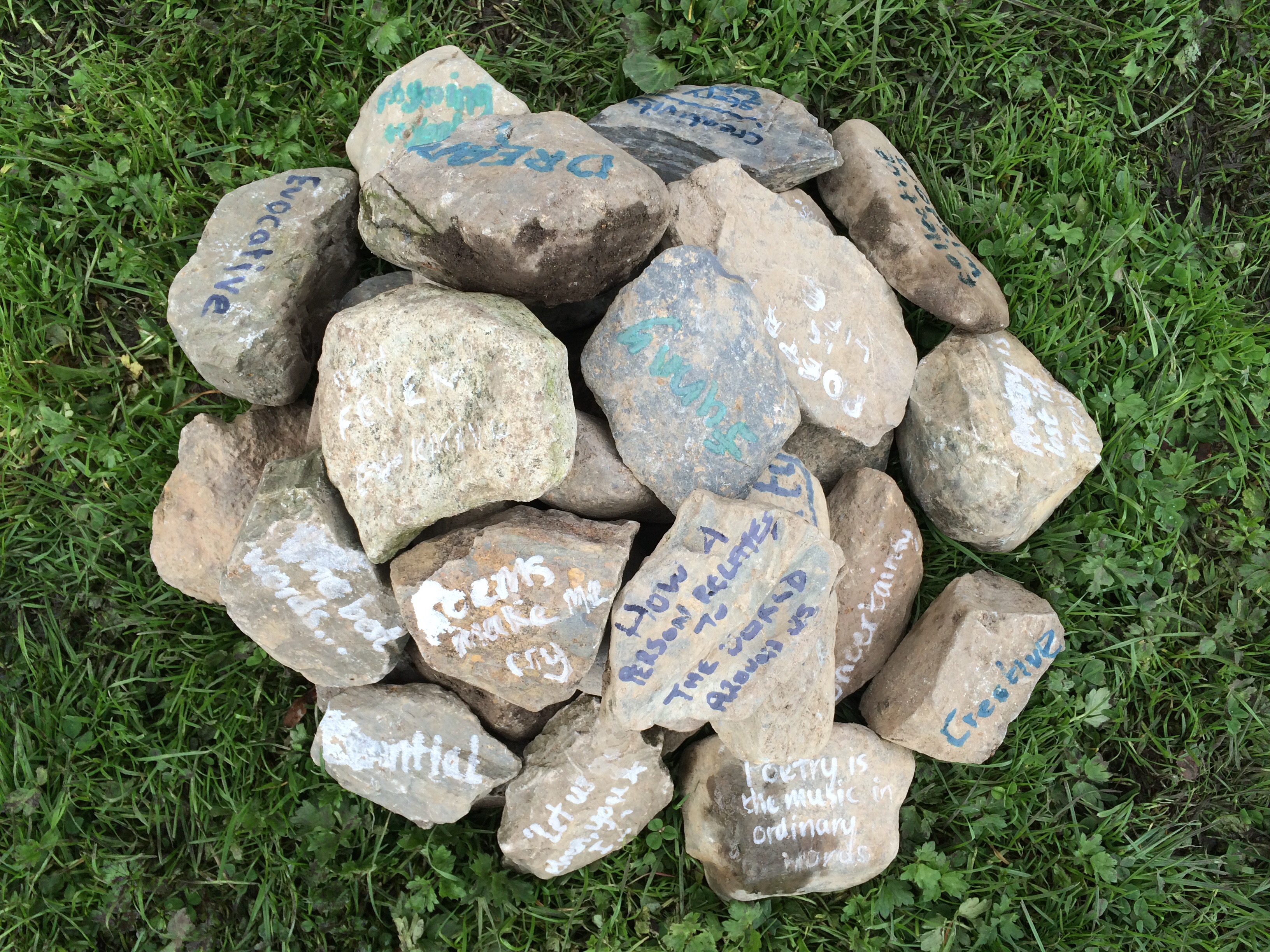
Poetry Cairn, Lakes Alive Festival

I’ve had a couple of performances this month, the first of which was Lakes Alive Festival in Kendal. My performance took place in a giant teepee in the afternoon, but in the morning I created a Poetry Cairn. Over the course of a morning, I invited passers-by to talk to me about poetry. What does poetry mean to you? People were then encouraged to write their answer on a stone and add it to the cairn, so that by the end of the morning, we had built a cultural landscape marker of our own, marking people’s relationships to poetry.

I was also thrilled to be part of a second festival this month, hosting an Adult Youth Club event at Rheged, as part of Eden Arts’ C-Art Festival. Based on the idea that you’re never too old to have fun, the event featured music from Ekobirds and poetry from the fantastic Loud Poets collective, as well as a quiz, and tables strewn with crayons & modelling clay.

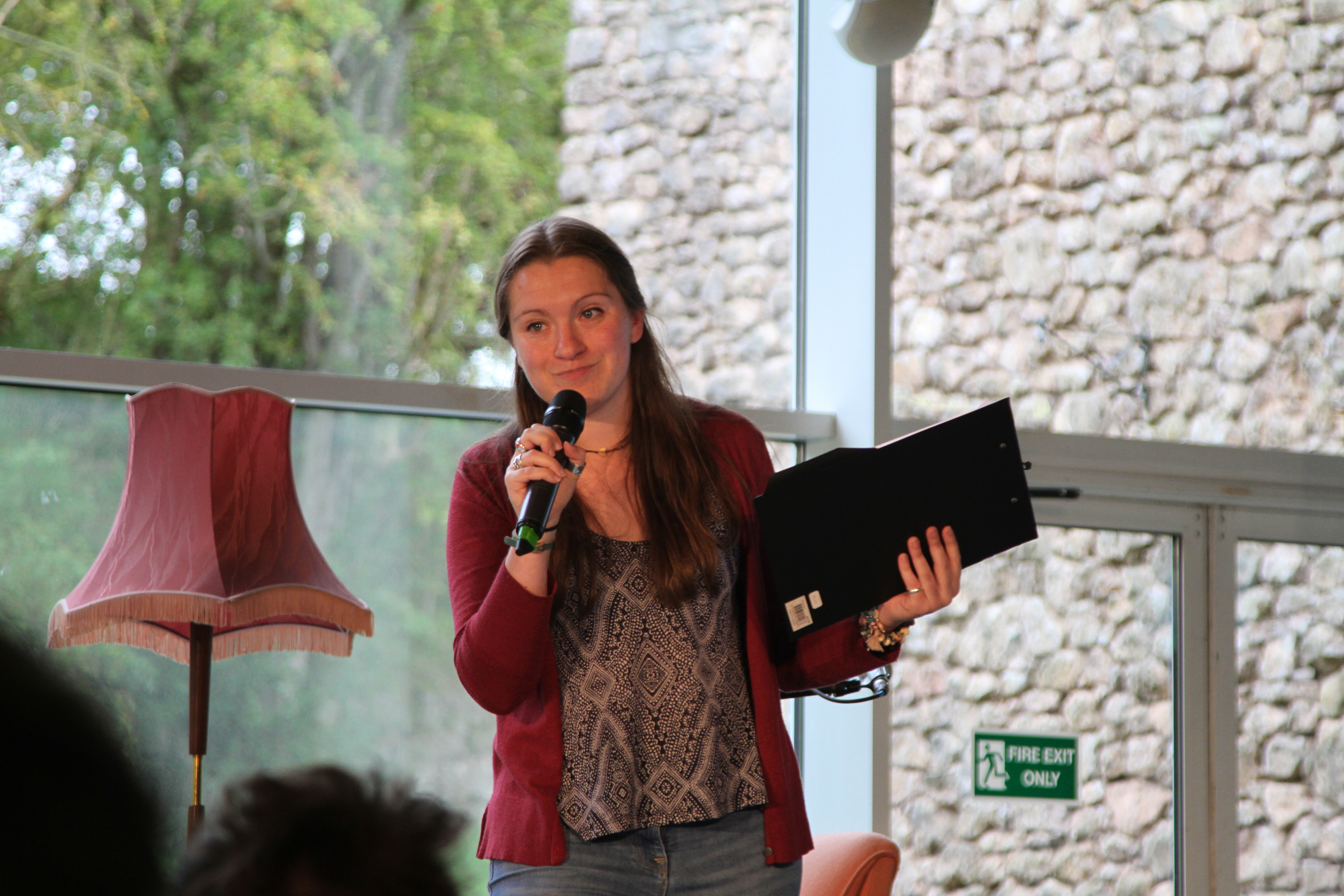
Katie Hale. Photo - Tom Lloydphoto: Tom Lloyd

And continuing on the poetry theme, this month also brought National Poetry Day. This year for National Poetry Day, BBC Local Radio commissioned 12 poets (one from each region) to write a poem based on a local dialect word. The project was called #FreeTheWord, and was run in partnership with the Oxford English Dictionary.

I was selected to represent Cumbria in the project, and wrote a poem based on the verb ‘to twine’ (meaning ‘to moan’ or ‘to complain). The poem is called ‘Ode to Twining’ and you can read it and watch the video here.

Click here to hear the poems from the other BBC regions.

But September has also been a month of fiction. Despite everything else, I’ve also been working on my novel, which is now at the redrafting stage. I think I expected this stage to be easier than writing the first draft. After all, at least I wouldn’t be confronted with the monolithic blank page. But actually I think it’s harder. There’s more pressure when you’re redrafting. Suddenly it starts to matter whether it’s ‘good enough’, whereas before it was just about building up the word count and getting the bones of the story down on the page. Suddenly, I’m having to try to hold the whole novel in my head at once.

But that doesn’t mean it isn’t enjoyable – which is a good thing, as I was worried I’d be less fired up by the manuscript once I’d written how the story ends. Hopefully, this means I’m doing something right. Penguin Random House seem to think so, so that’s encouraging!

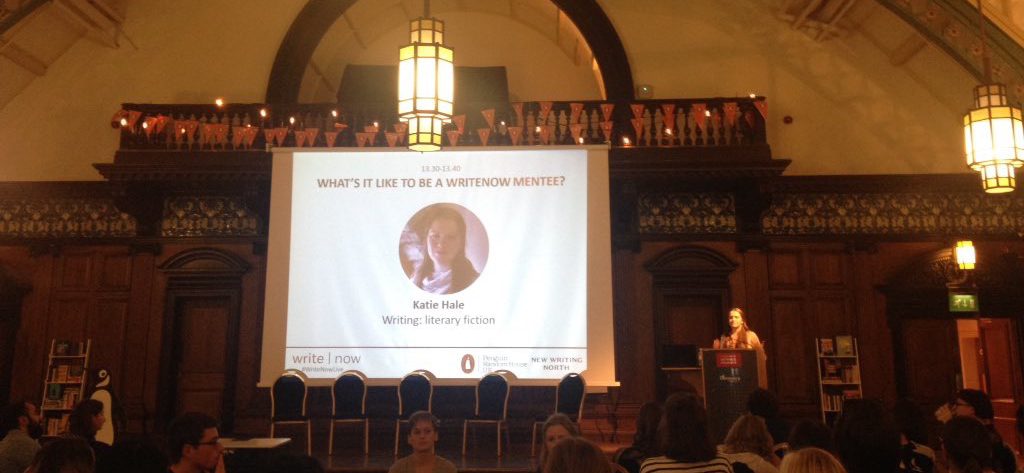
Penguin Random House: WriteNowLive Newcastle

And speaking of PRH… Last weekend I was invited over to Newcastle, to speak at the next round of WriteNow Live insight days. This is part of the shortlisting process of the second year of WriteNow, and as one of the first year’s mentored writers, PRH asked me to go and talk about my experience of the project so far, and the impact it’s had on me. Mainly, I talked about how being accepted on the scheme, and having someone champion my work, has boosted my confidence, and help me overcome those internal barriers to writing the manuscript in the first place. You can read the whole speech here, if you fancy.

Then suddenly September is over, October has arrived, and it’s well and truly autumn. Guess I’ll just have to spend those chilly autumn days snuggled up inside & working on my manuscript!

*

The month in books:

It hasn’t been a bad month for reading, although as always, I wish I could carve out more time for it. Especially now the nights are drawing in; there’s nothing better than curling up by the fire with a mug of hot chocolate and a good book.

  • Urban Myths and Legends (Emma Press anthology)
  • Often I Am Happy, by Jens Christian Grøndahl
  • Russian Roulette, by Anthony Horowitz
  • Good Bones, by Margaret Atwood
  • Imaginary Friends, by Philip Pullman
  • Room, by Emma Donoghue
  • The Power, by Naomi Alderman
  • The Unaccompanied, by Simon Armitage

*

The month in pictures:

Save

Save

Save

Save

Yesterday, I was invited to Penguin Random House’s WriteNow Live event in Newcastle, to talk to 50 of this year’s selected writers about my experience of the mentoring scheme, and what it’s done for me. So today, I thought I’d share the talk I gave:

*

IMG_4519Penguin Random House: WriteNowLive Newcastle, Katie Hale

Back in February, I was sitting in a room in Manchester on my own WriteNow insight day. Like all of you, I was there because I felt there were barriers to seeing my work in print.

Some of the barriers we face are external. I recently went to see a friend’s performance at the Fringe. It was a one woman spoken word show about coming out, set against the history of the secret queer language, Polari. At the end, an audience member (it may or may not be relevant that he was a middle-aged white male) came up to her and said, ‘It’s good, but it’d be better if you took out the gay bits.’

Again and again, we as writers come face to face with this bizarre attitude that straight white men write stories that are universal, but if you’re a ‘marginalised’ writer, you’re only writing for other people within your own group. These are the kinds of trends in publishing, and the external barriers, that WriteNow is working to overcome, and probably the reason that a lot of us are here today.

But we also face internal barriers, and I’d like to talk a bit about mine.

I nearly didn’t apply to WriteNow. I’d had an idea for a novel in my head for a while, but never had the confidence to do anything about it. I wrote poetry, not fiction. I had this notion that writing prose as well would be somehow wrong – like I’d be jumping outside this little box I’d put myself in, and that wasn’t allowed. I also wasn’t sure it’d be any good.

The night before the deadline, I forced myself to sit down and write the opening section of my novel. The next day, I ended up going to a McDonalds to use the wifi, so that I could submit my application just an hour or two before it was due – not because I was disorganised, but because I didn’t have confidence in my own work even to submit it.

But here’s the thing: it wasn’t just my work I didn’t have confidence in – it was myself. So I put all kinds of barriers in my own way, and came up with all kinds of reasons not to apply: I was a poet, not a novelist. I didn’t have what it took to write a longer piece of work. I didn’t know enough about plot, or character, or dialogue. I wasn’t right for the WriteNow programme. I wasn’t writing anything shocking or revelatory about marginalised subcultures. I didn’t ‘look’ gay.

Skip to a few months later, and I was sitting in a room in Manchester with forty-nine other nervous writers. Somehow, miraculously, I’d made it this far, which meant that somebody at least thought my writing wasn’t terrible – although being a writer, I do have an overactive imagination, and there was a small part of my brain that was cooking up all kinds of administrative errors that meant I’d been invited to the insight day by accident. Not true, obviously. Nobody is here by accident – you’re here because you’ve worked hard for it.

I didn’t eat lunch on my insight day – I was too nervous about my one-to-one, which meant I went into it feeling a bit light-headed. As it turned out, I needn’t have worried, because this was when I first met Tom Avery – who I’m going to name-drop because I think he deserves to be named. In that first meeting, Tom gave me such on-point constructive feedback on my work, that it felt right the moment he said it. Half a year on, Tom has given me feedback on the first draft of my manuscript, and I’m rewriting it ready for our next meeting in November. He’s given me new insight into the story I’m telling, but he’s also given me confidence in my novel. It isn’t just confidence that I can write, it’s confidence that I should write.

Because ultimately, WriteNow is about stories. It isn’t about overcoming diversity in some box-ticking photo-opp way. Penguin Random House is a business, not a charity – and it’s a business that relies on individual voices. Our voices. You guys are all here because of your story. You’re here because you can write.

I guess WriteNow has been like school, in a way. There are the things it sets out to teach us, like what publishers mean by certain terms, and how the process of finding an agent works. Then there’s the hidden curriculum: the things you learn along the way.

So I’d like to finish this talk by sharing some of the things I’ve learned from that hidden curriculum, the little pieces of advice I’ve picked up along the way, and I hope they’re useful to you, too.

  1. Eat lunch today. Editors are not scary people – they’re just people with a passion for stories and good writing, and you’re all here because you’re good writers.
  2. If you have a bio that says you’re an ‘aspiring writer’, take out the word ‘aspiring’. If you’re here today, then you’re already a writer.
  3. Never wait till you ‘know enough’ to write a book. I’ve spoken to enough published writers who still don’t feel they ‘know enough’, and the best way to learn is by practising.
  4. Make friends. Make friends in writing groups at home. Make friends with other people here. These guys are your colleagues, not your competition.
  5. Be loud. Don’t sit in a corner apologising for your manuscript. And if you don’t feel confident, that’s ok, because pretend confidence can be just as effective as the real thing.
  6. Have fun. Writing is a long and lonely process. Editing is even tougher. When the grind of the work is getting you down, remember that drive that made you pick up a pen or open your laptop in the first place.
  7. And last but not least, I want to share a piece of encouragement we give each other on our WriteNow mentees Whatsapp group: Deep breath. Keep writing. You’ve got this.

Penguin Random House: WriteNowLive Newcastle

Save

It’s amazing how much time it takes to get back to normal after a month of being away. Especially when that ‘month away’ involves taking a show to Edinburgh Fringe. I’ve been back home about a week and a half now, and I think I’ve finally caught up on sleep, got back to grips with what day of the week it is, and (mostly) responded to the emails stacked up in my inbox.

Edinburgh Fringe was an incredible experience. Although I didn’t get to see as many other shows as I’d imagined I would (the one down-side of having to work on and flyer for your own show), I don’t think I’ve ever felt so steeped in art and creativity. I spent practically the whole month with my head buzzing with ideas and just itching to pick up a pen.

Of course, the month wasn’t without its difficulties. When your director tumbles down Arthur’s Seat and breaks her ankle, or one of your cast members loses her voice, or the mics stop working half way through a show, you have to find a way to rally round. But that’s why it’s so important to have a good team on board. Which, luckily, is exactly what we had.

The Fringe in numbers:

360 tweets
33 stars given
26 performances of The Inevitable Quiet of the Crash
11 cast, band & crew members
7 trains taken
5 flats stayed in
2 awards won
1 ride in the back of an ambulance
1 cello string snapped
100+ coffees drunk

The Inevitable Quiet of the Crash ran at C Royale, 2-27 August 2017.

CAST:

Anna // Emilie Finch
Sally // Amelia Gabriel
Julia // Ellen Timothy

*

BAND:

piano // Peter Shepherd
drums // Chris Cottell
cello // Emily Hill & Susie Lyness

*

CREATIVE:

words // Katie Hale
music // Stephen Hyde
director // Issy Fidderman
musical director // Peter Shepherd
movement director // Nils Behling
lighting // Jennifer Hurd
sound // Nat Davies

*

BEHIND THE SCENES:

production // Edward Armstrong & Anya Boulton
marketing
// Katie Hale & Anya Boulton
trailer // Úna O’Sullivan

Keep an eye out for the future of the show!

Save

Save

Save

With The Inevitable Quiet of the Crash opening in Edinburgh this week, I’m thinking in dramatic terms at the moment. BUT that doesn’t mean that you have to write drama for this prompt. In fact, it’s probably better if you don’t…

This month, it’s all about the detail. It’s about observation and imagination. It’s about exploration on the most minute level.

This month, I’m challenging you to describe the events of a single second.

It’s up to you what happens in that second. It could be nothing much more than you, sitting on the sofa looking out of the window. Or it could be something much more dramatic, like a gunshot or jumping from a diving board.

Whatever moment you choose, try to imagine every single detail of that one action. Think of it like a single second of film.

What is your body doing (or the body of the person in the scene, if it isn’t you). How do the muscles move? What triggers them? Is it a reflex reaction, or the product of long deliberation? Is the action reluctant or keen? Are the limbs heavy, or quick and agile? What’s going through your mind / the character’s mind? It’s surprising how many things a person can think in one second. There are our active thoughts – the things we’re conscious of thinking, that we might narrate in a stream-of-consciousness. Then there are the other more subtle associations. The smell of herbs that half-take us back to that restaurant in Italy; the way the light catches the window, which makes us feel all warm inside. The things we feel without actually thinking them aloud.

Then of course, there’s what’s happening in the rest of the scene. Are the surroundings changing? Is there something happening far away that affects the mood? What happened just before? What’s about to happen next? All these things have an effect on the moment.

So that’s my challenge. Tell the story of a second. The whole story. In a single second.

Good luck!

Five minutes ago it was the end of May. Now it’s nearly the end of July.

When I think about it, it isn’t really suprising that the time’s gone so quickly. After all, it’s been a pretty busy couple of months…

Poetry:

BREAKING THE SURFACE: The main thing in my poetry life is that I’ve launched my pamphlet! Yes, that’s right: I am now the author of a slim volume of poetry which actually has my name on the cover and my poems on the pages in between.

Breaking the Surface officially came out at the end of June, but I sort of jumped the gun on that one, and had the launch on 6th June. Well, I say ‘the launch’ – what I actually mean is the first launch, because I had two.

The first was at Penrith Old Fire Station. I read poems from the pamphlet, alongside two members of Dove Cottage Young Poets, who also performed, and who pretty much stole the show: Hannah Hodgson & Emily Asquith. I say ‘pretty much’ because there was also an open mic, and – more importantly – a buffet. Always a good thing at a poetry event! (Or any event, for that matter…)

The second was in Crosthwaite Village Hall. This was a joint launch with Pauline Yarwood, whose pamphlet, Image Junkie, is published by Wayleave Press.

PRIZES: I’ve also had a lucky couple of months (following on from another lucky couple of month before that). My poem, ‘The Selkie’s Child’, was chosen by Hannah Lowe to win the Ware Poetry Prize. A couple of weeks later, another poem (‘Offcomer’) was shortlisted for the Frogmore Papers Poetry Prize.

Fingers crossed the lucky streak keeps going!

ALSO: As well as prizes & publications, there’ve been quite a few performances. (Alliteration – see what I did there?) Some of these were my own (I had a lovely evening as the guest reader at an open mic night at Cakes & Ale in Carlisle, and a trip to Derby to read for Derby Poetry Group).

Some of the performances, though, were other people’s. In particular, July saw the culmination of a schools project I’ve been working on with New Writing North. This year, I’ve been working with three schools across Cumbria (Barrow Island Primary School, St Bede’s Primary School & Monkwray Junior School), to write poems based on New Writing North’s children’s show, Hey Presto! – which toured libraries at the end of last year. The project culminated in the production of an anthology, called All the Things We Would Pull from a Magic Hat, and performances in Monkwray School and Barrow Library. Seeing the children’s pride in performing their poetry for an audience, and their excitement at having their names in a book, was the perfect end to the project.

Barrow Island Primary School - work with New Writing North and Katie Hale


Fiction:

The fiction has been largely in a ‘thought’ phase over the past few weeks. This isn’t a cop-out of saying that I haven’t been working on it. I have. But so much of a writer’s work goes on in the mind, and that’s what’s been happening with the novel.

In June, I went down to London for my first WriteNow mentoring meeting with my editor at Penguin Random House. It was such a rewarding meeting: to have somebody look at the first draft of the novel in its entirety and really examine what was working and what still needed attention. There was a lot of very encouraging positive feedback. There were a couple of sections that I wasn’t sure about, which Tom (my editor) highighted as needing work, so it was good to have that confirmation.

Generally, it’s left me with a lot to mull over, ready to start reworking the existing draft in the next week or so.

Meanwhile, I’ve been working on…

The Inevitable Quiet of the Crash - a new musical at Edinburgh Fringe 2017, lyrics by Katie Hale & music by Stephen Hyde

Theatre:

The Inevitable Quiet of the Crash opens at Edinburgh Fringe in ijust a few days time! Which means the past 8 weeks have involved a lot of last-minute edits and adjustments as we work towards opening night.

Something fascinating happens when you give your words over to somebody else to work with. Suddenly, the words cease to be yours. Someone else takes them, rolls them around their mouth and delivers them back to the world in a voice that isn’t yours. It’s the closest I’ve been to becoming Frankenstein, literally bringing another human to life.

But of course, working with other people inevitables means changing things. One of the joys of working with actors is that they inhabit the character fully. Of course, this is something I try to do during the writing process, but I’m trying to juggle multiple characters, multiple storylines, and an overarching plot. Whereas for the actor, they focus on the one character and learn to inhabit their skin. They walk in the character’s shoes. They look through the character’s eyes – which means that they spot things that I don’t.

Hence rewrites and revisions.

The result? Hopefully a more rounded and complete show, with truer, deeper characters. Hopefully a successful run at the Fringe!

Find out more about the show and how to get tickets here.

Or read my interview with Gareth Vile, talking about the show here.

*

So all in all, a pretty busy couple of months!

Oh yes, and I also went to Iceland with my friend & fellow writer Jess Rich. (The country, that is – not the frozen food shop.)

Iceland

The months in books:

I haven’t actually read as much as I’d like to these past couple of months – probably because I’ve been so busy writing, travelling, and tying myself up in admin knots. But what I have read has been a good mixture of new works (or at least, new to me) and old favourites.

I’ve particularly enjoyed rereading the Harry Potter series. A few weeks ago, Harry Potter turned 20. So that evening, when I couldn’t sleep, I pulled my tatty, dogeared but very well-read Philosopher’s Stone from the shelf and immersed myself. What fascinated me most was how much more I noticed this time around. I’ve read these books several times; I thought I knew everything they had to offer. But this was the first time I’d read them since starting to write fiction of my own, and suddenly I’d become alive not just to the stories, but to the writing itself. One of the message’s in Alain de Botton’s The Art of Travel (which I also read recently) is that drawing an object helps you to observe and understand that object; it’s the same with writing. Now that I’ve tried to create my own story, I can observe and understand J K Rowling’s writing process in a completely different light.

  • Confabulations, by John Berger
  • Girl Meets Boy, by Ali Smith
  • The Character of Rain, by Amelia Nothomb
  • Harry Potter and the Philosopher’s Stone, by J K Rowling
  • Harry Potter and the Chamber of Secrets, by J K Rowling
  • Harry Potter and the Prisoner of Azkaban, by J K Rowling
  • Harry Potter and the Goblet of Fire, by J K Rowling
  • Harry Potter and the Order of the Phoenix, by J K Rowling
  • Harry Potter and the Half-Blood Prince, by J K Rowling
  • Harry Potter and the Deathly Hallows, by J K Rowling
  • The Fishermen, by Chigozie Obioma
  • The Art of Travel, by Alain de Botton

The months in pictures:

Save

Save

Poetry has a very close relationship to sound. It’s one of the things that sets it apart from prose, which is often read internally; poetry changes so much when it’s performed out loud. With its long association with an oral tradition, with ballads and song, with rhythm, meter and rhyme, the very act of writing poetry becomes an act of engaging with sound.

‘Poetry begins in those situations where the voice has to be raised: the hawker has to make himself heard above the market hubbub, the knife-grinder has to call the cook out into the street, the storyteller has to address a whole village, the bard must command the admiration of the court. The voice has to be raised. And it is raised in rhythm.’ – James Fenton, An Introduction to English Poetry (London: Penguin Books, 2003)

I actually ran a school workshop about poetry and sound just the other week. I was working with my regular group of Yr 4 pupils at St Patrick’s School in Workington, where we looked at John Clare’s poem, ‘Pleasant Sounds’. We talked about Clare’s use of ‘sound words’ (such as ‘pattering’ and ‘whizzing’), and about how some of the sound words he used were unexpected, like ‘flirt’ and ‘halloos’. Then the children thought about a favourite place, and wrote about all the different sounds they could hear in that place.

Which brings me onto this month’s challenge:

Write about the next sound you hear.

It could be a large sound, or a very small one. Whatever it is, I want you to focus on it. Describe it in as much detail as you can.

Start by describing the sound itself – what are the best words for the sound you can hear? Is it loud or quiet? Does it invade your ears, or do you really have to strain to hear it? Is it continuous, or short and sharp like a puncture?

Then expand the picture out from there. What’s making the sound? Can you see it? What does it look like? Whatever’s making it: does it change as it makes the sound? How does it affect the other sounds around it? How does it affect you? Does it remind you of something else? Another time you heard it, perhaps, or something else that makes a similar noise?

The trick with this exercise is focus. Focus all your energy and attention on that one sound, and let the detail fill the words.

As always, I’d love to see the results. Good luck, and happy writing!

After a month of writing very little while travelling around Cambodia & Vietnam, May has been full on. Honestly, since landing at Manchester airport at the end of April, I don’t think I’ve stopped.

Finding time to write in London

After the Ballymaloe International Poetry Prize’s award ceremony in Dublin, and the South Downs Poetry Festival weekend residential over the bank holiday weekend, May got into full swing with a couple of days hanging out on London’s Southbank and writing, as well as seeing ‘Consent’ at the National Theatre, and drinking wine with friends (always important).

From there, I headed up to Cambridge for the Jane Martin Poetry Prize award ceremony, held at Girton College. Judged this year by Grevel Lindop & Malcom Guite, the Jane Martin Poetry Prize is awarded annually to a poet under 30, for a group of up to four poems – and this year, I was lucky enough to win it. It was a really fun evening, with the award ceremony taking place in the old library, followed by a delicious formal hall dinner. I spent the night in the college, then headed home the next day.

Which was a good thing, because while I’ve been at home, there have been progressions with all three of my big current projects:

Poetry: This month I wrote a couple of new poems, but more importantly: I proofed my pamphlet. It was an odd (but satisfying) experience, seeing the printer’s proof arrive in my inbox – like spending years growing & nurturing a tree, then coming out of the house one day to find it suddenly in bloom. But that blossom will be turning into something even more substantial this week, as the pamphlet itself finally arrives, ready for the big launch on Friday. Very exciting!

Novel: A huge one this month, as I’ve finally finished the first draft of the novel! Which means that I actually got to the end, with no gaps in the middle which just say ‘write something here’. It may be messy, but it’s still a full complete draft. At that moment, when I plugged my laptop into the printer and pressed ‘print’, I was so excited I actually wriggled – like Christmas Eve when I was a child, and I couldn’t sleep for wriggling. Now, I just need to edit it. (I say ‘just’…) I have my first one-to-one with my wonderful editor on the Penguin Random House WriteNow scheme, Tom, in a couple of weeks, and after that I’ll have a better idea of how to move forward with the manuscript. But still: exciting times!

Musical: I’ve done very little actual work on the musical this month – and what I have done has only been in the past week, as we start to look at shaping this draft up into its ‘finished’ form, ready to workshop it with the cast next month. BUT that doesn’t mean nothing has been happening, because tickets for the musical (called The Inevitable Quiet of the Crash and co-written with composer Stephen Hyde) went on sale! The show runs 2nd – 26th August 2017, at the Edinburgh Fringe, and you can book your tickets nicely in advance here.

And that’s pretty much been my life this month! Lots of writing. Not a lot of sleep. Ah well. Maybe June will be a bit more relaxed…? (I doubt it.)

The month in pictures:

Save

Save

Until very recently, I was an unbeliever. I’m not talking about religion or magic or the supernatural – I’m talking about writers’ block. If you’d asked me a year ago, I’d have said there was no such thing. I thought it was all a figment of the imagination.

Then it came for me.

In some ways, I stand by what I said: it is all in the mind. But: ‘Of course it’s all in your head. But that doesn’t mean it isn’t real.’ (Thanks, Dumbledore.)

The way I see it, there are two types of writers’ block, each with their own different cure.

TYPE ONE:

The Easy Type

I’ve met so many people who tell me they have trouble writing. When I ask them how often they write, the answer is often something along the lines of: ‘I’m not writing at the moment, I’m looking for inspiration.’

‘Inspiration exists, but it has to find you working.’ – Pablo Picasso

Here’s the thing: writing is hard. You’re reaching into the mysterious parts of your soul, pulling out what you find and attempting to wrestle it onto a page. You’re pulling something fragile out into the open. Naturally, the body tries to put up defences.

‘The easiest thing to do on earth is not write.’ – William Goldman

Writing can be mentally and emotionally draining. It’s so much easier to check facebook, or binge watch a TV show, or do the dishes, or check our emails, or cook an elaborate dinner, or any of the other things we do to avoid actually sitting down and writing.

This procrastination can be a manifestation of many things: fear of getting it wrong; laziness; taking the easy road; an uncertainty about the work; embarrassment; worry about not living up to other people’s expectations…

For all of these, there’s one very simple cure:

Make the time to sit down and write.

An hour. Two hours. Three. It’s up to you, just as long as you go to your writing space and stay there. Don’t get up and dust the top of the kitchen cupboards. Don’t tweet. Leave the list of household chores somewhere where you can’t see it.

If nothing comes, write about how you can’t think of anything to write. Repeat this routine every day, or every couple of days, as often as you can. If you turn up to work, then eventually the inspiration will as well.

writing prompt - Katie Hale

TYPE TWO:

The Tricky Type

What makes Type One easy to cure is that the cure is physical. You get yourself into your writing space and something will eventually turn up. Type Two is so tricky because the cure isn’t physical. It’s a purely mental battle, and that’s much harder to fight.

This is the type of writers’ block I didn’t realise existed, until about a year ago. Because sometimes, it isn’t just laziness or a fear of creating the work that blocks us. Sometimes, there’s a much deeper problem.

I’m talking about things that go beyond the work itself. Big things. Things like grief for a loved one. Anxiety. Depression. A big upheaval. Some sort of earthquake that shakes the foundation of our lives.

Something like this isn’t always a block. Sometimes, it can draw the work out of us and turn the creativity into a therapeutic process. But often, this therapeutic creativity comes later. Initially, there’s a block.

This block can’t always be solved by just turning up to the writing station. Often, solving the root problem has to come first. There’s no easy way to do that. Anyone who has ever suffered from any form of mental health issue will know that it’s a complicated process – one that takes time and patience and a lot of self-acceptance – and that ‘solving’ is often a misnomer anyway.

And often, once the root problem is addressed, or at least accepted, the writing will start to flow again. Not always, but for me, this can help. (Of course, at this stage, you still need to turn up to the desk…)

Good luck, and happy writing!

Poetry can be about anything. In many ways, that’s a huge advantage. It gives you freedom to explore any subject that interests you, and to view it through whatever frame seems appropriate. As I like to tell children in my schools workshops, there are no rules in poetry.

But all those options can be a little bit daunting. You know that feeling when you’re looking at a menu and there’s too much to choose from, it’s overwhelming, and suddenly you don’t want to eat anything at all? Sometimes I feel a bit like that about poetry.

So I thought I’d create a prompt that restricts that slightly.

Your goal? To write about something blue.

It can be anything you like – big, small, bright blue, sky blue, azure, navy… Maybe a poem about a shallow coral sea, or the depths of the Pacific. Perhaps the sky on a summer day, or a swimming pool in a fancy hotel. Or maybe it’s a smaller object: a blue bottle, a favourite pair of denim dungarees, bathroom tiles. Perhaps you want to write about blueness in the figurative sense, about being blue, or playing the blues.

Whatever you choose, start with the object and its blueness. Continue writing from there, and see where the poem takes you.

As always, I’d love to see anything you come up with.

Good luck, and happy writing!

Another month – how do they go so quickly?

March always feels as if it should be a month of waking up. It’s when nature really kicks into gear at the end of a long winter. The nights are lighter, I can ditch the heavy winter coat, and there are daffodils in the jug on my windowsill. Oh, and lambs in the field. One of my favourite things about spring, and one of the joys of living in the country: getting to see the lambs skipping and playing in the fields around the house.

Of course, it isn’t just about flowers or adorable farmyard animals. It’s also (like every month) about writing.

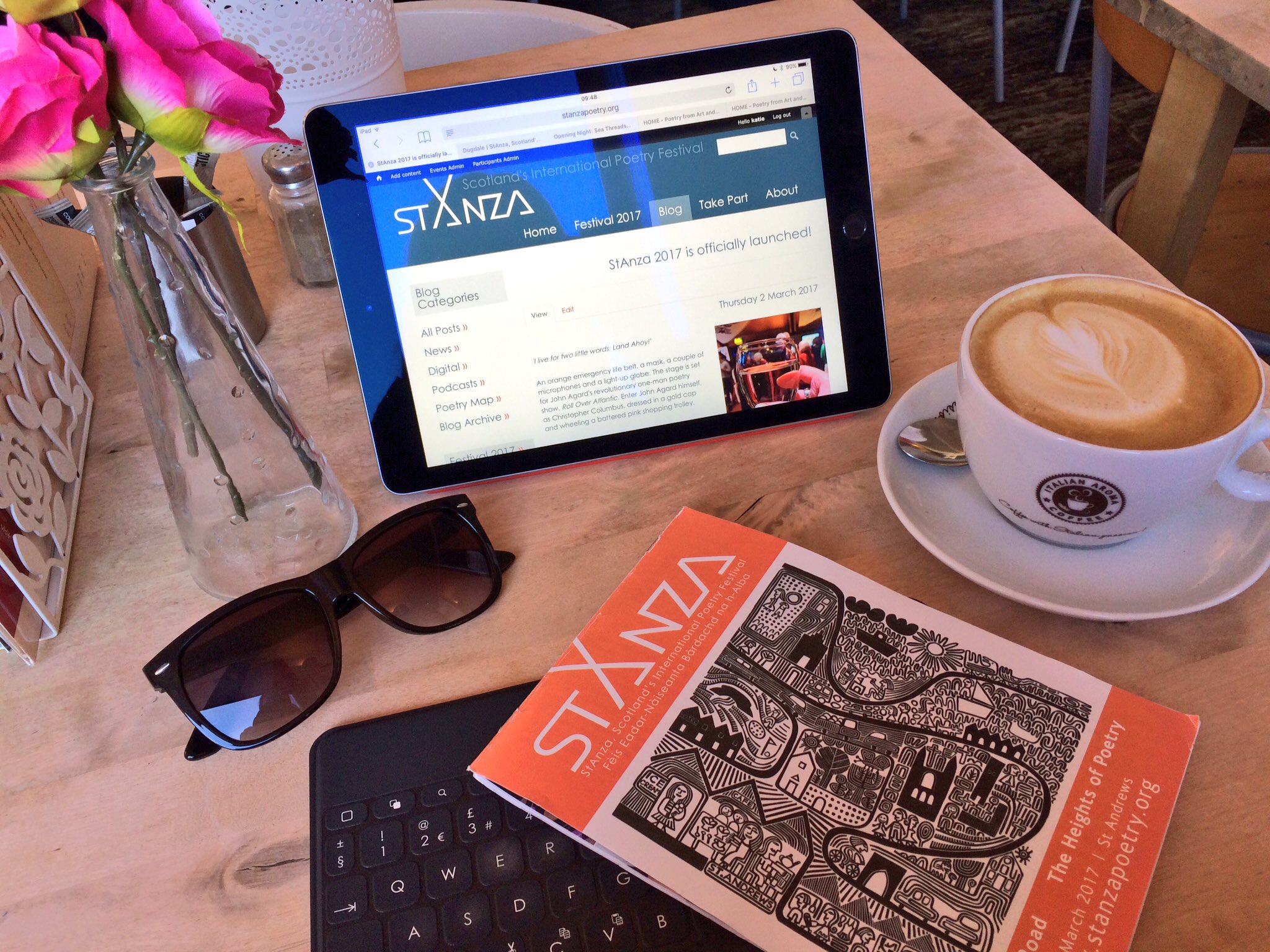
And I couldn’t have asked for a better start to the month. At the beginning of March, a whole host of poets & poetry lovers make their annual pilgrimage to St Andrews in Fife, for one of the best poetry festivals around: StAnza. I first went to StAnza during my MLitt year at St Andrews, when I volunteered as a Participant Liaison Officer, looking after poets & speakers, and taking them to and from the venue (or ‘PL-ing’, as it’s known by regular festival volunteers).

This year was my third StAnza, and as wellas PL-ing, I was also the festival’s in-house blogger. This meant writing a blog post each day about what had happened at the festival the day before. In some ways, this was quite a challenge, as there was pressure to write something (and something interesting, too) every day. I couldn’t just switch off for a day. But the flip-side of that was that it made me focus. During every event, I was concentrating, making notes, making sure I had something to say about it for the blog. Which meant that I probably took in more from the festival than normal – which is saying a lot, because I usually come away with my head stuffed full of thoughts & words & ideas.

Since I first volunteered there in 2013, the festival has really become a kind of family. It’s such an inspiring week, and has become a highlight of my social and creative calendar.

Read my StAnza blog posts here:

StAnza blog post writing

At the end of February, I learned I’d been selected for Penguin Random House’s Write Now mentoring scheme. In March, Penguin Random House publicly announced the list of mentees, which was exciting, and pretty much wholly occupied my twitter stream for a while. The actual mentoring process hasn’t started yet, but already it’s pushed me to write more of the manuscript, which can only be a good thing.

Poetry-wise it’s been a month of successes, too.

This month, the shortlist for the Ballymaloe International Poetry Prize was announced. There are four writers shortlisted, and this year, my poem was one of them! Now I need to figure out what to wear for the prizegiving next month…

And, as if that wasn’t enough, the following week I received second prize in the Tannahill Poetry Prize, based in Scotland. We went up to Lochwinnoch for the prizegiving evening – me & my fan club (aka parents). It was an evening of music, courtesy of local folk duo Witches Brew, and poetry, from the other prizewinning writers and from judge Sally Evans. Cue a bit of a Cumbrian takeover, by both myself and Kathleen Jones (who won the third prize & is also a Cumbrian poet).

I’ve also delivered a few schools’ workshops this month, for New Writing North and the Wordsworth Trust – including one at Dove Cottage, which is always good fun. (Although sometimes it feels as though you’re writing with Wordsworth looking over your shoulder.)

Mostly, this month just feels as though it’s flown by. Like the writing time has just disappeared in a whirlwind of everything else happening. Which is maybe a good thing. Sometimes I think that I need a break from writing. Creativity is a muscle, and while it’s good to exercise that muscle, it can also get overworked. Sometimes I just think I need to give the writing muscles a break.

*

THE MONTH IN BOOKS:

This month has been a fairly quiet one for reading, with only two books (though numerous individual poems – too many to list here). Part of this is that I simply haven’t made enough time for reading. Part of it is that I think my brain is starting to feel saturated, clogged up with words. But that’s fine – I have a break coming up very soon… (But shhh. Spoilers.)

This month’s two books are:

  • The Idle Traveller, by Dan Kieran
  • The Quiet American, by Graham Greene

THE MONTH IN PICTURES:

Last week, I made my annual trip north to StAnza International Poetry Festival. This was my third festival volunteering for StAnza, and as well as my usual job of looking after poets, I had the responsibility of being the festival’s in-house blogger.

Amongst all the wonderful talks and readings and performances, there was one event that stood out as being not about the art (at least, not in its purest form), but about the practicalities of making that art pay.

‘Making a Living as a Poet’ was an event sponsored by the Society of Authors. Chaired by Ken Cockburn, poets Sarah Hesketh and Harry Giles talked about how to make money from being a poet – although, as Harry qualified, ‘You can make a living from poetry, but it’s a crap living.’ 

That aside, I thought I’d share with you some of the wisdom learned during that event.

Reading April De Angelis, 'Playhouse Creatures'
April De Angelis, ‘Playhouse Creatures’

HOW TO MAKE A LIVING AS A POET:

  • Find cheap rent. Poetry doesn’t pay well. Unless you have some uncanny luck or you’ve made a deal with the devil to bag a big prize every couple of months, you’re not going to make it onto the Forbes rich list through writing poems. So living somewhere where the rent is a bit cheaper, and living costs are more affordable, is going to be vital.
  • Turn up to stuff. Like so many fields of work, poetry and writing are all about making connections. I don’t mean this in a kind of ‘old boys’ way, but if someone recognises your name on an application, it’s a good start. If you get to know people, they’re more likely to think of you when it comes to work. This goes for organisations, arts councils, collaborations with other artists… The good thing is that poetry networking isn’t nearly as scary as big business networking; it isn’t about striding into a room in a sharp suit, killer heels and blood-red lipstick, then bowling everyone over with with that cut-throat marketing pitch. It’s actually just about hanging out with other lovely artsy people and having interesting conversations.
  • Say yes to everything. Become known as the person who will do the work, rather than the person who refuses the work. Sarah Hesketh started the event by saying that, by accepting any work she could in the field of literature, there’s now ‘a touch of poetry’ on everything she does. Or, as Harry Giles said: you can’t get a full-time job just making art, but you can stitch together enough arts jobs to almost make a living.
  • Be nice. People don’t re-employ people who are rude to them. It’s just common sense.
  • Be professional. Same thing. If you never meet deadlines, or you constantly bitch about your colleagues (which will get back to them – it’s a small world), or you don’t do the work you’ve agreed to do, then people are unlikely to come back to you when the next employment opportunity comes around.
  • Seek out funding. Don’t wait for the work to come to you. Go out and find it. A couple of people seemed surprised by this – isn’t it pushy to ask for work / funding when it hasn’t been offered? But let’s use a more quotidien analogy: grocery shopping. Let’s say you’ve run out of food. Your cupboards are empty, there’s nothing but that mouldy bit of cheddar at the back of the fridge, and all you have in your freezer is half a bag of frozen peas. There are two options. Option 1: sit at your kitchen table twiddling your thumbs and hope someone knocks on your door with a trolley-full of food. Option 2: go to the supermarket and do some food shopping. Obviously, the most obvious and effective of these is option 2. You go out and get some food. It’s the same with work and funding. Instead of waiting for someone to come along and offer you a residency, get in touch with the organisation where you’d like to be poet-in-residence and work together to put together a funding bid. Instead of wishing someone would pay you just to write poems, apply for PhD funding: 3 years of effectively being paid to write a collection of poems. Of course, this all means more admin, but as Harry put it: ‘Making art is also the amin of making art.’ Which brings me onto…
  • Do an apprenticeship. As with any industry, you need to learn how it operates, and have the skills to operate within it. Sarah Hesketh spent a few years working for small arts organisations, in the kind of admin role where she learned how to do everything: events planning; marketing; press releases; funding bids; working with artists; evaluation… All the arts admin skills you need to operate as an individual artist. Of course, this isn’t everybody’s cup of tea. Some artists can’t think of anything worse than having to spend half (or even most) of their day doing admin. Which is fine. There are plenty of other ways to support your writing. Get a job in a cafe or a bar. Work in a funeral parlour. Drive an ice cream van. As long as you’re doing something that you enjoy and that still leaves you at least some time for the writing, then that’s fine. Living as a writer can be as individual as the writing itself.
  • Don’t rely on publishing a book as a way of getting rich. Harry Giles: ‘You make beer money publishing a book. Think about a book as a business card.’ The sad fact is that you don’t get 6-figure advances for poetry. Most books and pamphlets are published by small independent presses and a run of 500 is generally considered pretty good going. So just because you’ve got a book- or pamphlet-deal, it doesn’t mean you can’t start shopping for a luxury yacht. Although the actual writing of poems may be the biggest thing in terms of importance, it’s probably going to be the smallest in terms of actual financial income. But…
  • Make really good art. Although it might not make much money in and of itself, it’s still important that you write really good poems. If you’re applying for residencies or academic positions or running poetry workshops, then the people you’re teaching or applying to will want to know you’re competent in your art form. It isn’t a financial goldmine, but it’s still the thing around which all the rest of your work centres. Which is good, because the poetry is probably the reason you’re doing all this in the first place.

Other than that, just keep your fingers crossed you win something big, like the National Poetry Competition. There’s always an element of luck in life – do you meet the right person who’s going to love and champion your work, or do you write that poem which happens to speak to the personal experience of the editor selecting work for a magazine? But the more you go to things and meet people and put your work out and apply for opportunities and get involved, the greater the chance of those things happening.

The more nets you throw out, the more chance you have of catching a fish.

Read why I’m aiming for 100 literary rejections this year.

January always feels like an odd month to me. It seems to take ages to get going, and then before you know it, it’s almost over. Cue a frantic rush to get up to date on all the things I should have been doing at the start of the month. Oops.

That aside, January is always a month of beginnings. It’s a month of testing myself, to see how closely I can stick to my newly made resolutions. So far, it’s been a bit of a mix.

  • I haven’t got particularly far with my 100 rejections – although I did send some poems out the other day, so maybe there’ll be some on their way shortly.
  • I’ve read 4 books, so I guess I’m kind on track to my 50 by the end of the year.
  • So far, I’m keeping up with my weekly blog posts, so that’s a big tick on the resolutions list.
  • As for the novella, I’m now officially over half way through the first draft of this, so this one is looking fairly promising.

Sometimes when you travel, it's easy to forget how beautiful it is at home.

But how has it gone apart from that?

Mostly, I’ve been trying to get back into some sort of routine. Before Christmas, I had about 3 weeks of being in this fantastic routine that was probably one of the most productive of my life: get up before 7am, write all morning, sometimes go for a walk / run, do admin in the afternoon, relax / read / make Christmas decorations in the evenings. Then Christmas happened and that sort of went by the wayside. Now, I’m getting into a kind of routine, which isn’t really the one I want. It seems to be: get up late, mooch around trying to write, fail, read a book to pass the time, finally manage to write something that’s halfway decent by about dinner time, do some frantic admin, clamber into bed at around 1am.

Luckily, I’ve spent the past week with Stephen, working on the rewrites of our musical – and there’s nothing like another person to make you get your act together and get working, so it’s been a productive week. Keeping my fingers crossed that that productivity follows me into February.

In other news:

I had a great weekend in London with the lovely Elizabeth Mann, at the T S Eliot readings (and spending far too much time & money in the city’s various bookshops). It was such an inspiring occasion – and a huge congratulations to Jacob Polley on his win!

January’s Word Mess open mic night was one of the busiest we’ve had, with a fantastic variety of readers. (The next one will be on Tuesday 28th February.)

I started 2 new blog series: a monthly writing prompt, starting with a prompt about beginnings; and Face to Face, series of short conversations I’ll be having every month, talking to interesting people about the things that interest them. So far, so good! 🙂

I’ve started my schools workshops again. One of my personal favourites was looking at riddles & kennings with my Yr 4s at St Patrick’s Primary in Workington. Their special topic is currently the arctic, so we wrote some arctic-themed riddles. Any guesses…?

I am a ship-sinker.
I am a crack-maker.
I am a wave-breaker.
What am I?

*

I am a birth-giver.
I am a snow-hunter.
I am a seal-eater.
I am a den-sleeper.
What am I?

*

I am a cookie-eater.
I am a toy-maker.
I am a milk-drinker.
I am a sleigh-driver.
I am a chimney-climber.
I am an elf-checker.
I am a beard-grower.
What am I?

Looking forward to going back there this month to work more on description & close observation.

THE MONTH IN BOOKS:

  • All We Shall Know, by Donal Ryan
  • The Handmaid’s Tale, by Margaret Atwood
  • Anthology of the Sea (Emma Press)
  • Reasons to Stay Alive, by Matt Haig

Currently reading: The Art of Travel, by Alain de Botton, and Human Acts, by Han Kang

THE MONTH IN PICTURES:

Series 1, Episode 1: Supal Desai

Ever notice how most of our interaction is now via phone, or messenger, or email, or skype? At least, it sometimes seems that way for me.

Face to Face is a new series of short conversations I’ll be having every month, talking to interesting people about the things that interest them. We’ll be chatting over cups of tea & pieces of cake, in my kitchen or wherever there’s a chance to stop and swap thoughts.

Phones down. Screens closed. Talking face to face.

S1 E1: In this first episode, I chat to Supal Desai about blogging and the creative process of writing a blog post.

Supal is the founder of a business risk consultancy based in London and the blogger behind the travel lifestyle blog, chevrons & éclairs. Her ideal Sunday would find her starting the morning in bed with a good book, newspaper or a cuddle, and then making brunch alongside music and endless cups of coffee. Her love for culture, art and history has taken her to the most exotic parts of the world, where she uses that opportunity to curate content that tells a story through fashion and food editorials.

So where do I come in?

I first met Supal in my friend’s kitchen, during our Masters year at St Andrews. She was cooking up something delicious-looking, and I was trying to convince her that haggis were little creatures that lived in the mountains.

Four and a half years later, we’re here:

I’ve never been very good at new year’s resolutions. Or rather, I think I’m good at them in the same way that everyone else is good at them: for about 3 weeks in January, and then letting them fall by the wayside for the rest of the year.

But this year, I’m making a number of them, and I’m determined to still remember what they were this time next year. Even more, I’m determined to achieve them, so that next year I have to come up with some new ones.

poetry definitions - Katie Hale
^ I guess I could aim not to be a ‘poetaster’…?

If 2016 has been the year of celebrity deaths & surprise election results, then I’m intending to make 2017 the year of writing-in-numbers (as distinct from writing-by-numbers, which is not to be encouraged).

And those numbers are: 100, 50 and 1

*

RESOLUTION NUMBER 1:

Inspired by Kim Liao’s article back in June, I’m aiming for 100 literary rejections.

This is the one resolution that I actually don’t mind whether I achieve it or not. The idea is that aiming for rejections is less daunting than aiming for acceptances, so you’re more likely to bite the bullet and submit in the first place.

And 100 is such a big number that it forces you to think outside the box and submit to opportunities that you wouldn’t normally consider inside your comfort zone. Given that this is exactly how I got my place on Penguin’s WriteNow insight day in Manchester for February 2017, it’s something I already believe in: apply for opportunities, as you never know where that opportunity may lead.

(Obviously, if I somehow miraculously achieve 100 acceptances instead of 100 rejections, I think I’ll get over the fact that I didn’t tick off the resolution itself.)

new year writing resolutions: Katie Hale

RESOLUTION NUMBER 2:

As always, I’m aiming to read 50 books in 2017.

This is always my resolution (at roughly one a week, I see no reason why I shouldn’t be able to achieve this). In 2016 I read 57 books, and I’d quite like to read more this coming year. After all, reading is the key to writing.

As for what I’ll be reading, I already have a few books lined up – thanks in part to a late December splurge at the New Hedgehog Bookshop in Penrith. And then I’d like to read some of the poetry & fiction that’s been waiting patiently on my shelves, as well as building a bigger library of contemporary plays. And with StAnza in March and Kendal Poetry Festival in June, I’m pretty sure there’ll be plenty of new poetry to tempt me.

*

RESOLUTION NUMBER 3:

To write 50 blog posts for this blog.

Really, I’m going for one a week, but 50 is a nicer number than 52, and it gives me a little bit of wiggle room.

Some of these will be writing updates, some will be actualy pieces of writing (from me and hopefully also from some of my schools workshops), and some will probably just be a bit of fun.

I’m also planning to post a monthly writing prompt, on the first Sunday of every month. When I was running my young writers’ group, I used to email the young writers a prompt every week – so I thought I’d continue the tradition, but on a slightly less frequent basis. After all, I’m not Jo Bell.

script writing for theatre - Katie Hale

RESOLUTION NUMBER 4:

To take 1 show to the Fringe.

But more on that in the new year, hopefully. Spoilers!

*

RESOLUTION NUMBER 5:

To finish at least 1 draft of the novella.

1 draft. 1 very very rough and probably unfit-for-human-consumption draft.

Actually, I’m hoping to have this completed by the end of February, so really there’s no reason not to complete several drafts of it in the months that follow. At least, that’s the plan. But other things always crop up – and yes, Stephen, if you’re reading this, don’t worry: I will also be working on the rewrite of Yesterday during this time. Just hoping that old stereotype about women being good at multi-tasking proves to be true!

typewriter - Katie Hale

So there are my 5 new year’s resolutions for 2017.

2016 has felt a lot like finding my feet as a full-time writer. I’m hoping that 2017 is when I’ll really start to run.

*

Happy New Year!  🙂

Save

My Writing Life: Weeks 10 & 11

A fortnight of updates this week – which is my way of skirting round the issue of not posting last weekend. Largely becauuse of the hearty poetry overdose mentioned above.

The fortnight in numbers:

  • 1 completed draft of a play script
  • 1 funding application submitted
  • 1 review written for Words by the Water
  • 2 festivals (StAnza Poetry Festival & Words by the Water)
  • 3 strolls along the St Andrews sea front
  • 4 bookshops visited (including a beautiful new one in St Andrews)
  • 5 prompts written for my young writers
  • 6 books read / partly read
  • 8 trips to various St Andrews cafes
  • 9 teddy bears donated for an upcoming project
  • 16 new books acquired (oops!)
  • 35 (ish) events worked on / attended
  • Countless coffees / teas / chai lattes drunk

Hence only 1 blog post.

St Andrews castle & Castle Sands beach

Over the past two weeks, I’ve attended two festivals. I volunteered at StAnza Poetry Festival (St Andrews, Fife), and then received a young person’s bursary to attend Words by the Water in Keswick. (I’m going to miss being a ‘young person’ once I turn 26. Goodbye rail discounts and cheap theatre tickets. Hello adulthood.)

StAnza was a wonderful whirlwind of poetry. I counted up from the brochure, and I think I attended and / or worked on around 25 poetry events over 5 days. Poets from Jo Bell, to Don Patterson, to Lemn Sissay, to Sean O’Brien, to Matthew Sweeney, to Em Strang, to Fiona Benson… The list goes on and on.

Words by the Water was slightly less hectic: only 10 events, and I was only attending those, rather than working on them. I was also lucky enough at Words by the Water that one of my bursary tickets was for James Rebanks’ talk, which was completely packed. I think every single seat in the house was taken – which is around 500 seats. (I wrote a review of this event, as part of my bursary agreement. Hoping it should be on the Words by the Water website in the not-too-distant future.)

We also had a film showing at Penrith Old Fire Station this week: This Changes Everything, followed by a discussion about climate change (which got quite heated, ironically).

Other highlights of the fortnight? I completed a draft and a redraft of my play! I also discovered a lovely new bookshop in St Andrews, where there are sliding ladders to reach the top shelves and they give you a cup of tea while you’re browsing.

The week in books: week 10

The week(s) in books:

  • Joshua Levine, Forgotten Voices of the Blitz and the Battle for Brittain
  • Joshua Levine, The Secret History of the Blitz
  • Caroline Moorhead, Village of Secrets: Defying the Nazis in Vichy France
  • James Rebanks, The Shepherd’s Life
  • David Hare, Amy’s View
  • [currently reading:] Margaret Atwood, The Blind Assassin

An unusual amount of non-fiction recently. Partly because I’ve rediscovered the joys of research (seriously: finding stuff out can be so much fun!) and partly because I’ve been wanting to read James Rebanks’ book for ages, and it’s just come out in paperback (much more affordable than hardback)!

I was also lucky enough to see David Hare speak at Words by the Water, so raided a second-hand bookshop any came out with Amy’s View – now signed by the author.

As for The Blind Assassin: it’s been on my bookshelf for years, so I thought it was high time I actually read it. Only on about page 200, but so far hugely enjoying it.

The week in books: week 11 - David Hare / James Rebanks / Margaret Atwood
The week in books: week 11

The week(s) in pictures:

My Writing Life: Week 9

Posting a day later than usual this week, due to a slightly hectic Sunday. (For ‘hectic’, read: writing a scene of a play, completing two funding applications and working on the bar at Box of Tricks’ Theatre Company’s show, Chip Shop Chips.)

IMG_0095

Which pretty much sums up the whole week, really. In the best possible way.

As well as the Sunday madness mentioned above, this week has seen: a meeting in Kendal for some work I’m doing with Curious Minds (through New Writing Cumbria) – followed by a chai latte at one of my favourite Kendal Coffee shops, Brew Brothers; a comedy night at Penrith Old Fire Station to raise money for Cumbria Flood Appeal, ft. Rory Bremner, Justin Moorhouse, Fred MacAulay and Wendy Wason; a trip to Penrith’s independent cinema to see the NT Live broadcast of the National Theatre’s As You Like It; a very successful meeting at Clifton Primary School to talk about Arts Award; a trip to Carlisle to visit Prism Arts’ Creative Arts & Conversation group; cooking this week’s communal lunch at Eden Arts; writing a couple of new scenes of a play; and another funding application.

Phew!

And you know what it’s made me realise? That I don’t do enough.

No, I don’t mean that in terms of work. In terms of work, I don’t really stop. This is because I’ve spent several years cramming all of my writing and my freelance work into my spare time. So now, having freed up a lot more time for writing and freelance work, I should have lots more spare time. All that time that used to be writing time should now be free.

But there’s a problem: I no longer know how to spend free time.

I know that sounds stupid. But seriously: I had a couple of hours the other day and I seriously couldn’t work out what to do with them. It’s like I’ve forgotten what to do with time that isn’t spent reading or writing.

So that’s one of my targets: to reclaim my free time. More particularly, to reclaim my weekends. (Getting out of bed on a Monday morning is so much harder when you’ve just spent the whole of Sunday working flat out.)

I’m not quite sure what I’m going to do with this free time that I’m determined to make. Something non-word-based. Maybe something outdoors-based? I think I’d like to get back into photography. And maybe do more crafting as well – something I’ve done very little of so far in 2016.

But something that doesn’t let me suffer from creative burnout.

Watch this space!

The week in pictures:

My Writing Life: Week 7

You know those weeks where you think you’ll take it easy and focus on one thing, then by the end of it, you’ve created two new arts projects, drafted three new poems, written 25% of a play, read four books, kept up to date with all your admin, and somehow managed to find time for a bit of a social life as well?

No?

Well this week has been one of those.

The ‘one thing’ I was planning to focus on was the play, so actually 25% is slightly (though only slighlty) under what I wanted to write of it this week.

But, as seems to be my new norm, I’ve been slightly distracted by the poems clamouring for space in my head. I tried (not entirely successfully) to save up the poetic energy till yesterday – when I took part in Kim Moore‘s Barrow Poetry Workshop. As always, I came away from the workshop with something that I want to work on. Poetic energies = successfully channelled.

As for my other artistic energies?

As I was driving home from a busy day at Eden Arts on Tuesday, I started thinking how it was over 2 years since I’d done any guerrilla poetry style projects (the last one being Beneath The Boughs at Lowther Castle in 2013), and how I should probably think about doing another one in the next year or so. By the time I pulled into my drive, I had fully planned not one, but two, new arts projects. By the time I’d made and drunk a cup of tea, I’d ordered all the materials for one of them.

Project 2 is still under wraps for now (though if you have an unloved teddy bear you want to donate to it, drop me a line), but I launched the first project today:

Poetry Plaster Packs aim to spread a little poetry, joy and healing. Each one contains:

  • a plaster (for the literal cuts and scrapes)
  • a cheerful little poem (for the figurative ones)
  • a little gift – because let’s face it, who doesn’t love a present?

Today, I left 40 little Valentine’s Poetry Plaster Packs around Penrith: under car window wipers, stuck to ATMs and inside phone boxes, on dryers in public toilets, and stuck to parking meters.

img_0084

I’ve already had a couple of lovely comment from people. One recipient tweeted this:

While someone else emailed me via my website: ‘With my 3 year old daughter and locked my keys in the car.. your little plaster pack brightened up my day.. and the sweets kept my daughter entertained until the spare set got to me about 40 minutes later. So thank you.’

So far a success! Definitely more Poetry Plaster Packs to follow…

In other news, the Cumbrian weather finally feels like it’s turned (though I’ll say that cautiously, because I don’t want to jinx it). At least, it’s currently snowing, which makes a change from rain, and we’ve had a couple of sunny days, which have meant I’ve been able to go for little strolls along the lanes whenever I’m struggling with a piece of writing: something that never fails to help me find a solution.

The week in books:

  •  Duncan MacMillan, Lungs
  • Nick Payne, Constellations
  • Zinne Harris, How to Hold Your Breath
  • Ariel Dorfman, Death and the Maiden

A week of theatre this week, in an attempt to keep myself in the playwriting zone. Death and the Maiden has been sitting on my bookshelf for sometime, just waiting to be read, so I figured it was probably about time to give it a whirl. Definitely a good decision to read it.

The other three are more recent plays, and are the three that I (perhaps rather extravagantly) bought last week at the National Theatre bookshop. But money spent on books is never a bad thing, and these three were all such great plays that I’m not sorry at all. How to Hold Your Breath is particularly one that stayed with me; after I read it on Tuesday night, I had a really unproductive morning on Wednesday, as I just couldn’t stop thinking about it! Definitely the mark of a good play.

The week in pictures:

My Writing Life: Week 6

It only feels like a day ago that I was writing last weekend’s blog post, and yet, it also feels like months ago… One of the sure signs of a busy week.

Busy, yes, but also satisfying, hugely enjoyable, and out of the ordinary. In fact, I’m beginning to think that this new life doesn’t have an ‘ordinary’ at all…

InstagramCapture_c173e0cd-542c-4a3d-98d9-6f4bc78f6eea

It’s been quite exciting admin-wise. During my day a week at Eden Arts, we set up and organised a monthly wordy open mic night, Word Mess, which will start in March. I’ve also been handing out leaflets and posters for the Three Inch Fools’ Easter Shakespeare workshops.

Aside from that, it’s been almost a direct split between writing and relaxation.

I spent a couple of days in London, staying with the lovely Supal for a much-needed catch-up and a wander round the capital. We spent a good deal of time in independent book and coffee shops – including the delightful Primrose Hill Books, where I impulse bought a book called The Penguin Lessons (about a teacher at an Argentinian boarding school who rescues a penguin from an oil spill and takes it to live on his terrace at the school). Because let’s face it: who can resist a book about a penguin…? Certainly not me!

I also finally made it to the Attendant Cafe. Attendant is an underground cafe, created in an old public toilet. I’d heard about it ages ago on a couple of travel blogs, and couldn’t wait to visit for myself. (I have a bit of an obsession with toilets; when I was travel blogging I used to publish a ‘Loo witha View’ series, of unusually beautiful views from toilets from my travels). Fittingly, then, this trip to Attendant also doubled up as a chance to chat about blogging and travelling with Supal, who runs chevrons & eclairs.

But London wasn’t all coffee and sightseeing. I also spent some time sitting in one of the work spaces in the National Theatre, via spending a little more money than intended at the National Theatre Bookshop. As you may guess from this week’s reading list (below), I’m currently in playwriting mode. I couldn’t think of a better place to work on a play than in a quiet corner of the National Theatre itself.

Back up north, I spent a day at a poetry workshop at Tullie House Museum & Art Gallery. Tullie House are currently hosting the National Portrait Gallery’s Picture the Poet exhibition. As part of the exhibition’s outreach programme, they’re working with Apples & Snakes to run poetry workshops (leading to a showcase) for groups around Cumbria. One of these groups consists of Tullie House Youth Panel, along with one of my young writers from New Writing Cumbria’s Rabbit Rabbit (rabbit) group. They’re working with poet Jenny Lindsay, who ran a fantastic worksop, as part of a series that will eventually lead to all of the young people writing an individual poem and a group piece.

Needless to say, I took advantage of the workshop and drafted a poem of my own. I may be attempting to focus on playwriting, but somehow poems just keep popping up in my head – and who am I to deny them their existence?

The week in books:

The week in books

  • Sarah Corbett, And She Was
  • Mark Ravenhill, Shopping and F***ing
  • Sarah Kane, Blasted
  • Tom Michell, The Penguin Lessons
  • April de Angelis, Plays: 1 [Ironmistress; Hush; Playhouse Creatures; The Positive Hour]

This week has been largely about drama. It’s been a mixture of re-reads (Blasted, Shopping and F***ing and Hush) and new reads (Ironmistress, Playhouse Creatures and The Positive Hour), which has been both fun and refreshing.

I also read Sarah Corbett’s And She Was, which has been sitting in my car for the past few months, begging to be taken inside / into a coffee shop and read. I saw Sarah perform at Ilkley Literature Festival, and got her book (along with Mona Arshi’s Small Hands, also published by Pavillion Poetry) shortly afterwards.

There was also, of course, the book about a penguin that I picked up in Primrose Hill. Because, once I’d bought it, I could hardly resist reading it, now, could I?

The week in pictures:

A little bit of everyday life this week, from insightful passages in books, to cafes, to birthday cake:


My Writing Life: Week 4

I’ve always been a bit contrary. Even when I was at school, I never wanted to do the thing I was supposed to be doing – but in my own special geeky little way. I still worked hard, but I did French homework when I should have been concentrating on maths revision, and then maths homework when I should have been learning French vocabulary.

This week has been a little bit like that.

Recently, I’ve been thinking in plays. I firmly believe that different ideas come in different shapes: some are poem-shaped, some feel like pieces of drama, and some are undoubtedly novels. Recently, I’ve been having a lot of play-shaped thoughts, so at the start of the week, I decided to focus on playwriting and start drafting a piece of theatre that’s been gestating in the recesses of my brain for the past few months.

But, in typical me fashion, no sooner had I started getting words on the page, than my brain started firing off poems with all the frequency and urgency of a machine gun. Which is wonderful! But also slightly irritates the planner in me.

But the plus side of all this is that this has been my most productive week for poetry in over a year, which is wonderful.

It’s also been a week of meetings, starting with a very positive meeting at Shap School, about the prospect of running some workshops there, followed by the lovely weekly informal over-lunch meeting at Eden Arts (the first I’ve been able to make in a long time), and rounded off with a great meeting with James of Three Inch Fools (touring Shakespeare) to talk about marketing for their Easter workshops and performances.

It’s also been a week of flooding and books…

The week in books:

  • Angela Carter, The Bloody Chamber
  • A S Byatt, The Djinn in the Nightingale’s Eye: Five Fairy Stories

This week has been a week of modern fairy tales. (I was tempted to add Gail Carson Levine’s Ella Enchanted to the list, but I figured I should probably spend the time writing instead.) On Tuesday, I’d planned to pop into Prism Arts in Carlisle for a catch-up, but the wind and rain were so wild that I decided it was safer staying at home. As the river crept further and further back up the road, I snuggled up in front of the fire and read a book that’s been on my to-read list (and on my bookshelf) for years: Angela Carter’s The Bloody Chamber. After that, I was on such a roll with fairy tales, that I decided to also read A S Byatt’s The Djinn in the Nightingale’s Eye: Five Fairy Stories. Not only were these great reads, but I think they maybe had a slight influence on my wrting this week, too:


Not really any pictures from this week, but I did make a little for-fun video of last week’s trip to Morocco. The main outcome of this was my realising that I need to take much more video footage when I travel somewhere:


72 hours in Marrakesh from Katie Hale on Vimeo.

My Writing Life: Week 3

Three weeks into my new writing life, and I finally feel like I’m getting into some sort of rhythm. Which is strange, when you think that I haven’t yet had a ‘normal’ week. Take this week, for instance, where I spent the first two days of it in Marrakesh, bartering, discovering and soaking up the sun instead of writing. (Don’t worry, though – I’ve had a few very productive days to make up for it.)

InstagramCapture_0ba2f985-4c15-4dc8-94b2-0427c5598c19

But it hasn’t just been poetry I’ve been writing this week, though I have written and edited a good deal of that. I’ve written a little bit of drama. I’ve also been writing tweets.

Yes, this is the week that I created a trending hashtag on twitter.

For those of you who saw it, I’m talking about the #derangedpoetess controversy. For those of you who didn’t see it, let me give you a brief bit of background:

In last week’s Sunday Times, journalist Oliver Thring published an article about recent T S Eliot Award-winner Sarah Howe. On Friday, sparked by a tweet from Amy Key, a number of poets accused the article of being sexist.

I saw Amy’s initial tweet, followed her link to the article, and watched the responses begin to unfold. To be honest, my opinion was that the article probably wasn’t intentionally sexist; it was just bad writing. But you can read the original article here and decide for yourself.

If you ask me, the really unforgivable sexism set in when Oliver Thring, rather than holding his hands up and apologising for any accidental offence, tweeted this:

Well, it isn’t every day you get to respond to a term like ‘deranged poetess’! I tweeted a photo of myself writing, looking very calm and serious, and captioned it as a ‘definitely deranged’ poetess. Then I made it a hashtag.

The hashtag then began trending, and was even written about in a Guardian article! The rest, as they say, is history.

It hasn’t all been social media controversy this week, though. Aside from writing in my now Moroccan-goods-filled house, I’ve also been getting over a cold – aided by some medicine I picked up in a Berber pharmacy in Marrakesh. It’s a black powder, which you wrap in a hankie and inhale the scent, a bit like an olbas inhaler. It instantly clears the sinuses – like a miracle cure! Though I would quite like to know what it is that I’m inhaling… Anyone have any ideas…?

It’s also been a week of reading (though not quite as much as I’d have liked), arranging meetings and organising some volunteering work. And socialising! I know – very unlike me… Apparently writing and having a social life actually can go together!

img_0028

The week in books:

  • Sebastian Faulks, Birdsong
  • Ella Hickson, Eight
  • Mona Arshi, Small Hands

A novel, a play and a collection of poetry: feeling pretty well-rounded in my reading this week. I actually bought Small Hands way back in October at Ilkley Literature Festival, and it’s been sitting in my car ever since, waiting for me to take it into a cafe and start reading it. Unfortunately, my cafe time has been a bit limited since then. But I must say, the little book has waited very patiently, and was well worth it. Some beautiful poems, and also a couple that I could use for teaching, which is always a bonus.

The week in pictures:
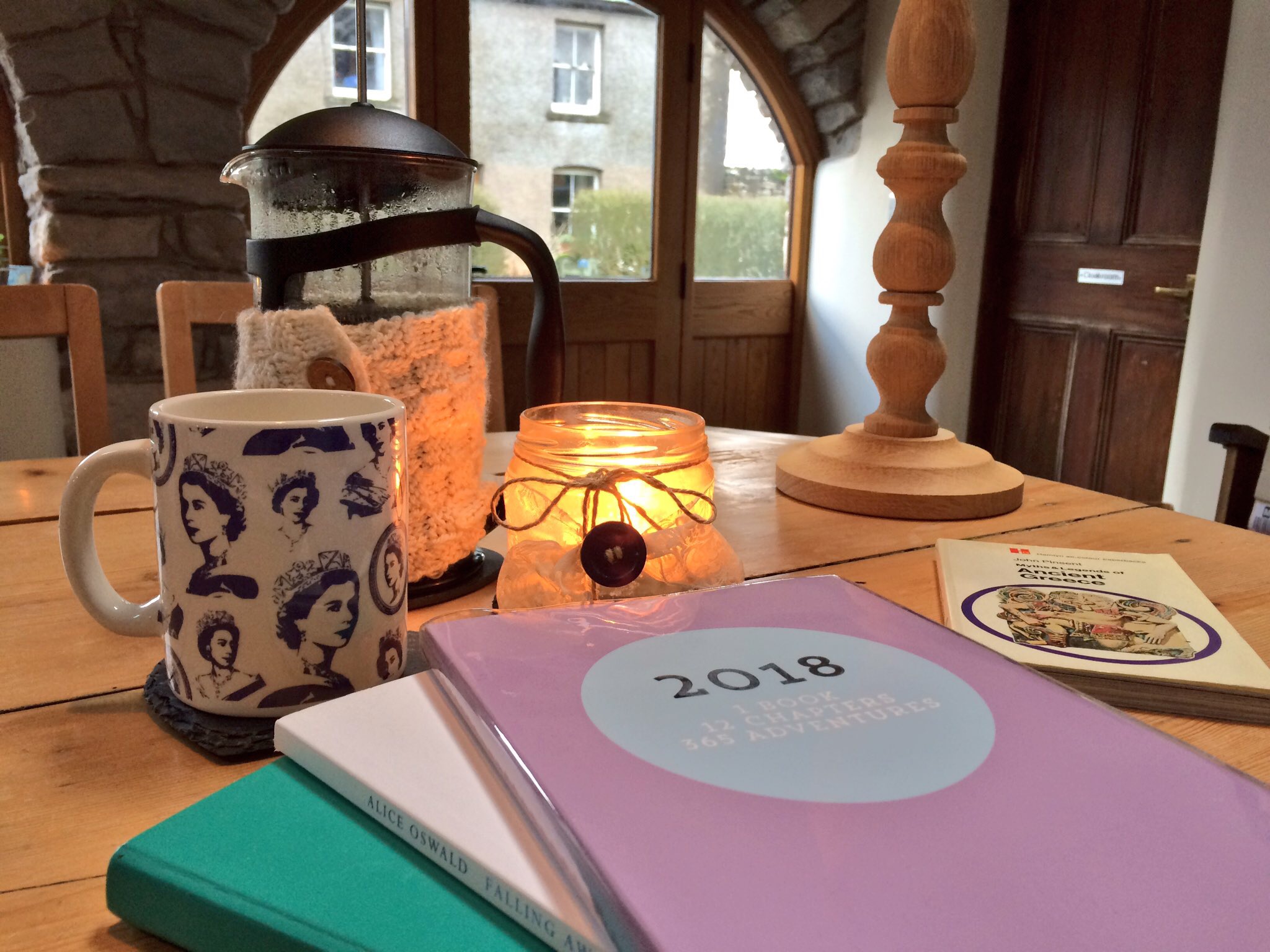
As promised last week, this week I’m sharing my photos from Marrakesh. Not necessarily very writer-ly, but full of beautiful bright colours and gorgeous blue skies.

My writing life: week 2

Writing poetry with a cup of tea. Katie Hale, Cumbrian poet / writer etc
Poetry & a cuppa

Confession: at the time of writing, the week is not yet over. I wrote and scheduled this post on Friday. Why? I’m currently in Marrakesh.

Bearing that in mind, it’s been a much shorter-than-usual week for writing, truncated even further by the fact that I’ve spent two days at the New Writing Cumbria office, rather than the usual one. I’ve also been delving into the joys of my tax return.

But even despite all that, I’ve been loving the writing time.

I wrote a poem about a whale, which I think is already very close to the final draft stage. I also discovered a very old draft of a very old poem (well, 3 years old), which I had completely forgotten about, and was able to rework into a completed piece. To make matters even better, it became a gogyoshi-ku. Thanks, BAR poets and Jacob Sam-La Rose, for introducing me to that particular poet form. Oh, in case you were wondering, a gogyoshi-ku consist of a gogyoshi (5-line poem that otherwise has no formal structure) followed by a haiku.

I also did something faintly amazing, and organised my computer filing system for my poetry. Whereas before I had one folder called ‘Poetry’, full of everything from finished pieces to brief jottings that should probably never be revisited, I now have a beautifully streamlined system of folders that gives me a geeky little tingle every time I think about it.

For the organisation geeks among you, my ‘Poetry’ folder is now organised like this:

  • Finished Poems
    • Published poems
    • Waiting for news [submitted to magazines]
    • Other poems
  • Poems to work on
  • Misc. documents
    • [archived drafts and jottings, filed by year]

And, inspired by the wonderful Kim Moore, I’ve now also created an Excel poetry submission spreadsheet, with a list of poems down the side, a list of magazines & journals to submit to across the top, and colour-coded boxes according to whether the poems have been accepted or rejected, or are waiting a response.

Now it’s just a case of making those systems work!


The week in books:

  • [still reading] Sebastian Faulks, Birdsong

(Though in fairness, it is a long book. And with the train ride to the airport and the long-ish flight to Marrakesh, I may have finished it and be onto something else by the time this post goes live.)

The week in pictures:
Photos of Marrakesh to follow next week!


My writing life: week 1

InstagramCapture_9fd867f9-2bde-45e0-bb61-2780dce46999

One week into my new life as a real life writer (!) and it’s time to take stock and see how it’s treating me. Admittedly, it hasn’t exactly been an average week…

I spent most of it in Portugal, thanks to my lovely parents, who decided that after the stress of leaving a job, I needed to relax before really knuckling down to any hard-core writing. So it’s been a week of sun (in small quantities), sand and seafood.

Not working and relaxing abroad means plenty of time for reading, and some time for writing thrown in. Having half-heartedly resolved to write a limerick a day in 2016, this week I’ve managed to write five. (5/7 is pretty good, right?) It’s a great way of practising rhyme without embarking on anything too serious, and a fun way to start the writing day. Here’s my favourite from the week:

There once was a high-handed billy goat
who purchased an outmoded frilly coat.
He thought it looked neat
as he flounced down the street,
but really he looked quite the silly goat!

Naturally, I’m not expecting quite so many late lunches and walks along the beach next week – especially with two days away from the writing desk and in the New Writing Cumria office, and a tax return to complete (joy of joys…)

But I’m definitely aiming for another 5 or so limericks, and plenty other writing besides.

The game, as Mr Holmes would say, is afoot!

The week in books:

  • E. Nesbit, The Enchanted Castle
  • H. G. Wells, The Island of Doctor Moreau
  • William Carlos Williams, Selected Poems
  • Claire Gaskin, a bud
  • [currently reading] Sebastian Faulks, Birdsong

This week has mostly been about novels and imagist poetry.

I started off with The Enchanted Castle, which is a classic Nesbit story about a princess (sort of) and a magic ring, and four children who have a magical adventure – and just what I needed to carry the Christmas childhood feeling forward into the new year. Then, shattering that childhood magic into a thousand sharp-edged pieces, I read The Island of Doctor Moreau, which I can only describe as Animal Farm meets Frankenstein meets Lord of the Flies.

William Carlos Williams is an interesting one – largely because he’s really not my cup of tea. Other than the two poems I knew before reading the collection (think: red wheelbarrow and plums in the icebox), there were only two poems in the whole book that I really, really liked – and they came within the last 5 pages. I’m chalking it up to 230 pages of perseverance.

Currently reading: Birdsong, by Sebastian Faulks

The week in pictures:
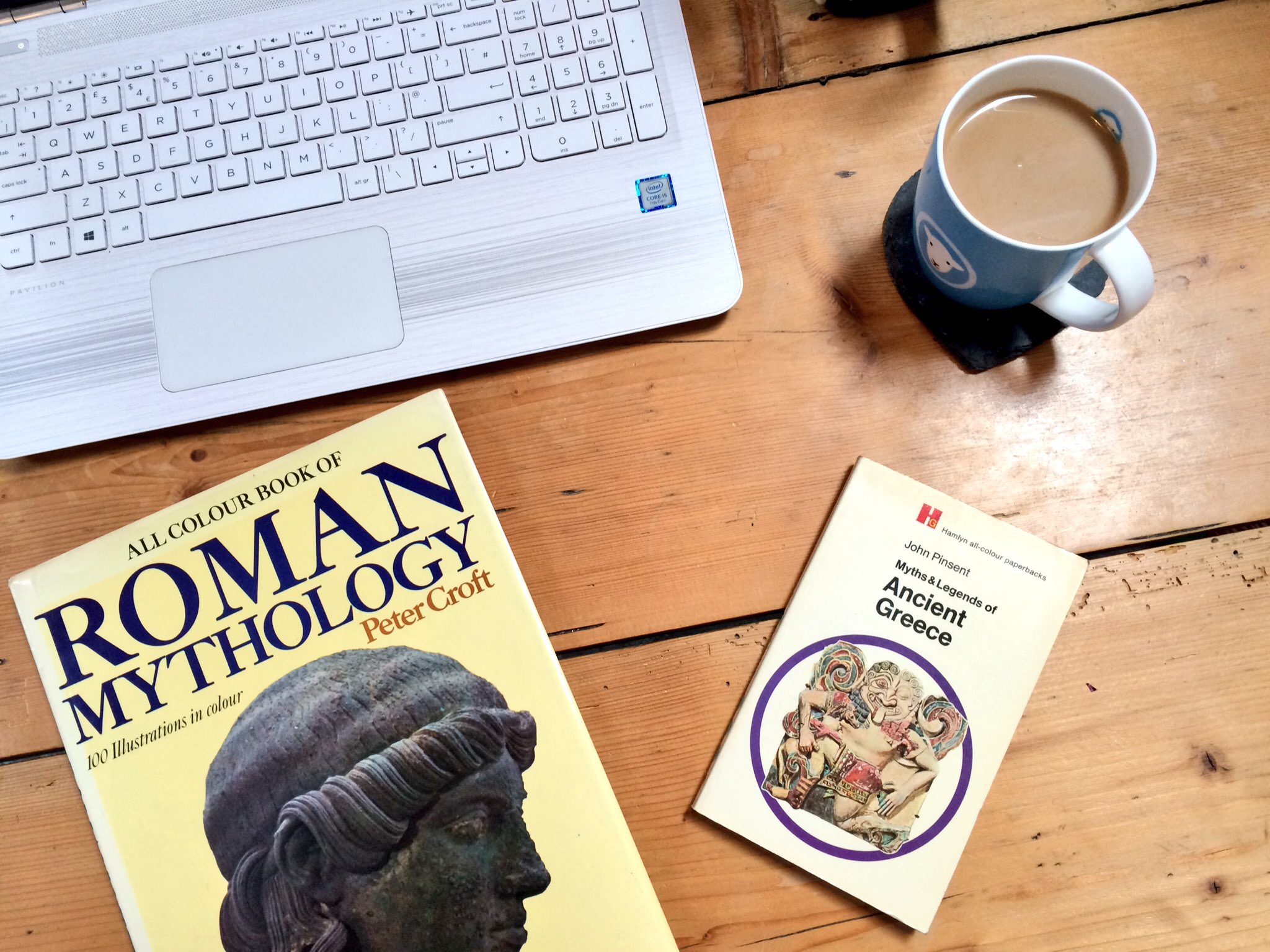
Shelagh Stephenson’s Enlightenment is an unsettling play – one which works on the fears of our imaginations, and the terror of our own smallness in an increasingly global world.

~ Cate Hamer (Lia): photo by Keith Pattison ~

It is this sense of individual insignificance that gives Zoë Waterman’s production such a powerful and contemporary feel – this could be anyone’s house, anyone’s family. In a world where solutions are always just a phone call or the touch of a button away, the sense of these characters’ helplessness pervades the play like a bad dream.

Cate Hamer is a strong central figure as Lia, the mother desperately trying to hold onto herself in her search for answers about her missing son. Through her powerful portrayal of a woman on the edge, we see the struggle for control that plagues all of the play’s characters, from the belligerent Gordon (Peter MacQueen) to Joanna, the ambitious media woman, played by Charlotte Mulliner. Mulliner perhaps best represents the precariously balanced nature of control; she is the character who has most of it at the start of the play, and the only one to bow out as soon as she feels it slipping. Her smart heels and slick performance throw Hamer’s portrayal of a frayed and despairing Lia into sharp relief.

Meanwhile, Patrick Bridgman excels in the role of Lia’s partner, Nick, whose cynical retorts provide much of the play’s humour – a humour that teeters on the edge of hopelessness; Bridgman perfectly balances the two, a master at straddling the line between the emotions he exposes and those he withholds.

However, it is Richard Keightley’s Adam who makes the play a truly disturbing piece. His entrance at the end of the first half is a wave of uncertainty in an already turbulent drama – a wave which becomes a tsunami by the end of the play, as his Machiavellian power games seek to twist the characters against one another with a ferocity that would make Pinter proud. Keightley creates a character with so many layers of manipulation and vulnerability that it becomes impossible to know when (or even if) he ever lays bare this complex character’s troubled core.

Even in such an exceptionally strong season comprising outstanding productions like The 39 Steps and Suddenly Last Summer, Theatre by the Lake’s Enlightenment shines out: a gripping piece of contemporary theatre that seeks to unhinge our sense of control and safety in our own fragile lives.

~ Enlightenment runs at Theatre by the Lake, Keswick, until 7th November 2015 ~

~ Richard Keightley (Adam): photo by Keith Pattison ~

A couple of months ago, I was running a poetry workshop in a small Cumbrian primary school on behalf of the Wordsworth Trust. At the start of the session, I asked the children whether they had any questions about poetry or about being a poet. One boy put up his hand and asked, ‘Are you on medication?’

As if that wasn’t enough, this then shaped the questions from the other children, such as: ‘Do you have any allergies?’ I then had a sensible one (‘How long have you been writing poetry?’), but it was instantly followed by, ‘How old are you?’ and several minutes in which the children frantically tried to guess my age. (If you were wondering, by primary school calculations I could apparently be anywhere between 19 and 43.)

I then started asking around, to see if other poets had similar stories of being asked interesting questions. Turns out, they do – particularly when children are involved.

Some of my favourites came from Helen Mort: ‘You’re the Derbyshire Poet Laureate, so does that mean you write poems about cats?’ Another child asked her, ‘Have you written any poems about sparkly fairies?’ – rounded off by a small yr 3 boy in a primary school workshop, who asked her what was in her handbag and if he could have a look.

Another question, which seems universal, is: ‘What do you write about?’

Universal it may be, but it’s still nearly impossibly to answer – so much so that Alex Bertulis-Fernandes described it as an ‘odd question’, despite the fact that it’s annoyingly common: ‘I’m not quite sure why I find it so strange, and I’m sure I’ve asked others the same – my answers to the question always feel unimpressive though.’

Polly Atkin agreed: ‘I hate being asked ‘what kind of poetry do you write’ as though there is an answer to that.’

She also ventured a couple of things she’d been told as a poet, as well as questions she’d been asked, such as a suggestion that she should use her 3rd place competition prize money buy a notebook so she could ‘keep practising’, as well as the cheek of a male poet who told her she should ‘stick to the women’s magazines’.

Another writer who had been told where he should publish his poetry was Owen Collins: ‘my Mum, when struggling to get her head round my ambitions, once told me that she thought I’d be very good at writing the poems for inside birthday cards…’

I’ve experienced this one myself. When I showed people the first good poem that I wrote (well, I thought it was good; it won a prize, so that’s something), one of my parent’s friends told me it was so good, it should go on the inside of a greetings card. I’m pretty sure he meant it as a compliment, but as it was a poem about dissatisfaction with a dying relationship, I’m not sure what kind of card it would be appropriate for. Maybe some kind of ironic Valentine…?

But I think my favourite contribution came from Lindsey Holland, who was asked: ‘If I write about breasts as hills, from a microscopic perspective, is that landscape poetry?’ And I desperately hope she answered yes.