Poetry has a very close relationship to sound. It’s one of the things that sets it apart from prose, which is often read internally; poetry changes so much when it’s performed out loud. With its long association with an oral tradition, with ballads and song, with rhythm, meter and rhyme, the very act of writing poetry becomes an act of engaging with sound.

‘Poetry begins in those situations where the voice has to be raised: the hawker has to make himself heard above the market hubbub, the knife-grinder has to call the cook out into the street, the storyteller has to address a whole village, the bard must command the admiration of the court. The voice has to be raised. And it is raised in rhythm.’ – James Fenton, An Introduction to English Poetry (London: Penguin Books, 2003)

I actually ran a school workshop about poetry and sound just the other week. I was working with my regular group of Yr 4 pupils at St Patrick’s School in Workington, where we looked at John Clare’s poem, ‘Pleasant Sounds’. We talked about Clare’s use of ‘sound words’ (such as ‘pattering’ and ‘whizzing’), and about how some of the sound words he used were unexpected, like ‘flirt’ and ‘halloos’. Then the children thought about a favourite place, and wrote about all the different sounds they could hear in that place.

Which brings me onto this month’s challenge:

Write about the next sound you hear.

It could be a large sound, or a very small one. Whatever it is, I want you to focus on it. Describe it in as much detail as you can.

Start by describing the sound itself – what are the best words for the sound you can hear? Is it loud or quiet? Does it invade your ears, or do you really have to strain to hear it? Is it continuous, or short and sharp like a puncture?

Then expand the picture out from there. What’s making the sound? Can you see it? What does it look like? Whatever’s making it: does it change as it makes the sound? How does it affect the other sounds around it? How does it affect you? Does it remind you of something else? Another time you heard it, perhaps, or something else that makes a similar noise?

The trick with this exercise is focus. Focus all your energy and attention on that one sound, and let the detail fill the words.

As always, I’d love to see the results. Good luck, and happy writing!

After a month of writing very little while travelling around Cambodia & Vietnam, May has been full on. Honestly, since landing at Manchester airport at the end of April, I don’t think I’ve stopped.

Finding time to write in London

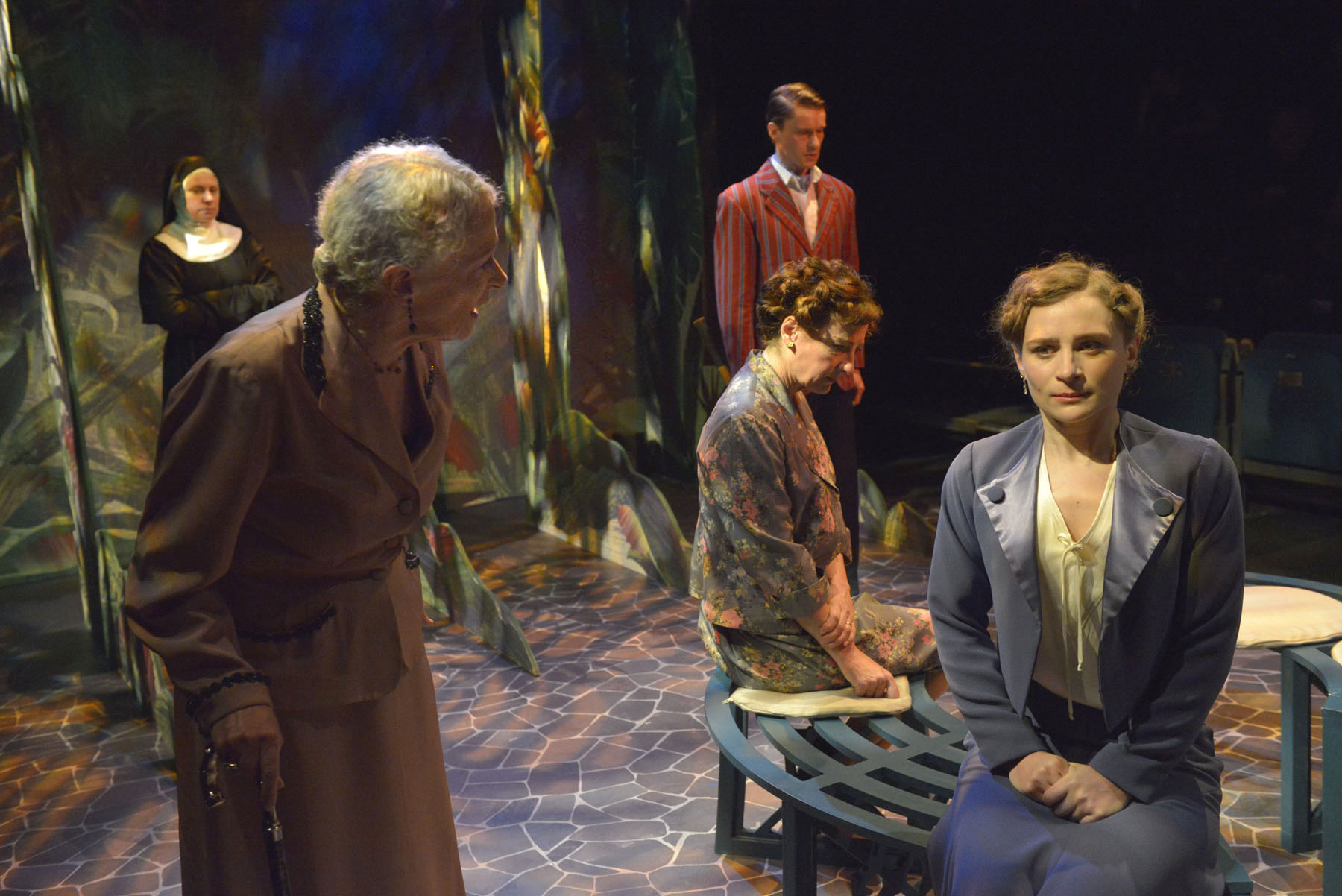
After the Ballymaloe International Poetry Prize’s award ceremony in Dublin, and the South Downs Poetry Festival weekend residential over the bank holiday weekend, May got into full swing with a couple of days hanging out on London’s Southbank and writing, as well as seeing ‘Consent’ at the National Theatre, and drinking wine with friends (always important).

From there, I headed up to Cambridge for the Jane Martin Poetry Prize award ceremony, held at Girton College. Judged this year by Grevel Lindop & Malcom Guite, the Jane Martin Poetry Prize is awarded annually to a poet under 30, for a group of up to four poems – and this year, I was lucky enough to win it. It was a really fun evening, with the award ceremony taking place in the old library, followed by a delicious formal hall dinner. I spent the night in the college, then headed home the next day.

Which was a good thing, because while I’ve been at home, there have been progressions with all three of my big current projects:

Poetry: This month I wrote a couple of new poems, but more importantly: I proofed my pamphlet. It was an odd (but satisfying) experience, seeing the printer’s proof arrive in my inbox – like spending years growing & nurturing a tree, then coming out of the house one day to find it suddenly in bloom. But that blossom will be turning into something even more substantial this week, as the pamphlet itself finally arrives, ready for the big launch on Friday. Very exciting!

Novel: A huge one this month, as I’ve finally finished the first draft of the novel! Which means that I actually got to the end, with no gaps in the middle which just say ‘write something here’. It may be messy, but it’s still a full complete draft. At that moment, when I plugged my laptop into the printer and pressed ‘print’, I was so excited I actually wriggled – like Christmas Eve when I was a child, and I couldn’t sleep for wriggling. Now, I just need to edit it. (I say ‘just’…) I have my first one-to-one with my wonderful editor on the Penguin Random House WriteNow scheme, Tom, in a couple of weeks, and after that I’ll have a better idea of how to move forward with the manuscript. But still: exciting times!

Musical: I’ve done very little actual work on the musical this month – and what I have done has only been in the past week, as we start to look at shaping this draft up into its ‘finished’ form, ready to workshop it with the cast next month. BUT that doesn’t mean nothing has been happening, because tickets for the musical (called The Inevitable Quiet of the Crash and co-written with composer Stephen Hyde) went on sale! The show runs 2nd – 26th August 2017, at the Edinburgh Fringe, and you can book your tickets nicely in advance here.

And that’s pretty much been my life this month! Lots of writing. Not a lot of sleep. Ah well. Maybe June will be a bit more relaxed…? (I doubt it.)

The month in pictures:

Save

Save

Until very recently, I was an unbeliever. I’m not talking about religion or magic or the supernatural – I’m talking about writers’ block. If you’d asked me a year ago, I’d have said there was no such thing. I thought it was all a figment of the imagination.

Then it came for me.

In some ways, I stand by what I said: it is all in the mind. But: ‘Of course it’s all in your head. But that doesn’t mean it isn’t real.’ (Thanks, Dumbledore.)

The way I see it, there are two types of writers’ block, each with their own different cure.

TYPE ONE:

The Easy Type

I’ve met so many people who tell me they have trouble writing. When I ask them how often they write, the answer is often something along the lines of: ‘I’m not writing at the moment, I’m looking for inspiration.’

‘Inspiration exists, but it has to find you working.’ – Pablo Picasso

Here’s the thing: writing is hard. You’re reaching into the mysterious parts of your soul, pulling out what you find and attempting to wrestle it onto a page. You’re pulling something fragile out into the open. Naturally, the body tries to put up defences.

‘The easiest thing to do on earth is not write.’ – William Goldman

Writing can be mentally and emotionally draining. It’s so much easier to check facebook, or binge watch a TV show, or do the dishes, or check our emails, or cook an elaborate dinner, or any of the other things we do to avoid actually sitting down and writing.

This procrastination can be a manifestation of many things: fear of getting it wrong; laziness; taking the easy road; an uncertainty about the work; embarrassment; worry about not living up to other people’s expectations…

For all of these, there’s one very simple cure:

Make the time to sit down and write.

An hour. Two hours. Three. It’s up to you, just as long as you go to your writing space and stay there. Don’t get up and dust the top of the kitchen cupboards. Don’t tweet. Leave the list of household chores somewhere where you can’t see it.

If nothing comes, write about how you can’t think of anything to write. Repeat this routine every day, or every couple of days, as often as you can. If you turn up to work, then eventually the inspiration will as well.

writing prompt - Katie Hale

TYPE TWO:

The Tricky Type

What makes Type One easy to cure is that the cure is physical. You get yourself into your writing space and something will eventually turn up. Type Two is so tricky because the cure isn’t physical. It’s a purely mental battle, and that’s much harder to fight.

This is the type of writers’ block I didn’t realise existed, until about a year ago. Because sometimes, it isn’t just laziness or a fear of creating the work that blocks us. Sometimes, there’s a much deeper problem.

I’m talking about things that go beyond the work itself. Big things. Things like grief for a loved one. Anxiety. Depression. A big upheaval. Some sort of earthquake that shakes the foundation of our lives.

Something like this isn’t always a block. Sometimes, it can draw the work out of us and turn the creativity into a therapeutic process. But often, this therapeutic creativity comes later. Initially, there’s a block.

This block can’t always be solved by just turning up to the writing station. Often, solving the root problem has to come first. There’s no easy way to do that. Anyone who has ever suffered from any form of mental health issue will know that it’s a complicated process – one that takes time and patience and a lot of self-acceptance – and that ‘solving’ is often a misnomer anyway.

And often, once the root problem is addressed, or at least accepted, the writing will start to flow again. Not always, but for me, this can help. (Of course, at this stage, you still need to turn up to the desk…)

Good luck, and happy writing!

Poetry can be about anything. In many ways, that’s a huge advantage. It gives you freedom to explore any subject that interests you, and to view it through whatever frame seems appropriate. As I like to tell children in my schools workshops, there are no rules in poetry.

But all those options can be a little bit daunting. You know that feeling when you’re looking at a menu and there’s too much to choose from, it’s overwhelming, and suddenly you don’t want to eat anything at all? Sometimes I feel a bit like that about poetry.

So I thought I’d create a prompt that restricts that slightly.

Your goal? To write about something blue.

It can be anything you like – big, small, bright blue, sky blue, azure, navy… Maybe a poem about a shallow coral sea, or the depths of the Pacific. Perhaps the sky on a summer day, or a swimming pool in a fancy hotel. Or maybe it’s a smaller object: a blue bottle, a favourite pair of denim dungarees, bathroom tiles. Perhaps you want to write about blueness in the figurative sense, about being blue, or playing the blues.

Whatever you choose, start with the object and its blueness. Continue writing from there, and see where the poem takes you.

As always, I’d love to see anything you come up with.

Good luck, and happy writing!

Another month – how do they go so quickly?

March always feels as if it should be a month of waking up. It’s when nature really kicks into gear at the end of a long winter. The nights are lighter, I can ditch the heavy winter coat, and there are daffodils in the jug on my windowsill. Oh, and lambs in the field. One of my favourite things about spring, and one of the joys of living in the country: getting to see the lambs skipping and playing in the fields around the house.

Of course, it isn’t just about flowers or adorable farmyard animals. It’s also (like every month) about writing.

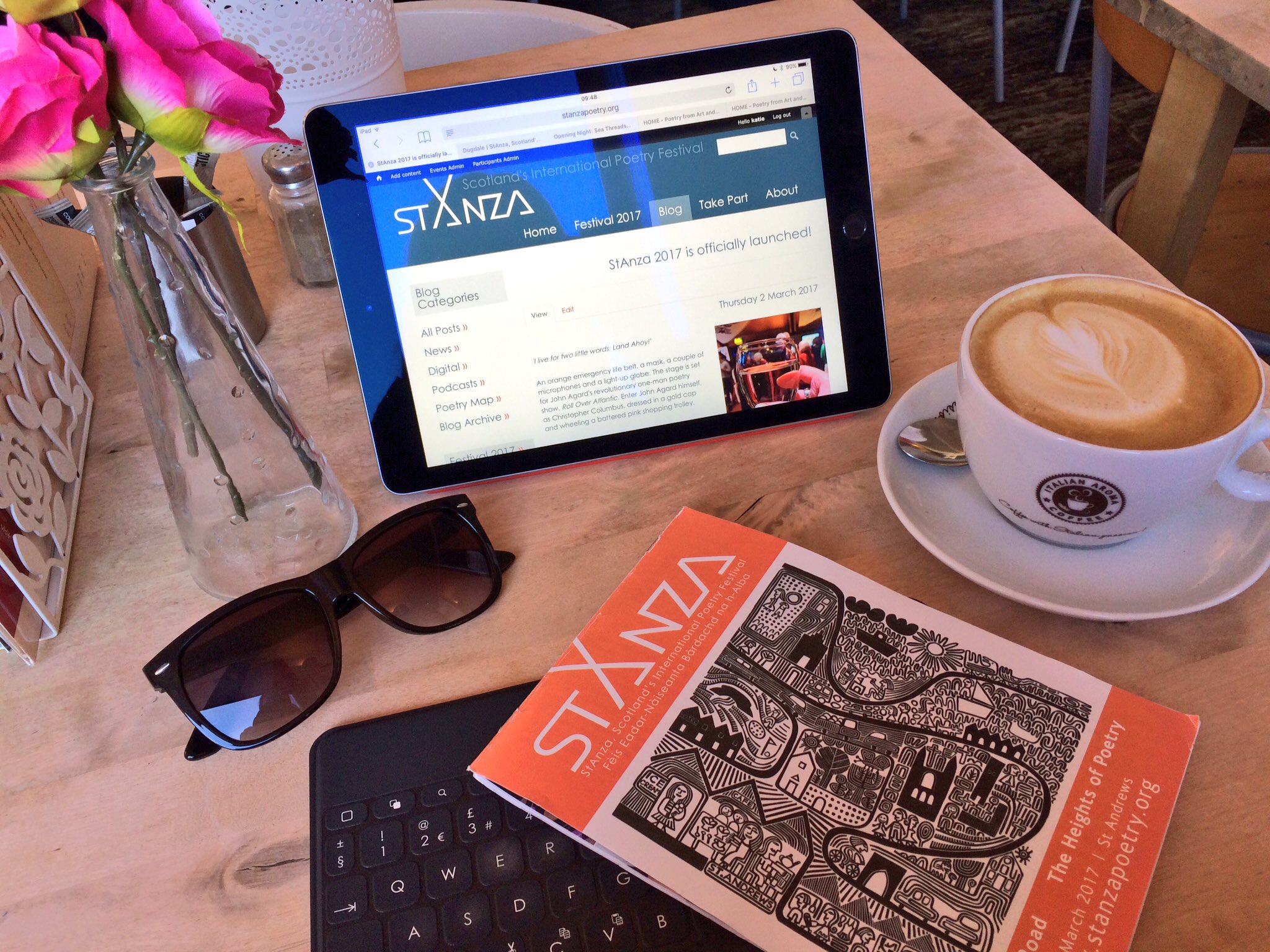
And I couldn’t have asked for a better start to the month. At the beginning of March, a whole host of poets & poetry lovers make their annual pilgrimage to St Andrews in Fife, for one of the best poetry festivals around: StAnza. I first went to StAnza during my MLitt year at St Andrews, when I volunteered as a Participant Liaison Officer, looking after poets & speakers, and taking them to and from the venue (or ‘PL-ing’, as it’s known by regular festival volunteers).

This year was my third StAnza, and as wellas PL-ing, I was also the festival’s in-house blogger. This meant writing a blog post each day about what had happened at the festival the day before. In some ways, this was quite a challenge, as there was pressure to write something (and something interesting, too) every day. I couldn’t just switch off for a day. But the flip-side of that was that it made me focus. During every event, I was concentrating, making notes, making sure I had something to say about it for the blog. Which meant that I probably took in more from the festival than normal – which is saying a lot, because I usually come away with my head stuffed full of thoughts & words & ideas.

Since I first volunteered there in 2013, the festival has really become a kind of family. It’s such an inspiring week, and has become a highlight of my social and creative calendar.

Read my StAnza blog posts here:

StAnza blog post writing

At the end of February, I learned I’d been selected for Penguin Random House’s Write Now mentoring scheme. In March, Penguin Random House publicly announced the list of mentees, which was exciting, and pretty much wholly occupied my twitter stream for a while. The actual mentoring process hasn’t started yet, but already it’s pushed me to write more of the manuscript, which can only be a good thing.

Poetry-wise it’s been a month of successes, too.

This month, the shortlist for the Ballymaloe International Poetry Prize was announced. There are four writers shortlisted, and this year, my poem was one of them! Now I need to figure out what to wear for the prizegiving next month…

And, as if that wasn’t enough, the following week I received second prize in the Tannahill Poetry Prize, based in Scotland. We went up to Lochwinnoch for the prizegiving evening – me & my fan club (aka parents). It was an evening of music, courtesy of local folk duo Witches Brew, and poetry, from the other prizewinning writers and from judge Sally Evans. Cue a bit of a Cumbrian takeover, by both myself and Kathleen Jones (who won the third prize & is also a Cumbrian poet).

I’ve also delivered a few schools’ workshops this month, for New Writing North and the Wordsworth Trust – including one at Dove Cottage, which is always good fun. (Although sometimes it feels as though you’re writing with Wordsworth looking over your shoulder.)

Mostly, this month just feels as though it’s flown by. Like the writing time has just disappeared in a whirlwind of everything else happening. Which is maybe a good thing. Sometimes I think that I need a break from writing. Creativity is a muscle, and while it’s good to exercise that muscle, it can also get overworked. Sometimes I just think I need to give the writing muscles a break.

*

THE MONTH IN BOOKS:

This month has been a fairly quiet one for reading, with only two books (though numerous individual poems – too many to list here). Part of this is that I simply haven’t made enough time for reading. Part of it is that I think my brain is starting to feel saturated, clogged up with words. But that’s fine – I have a break coming up very soon… (But shhh. Spoilers.)

This month’s two books are:

  • The Idle Traveller, by Dan Kieran
  • The Quiet American, by Graham Greene

THE MONTH IN PICTURES:

About a month ago, I wrote a post about how not to perform at an open mic night. Today, I wanted to expand on that, and talk about how to behave in a workshop.

Now before I start, I want to say that I love writing workshops. I’m part of 4 separate writing groups who meet in person, I’m in a couple of online writing communities, and I have two friends who I submit writing to on a weekly basis. Feedback workshops were a big part of my Masters, and I’ve benefited from them on a few writing residentials, too. I also happen to run writing workshops myself.

And yet…

If you regularly attend writing workshops, then you’ll probably instantly be able to think of a few examples of people who’ve rubbed you up the wrong way. This is to be expected. You’re putting a group of individuals in a room together, and basically asking them to dissect each other’s babies. It’s not surprising that people can feel a little raw, and tempers can flare.

Still, it needn’t turn into Hunger Games-style armageddon, or some sort of Mean Girls back-stabbing exercise in passive aggression. It’s basically all about consideration for others.

Katie Hale, Cumbrian writer / poet, runs creative writing poetry workshops for young people and children in schools and colleges

HOW NOT TO TAKE PART IN A WRITING WORKSHOP:

  • Say, ‘Here’s what I think of this poem,’ and then rip the piece of paper into tiny shreds.
  • Bring along your best poem, which you have no intention of changing. After all, you’re not there to actually workshop your poem, are you? You’re there to impress everyone with what an amazing poet you are. And people will be so bowled over by the fact they can’t find a single criticism to make about your writing, they’ll instantly want you to be their best writer-friend.
  • Listen to everyone’s feedback, then say, ‘Thanks, but I’m not going change it because I’ve already published it.’
  • Bring along that 20-page poem that’s been sitting in your desk drawer (unless you absolutely know that this is the kind of workshop that accepts longer pieces).
  • Use the phrase: ‘This poem’s shit.’
  • Aggressively defend your poem. Someone has taken the time to give you their considered opinion, so surely it’s only right that you batter them back down over it until they see it your way.
  • On the flip side: aggressively attack someone else’s poem. Sure, it’s their poem, but if they don’t agree with a piece of your advice, then you should keep repeating it (getting louder each time) until they do agree.
  • Take a phone call in the middle of the workshop.
  • While someone else is trying to make a point, have your own conversation – especially if that conversation is about how bad the poem is.
  • If it’s the kind of workshop with writing exercises, wait till the end to tell the workshop leader that you hate writing exercises because you find them prescriptive, and therefore haven’t written anything all workshop.
  • Tell everyone that you don’t really like workshopping your poems, because you don’t trust other people to understand them.

Got any more workshop horror stories? I’d love to hear them! Comments below….

Last week, I made my annual trip north to StAnza International Poetry Festival. This was my third festival volunteering for StAnza, and as well as my usual job of looking after poets, I had the responsibility of being the festival’s in-house blogger.

Amongst all the wonderful talks and readings and performances, there was one event that stood out as being not about the art (at least, not in its purest form), but about the practicalities of making that art pay.

‘Making a Living as a Poet’ was an event sponsored by the Society of Authors. Chaired by Ken Cockburn, poets Sarah Hesketh and Harry Giles talked about how to make money from being a poet – although, as Harry qualified, ‘You can make a living from poetry, but it’s a crap living.’ 

That aside, I thought I’d share with you some of the wisdom learned during that event.

Reading April De Angelis, 'Playhouse Creatures'
April De Angelis, ‘Playhouse Creatures’

HOW TO MAKE A LIVING AS A POET:

  • Find cheap rent. Poetry doesn’t pay well. Unless you have some uncanny luck or you’ve made a deal with the devil to bag a big prize every couple of months, you’re not going to make it onto the Forbes rich list through writing poems. So living somewhere where the rent is a bit cheaper, and living costs are more affordable, is going to be vital.
  • Turn up to stuff. Like so many fields of work, poetry and writing are all about making connections. I don’t mean this in a kind of ‘old boys’ way, but if someone recognises your name on an application, it’s a good start. If you get to know people, they’re more likely to think of you when it comes to work. This goes for organisations, arts councils, collaborations with other artists… The good thing is that poetry networking isn’t nearly as scary as big business networking; it isn’t about striding into a room in a sharp suit, killer heels and blood-red lipstick, then bowling everyone over with with that cut-throat marketing pitch. It’s actually just about hanging out with other lovely artsy people and having interesting conversations.
  • Say yes to everything. Become known as the person who will do the work, rather than the person who refuses the work. Sarah Hesketh started the event by saying that, by accepting any work she could in the field of literature, there’s now ‘a touch of poetry’ on everything she does. Or, as Harry Giles said: you can’t get a full-time job just making art, but you can stitch together enough arts jobs to almost make a living.
  • Be nice. People don’t re-employ people who are rude to them. It’s just common sense.
  • Be professional. Same thing. If you never meet deadlines, or you constantly bitch about your colleagues (which will get back to them – it’s a small world), or you don’t do the work you’ve agreed to do, then people are unlikely to come back to you when the next employment opportunity comes around.
  • Seek out funding. Don’t wait for the work to come to you. Go out and find it. A couple of people seemed surprised by this – isn’t it pushy to ask for work / funding when it hasn’t been offered? But let’s use a more quotidien analogy: grocery shopping. Let’s say you’ve run out of food. Your cupboards are empty, there’s nothing but that mouldy bit of cheddar at the back of the fridge, and all you have in your freezer is half a bag of frozen peas. There are two options. Option 1: sit at your kitchen table twiddling your thumbs and hope someone knocks on your door with a trolley-full of food. Option 2: go to the supermarket and do some food shopping. Obviously, the most obvious and effective of these is option 2. You go out and get some food. It’s the same with work and funding. Instead of waiting for someone to come along and offer you a residency, get in touch with the organisation where you’d like to be poet-in-residence and work together to put together a funding bid. Instead of wishing someone would pay you just to write poems, apply for PhD funding: 3 years of effectively being paid to write a collection of poems. Of course, this all means more admin, but as Harry put it: ‘Making art is also the amin of making art.’ Which brings me onto…
  • Do an apprenticeship. As with any industry, you need to learn how it operates, and have the skills to operate within it. Sarah Hesketh spent a few years working for small arts organisations, in the kind of admin role where she learned how to do everything: events planning; marketing; press releases; funding bids; working with artists; evaluation… All the arts admin skills you need to operate as an individual artist. Of course, this isn’t everybody’s cup of tea. Some artists can’t think of anything worse than having to spend half (or even most) of their day doing admin. Which is fine. There are plenty of other ways to support your writing. Get a job in a cafe or a bar. Work in a funeral parlour. Drive an ice cream van. As long as you’re doing something that you enjoy and that still leaves you at least some time for the writing, then that’s fine. Living as a writer can be as individual as the writing itself.
  • Don’t rely on publishing a book as a way of getting rich. Harry Giles: ‘You make beer money publishing a book. Think about a book as a business card.’ The sad fact is that you don’t get 6-figure advances for poetry. Most books and pamphlets are published by small independent presses and a run of 500 is generally considered pretty good going. So just because you’ve got a book- or pamphlet-deal, it doesn’t mean you can’t start shopping for a luxury yacht. Although the actual writing of poems may be the biggest thing in terms of importance, it’s probably going to be the smallest in terms of actual financial income. But…
  • Make really good art. Although it might not make much money in and of itself, it’s still important that you write really good poems. If you’re applying for residencies or academic positions or running poetry workshops, then the people you’re teaching or applying to will want to know you’re competent in your art form. It isn’t a financial goldmine, but it’s still the thing around which all the rest of your work centres. Which is good, because the poetry is probably the reason you’re doing all this in the first place.

Other than that, just keep your fingers crossed you win something big, like the National Poetry Competition. There’s always an element of luck in life – do you meet the right person who’s going to love and champion your work, or do you write that poem which happens to speak to the personal experience of the editor selecting work for a magazine? But the more you go to things and meet people and put your work out and apply for opportunities and get involved, the greater the chance of those things happening.

The more nets you throw out, the more chance you have of catching a fish.

Read why I’m aiming for 100 literary rejections this year.

I started going to open mic nights regularly when I was 18 and at university. Every week or two, I would catch the train into London and read at Poetry Unplugged at the Poetry Cafe in Covent Garden. It was a friendly and encouraging introduction to the open mic scene, and I became more confident performing my work to a bunch of strangers.

Since then, I’ve lost count of how many open mic nights I’ve been to. I’ve read in open mics at festivals, in bars, and in cafes, across two continents. I even run one every month at Penrith Old Fire Station.

Most of the time open mics are enjoyable and a fun way to spend an evening. But now and then, things happen. The balance tips, and writers start behaving badly. Sometimes, it’s a subtle thing that some of the audience may not even notice. Sometimes it’s so obvious it becomes a talking point for numerous open mic nights to come – a kind of writerly water cooler moment.

Guerrilla Poetry at Deptford Lounge

All of the following are based on real encounters at real open mic nights over the years:

HOW NOT TO READ AT AN OPEN MIC NIGHT:

  • Go over your time. Everyone has been asked to stick to 3 minutes, or 2 poems, and everyone obediently does. Not you though – you sneak an extra poem in there, and double your time. Nobody will mind, right? Not when your stuff is ‘so much better’ than everybody else’s?
  • Read an epic. It’s your pride and joy and took you years to complete – surely that means everyone else should sit politely through all 17 pages of it?
  • Stand up, announce that you’ve only ever written one poem but would like to take this opportunity to share it – then proceed to do so for the next 45 minutes.
  • Scroll through your phone and catch up on social media while other people are reading.
  • Have a chat in the middle of someone else’s set.
  • Leave as soon as you’ve read your poem.
  • Put your name down to perform, then leave without telling anybody before your set.
  • Keep your phone on loud. If you get a phone call in the middle of someone’s set, well that’s ok – your social life is much more important than their poem.
  • When that phone you forgot to put on silent does ring out: answer it, then have a conversation about how you can’t talk now, because you’re at an open mic night.
  • Heckle (unless you’re 100% sure that it’s the kind of night that allows this, and that the performer expects this). You think the performer is an ‘arrogant sod’? Well, why not shout out and tell him so in the middle of his next poem?
  • Film the performers without asking them first – especially if you’re not the organiser.
  • Use the last bit of your set to plug your own open mic night, which is ‘better than this one’.
  • Go to the bar in the middle of someone’s reading, especially if the bar is on the other side of the performance space, and you have to physically move the performer half way through their poem, in order to get past.

And that’s about it! Any other open mic horror stories to share? I’d love to hear them – share in the comments.

~ dates & details of Word Mess open mic night in Penrith, Cumbria ~

Series 1, Episode 1: Supal Desai

Ever notice how most of our interaction is now via phone, or messenger, or email, or skype? At least, it sometimes seems that way for me.

Face to Face is a new series of short conversations I’ll be having every month, talking to interesting people about the things that interest them. We’ll be chatting over cups of tea & pieces of cake, in my kitchen or wherever there’s a chance to stop and swap thoughts.

Phones down. Screens closed. Talking face to face.

S1 E1: In this first episode, I chat to Supal Desai about blogging and the creative process of writing a blog post.

Supal is the founder of a business risk consultancy based in London and the blogger behind the travel lifestyle blog, chevrons & éclairs. Her ideal Sunday would find her starting the morning in bed with a good book, newspaper or a cuddle, and then making brunch alongside music and endless cups of coffee. Her love for culture, art and history has taken her to the most exotic parts of the world, where she uses that opportunity to curate content that tells a story through fashion and food editorials.

So where do I come in?

I first met Supal in my friend’s kitchen, during our Masters year at St Andrews. She was cooking up something delicious-looking, and I was trying to convince her that haggis were little creatures that lived in the mountains.

Four and a half years later, we’re here:

Happy New Year!

When I was running Rabbit Rabbit (rabbit) young writers’ group, I used to send the young writers a writing prompt every week. I missed doing it, so I’m going to share a writing prompt as part of my weekly (weekend-ly) blog posts. I’m not Jo Bell, and this isn’t 52, so I’m going to share one a month rather than one a week: the first Sunday of every month.

And because this is January and it’s the first one, I thought I’d share a prompt about beginnings.

writing prompt - Katie Hale

If you think about famous novels, there are probably at least a few whose opening lines come to mind. Which makes sense – the beginning of a book is the part that’s supposed to grab us and make us want to read further.

For me, a good opening to a book is one that draws me in. It’s one that raises questions, or suggests a struggle that needs to be resolved. Sometimes it puts us right in the middle of the drama, straight away.

Take these examples – which, because we’re still within the festive season, I’ve done as a quiz (answers at the bottom of the post):

QUIZ:

  1. ‘It was a cold day in April and the clocks were striking thirteen.’
  2. ‘Marley was dead, to begin with.’
  3. ‘When he woke in the woods in the dark and the cold of the night he’d reach out to touch the child sleeping beside him.’
  4. ‘He was an old man who fished alone in a skiff in the Gulf Stream and he had gone eighty-four days now without taking a fish.’
  5. ‘People are afraid to merge on freeways in Los Angeles.’
  6. ‘Lyra and her daemon moved through the darkening Hall, taking care to keep to one side, out of sight of the kitchen.’
  7. ‘When the doorbell rings at three in the morning, it’s never good news.’
  8. ‘It was love at first sight. The first time Yossarian saw the chaplain he fell madly in love with him.’
  9. ‘He was afraid to go to sleep. For three weeks, he had been afraid of going to sleep.’
  10. ‘The boys, as they talked to the girls from Marcia Blaine School, stood on the far side of their bicycles holding the handlebars, which established a protective fence of bicycle between the sexes, and the impression that at any moment the boys were likely to be away.’
  11. ‘It was the best of times. It was the worst of times.’
  12. ‘The boy with fair hair lowered himself down the last few feet of rock and began to pick his way towards the lagoon.’
  13. ‘They say it came first from Africa, carried in the screams of the enslaved.’
  14. ‘In my younger and more vulnerable years my father gave me some advice that I’ve been turning over in my mind ever since.’
  15. ‘Like most people I lived a long time with my mother and father. My father liked to watch the wrestling, my mother liked to wrestle.’

How many did you get? Answers at the bottom of the post…

*

Writing a gripping first sentence is all very well for the opening of a novel, which sets up plot and conflict and character and story. But what about poetry?

I wonder how many of us think about setting up conflict and character and story in the opening of a poem? I wonder how many of us write opening lines to grip people with the drama of the poem, the way we might in a novel?

So that’s my prompt:

Write an opening line for a poem, which sets up drama and / or mystery, and whose sole purpose is to grip the reader.

Then, and only then, you can try writing the rest of the poem.

Here are a few poems that I think grip the reader really well:

‘Here, Bullet’, by Brian Turner

‘Bird’, by Liz Berry

‘Kiss’, by Ruth Padel

Happy writing!


ANSWERS:

  1. Nineteen Eighty-Four, George Orwell
  2. A Christmas Carol, Charles Dickens
  3. The Road, Cormac McCarthy
  4. The Old Man and the Sea, Ernest Hemmingway
  5. Less Than Zero, Bret Easton Ellis
  6. Northern Lights, Philip Pullman
  7. Stormbreaker, Anthony Horowitz
  8. Catch 22, Joseph Heller
  9. Strange Meeting, Susan Hill
  10. The Prime of Miss Jean Brodie, Muriel Spark
  11. A Tale of Two Cities, Charles Dickens
  12. Lord of the Flies, William Golding
  13. The Brief Wondrous Life of Oscar Wao, Junot Diaz
  14. The Great Gatsby, F Scott Fitzgerald
  15. Oranges are not the Only Fruit, Jeanette Winterson

My Writing Life: Week 6

It only feels like a day ago that I was writing last weekend’s blog post, and yet, it also feels like months ago… One of the sure signs of a busy week.

Busy, yes, but also satisfying, hugely enjoyable, and out of the ordinary. In fact, I’m beginning to think that this new life doesn’t have an ‘ordinary’ at all…

InstagramCapture_c173e0cd-542c-4a3d-98d9-6f4bc78f6eea

It’s been quite exciting admin-wise. During my day a week at Eden Arts, we set up and organised a monthly wordy open mic night, Word Mess, which will start in March. I’ve also been handing out leaflets and posters for the Three Inch Fools’ Easter Shakespeare workshops.

Aside from that, it’s been almost a direct split between writing and relaxation.

I spent a couple of days in London, staying with the lovely Supal for a much-needed catch-up and a wander round the capital. We spent a good deal of time in independent book and coffee shops – including the delightful Primrose Hill Books, where I impulse bought a book called The Penguin Lessons (about a teacher at an Argentinian boarding school who rescues a penguin from an oil spill and takes it to live on his terrace at the school). Because let’s face it: who can resist a book about a penguin…? Certainly not me!

I also finally made it to the Attendant Cafe. Attendant is an underground cafe, created in an old public toilet. I’d heard about it ages ago on a couple of travel blogs, and couldn’t wait to visit for myself. (I have a bit of an obsession with toilets; when I was travel blogging I used to publish a ‘Loo witha View’ series, of unusually beautiful views from toilets from my travels). Fittingly, then, this trip to Attendant also doubled up as a chance to chat about blogging and travelling with Supal, who runs chevrons & eclairs.

But London wasn’t all coffee and sightseeing. I also spent some time sitting in one of the work spaces in the National Theatre, via spending a little more money than intended at the National Theatre Bookshop. As you may guess from this week’s reading list (below), I’m currently in playwriting mode. I couldn’t think of a better place to work on a play than in a quiet corner of the National Theatre itself.

Back up north, I spent a day at a poetry workshop at Tullie House Museum & Art Gallery. Tullie House are currently hosting the National Portrait Gallery’s Picture the Poet exhibition. As part of the exhibition’s outreach programme, they’re working with Apples & Snakes to run poetry workshops (leading to a showcase) for groups around Cumbria. One of these groups consists of Tullie House Youth Panel, along with one of my young writers from New Writing Cumbria’s Rabbit Rabbit (rabbit) group. They’re working with poet Jenny Lindsay, who ran a fantastic worksop, as part of a series that will eventually lead to all of the young people writing an individual poem and a group piece.

Needless to say, I took advantage of the workshop and drafted a poem of my own. I may be attempting to focus on playwriting, but somehow poems just keep popping up in my head – and who am I to deny them their existence?

The week in books:

The week in books

  • Sarah Corbett, And She Was
  • Mark Ravenhill, Shopping and F***ing
  • Sarah Kane, Blasted
  • Tom Michell, The Penguin Lessons
  • April de Angelis, Plays: 1 [Ironmistress; Hush; Playhouse Creatures; The Positive Hour]

This week has been largely about drama. It’s been a mixture of re-reads (Blasted, Shopping and F***ing and Hush) and new reads (Ironmistress, Playhouse Creatures and The Positive Hour), which has been both fun and refreshing.

I also read Sarah Corbett’s And She Was, which has been sitting in my car for the past few months, begging to be taken inside / into a coffee shop and read. I saw Sarah perform at Ilkley Literature Festival, and got her book (along with Mona Arshi’s Small Hands, also published by Pavillion Poetry) shortly afterwards.

There was also, of course, the book about a penguin that I picked up in Primrose Hill. Because, once I’d bought it, I could hardly resist reading it, now, could I?

The week in pictures:

A little bit of everyday life this week, from insightful passages in books, to cafes, to birthday cake:


My Writing Life: Week 3

Three weeks into my new writing life, and I finally feel like I’m getting into some sort of rhythm. Which is strange, when you think that I haven’t yet had a ‘normal’ week. Take this week, for instance, where I spent the first two days of it in Marrakesh, bartering, discovering and soaking up the sun instead of writing. (Don’t worry, though – I’ve had a few very productive days to make up for it.)

InstagramCapture_0ba2f985-4c15-4dc8-94b2-0427c5598c19

But it hasn’t just been poetry I’ve been writing this week, though I have written and edited a good deal of that. I’ve written a little bit of drama. I’ve also been writing tweets.

Yes, this is the week that I created a trending hashtag on twitter.

For those of you who saw it, I’m talking about the #derangedpoetess controversy. For those of you who didn’t see it, let me give you a brief bit of background:

In last week’s Sunday Times, journalist Oliver Thring published an article about recent T S Eliot Award-winner Sarah Howe. On Friday, sparked by a tweet from Amy Key, a number of poets accused the article of being sexist.

I saw Amy’s initial tweet, followed her link to the article, and watched the responses begin to unfold. To be honest, my opinion was that the article probably wasn’t intentionally sexist; it was just bad writing. But you can read the original article here and decide for yourself.

If you ask me, the really unforgivable sexism set in when Oliver Thring, rather than holding his hands up and apologising for any accidental offence, tweeted this:

Well, it isn’t every day you get to respond to a term like ‘deranged poetess’! I tweeted a photo of myself writing, looking very calm and serious, and captioned it as a ‘definitely deranged’ poetess. Then I made it a hashtag.

The hashtag then began trending, and was even written about in a Guardian article! The rest, as they say, is history.

It hasn’t all been social media controversy this week, though. Aside from writing in my now Moroccan-goods-filled house, I’ve also been getting over a cold – aided by some medicine I picked up in a Berber pharmacy in Marrakesh. It’s a black powder, which you wrap in a hankie and inhale the scent, a bit like an olbas inhaler. It instantly clears the sinuses – like a miracle cure! Though I would quite like to know what it is that I’m inhaling… Anyone have any ideas…?

It’s also been a week of reading (though not quite as much as I’d have liked), arranging meetings and organising some volunteering work. And socialising! I know – very unlike me… Apparently writing and having a social life actually can go together!

img_0028

The week in books:

  • Sebastian Faulks, Birdsong
  • Ella Hickson, Eight
  • Mona Arshi, Small Hands

A novel, a play and a collection of poetry: feeling pretty well-rounded in my reading this week. I actually bought Small Hands way back in October at Ilkley Literature Festival, and it’s been sitting in my car ever since, waiting for me to take it into a cafe and start reading it. Unfortunately, my cafe time has been a bit limited since then. But I must say, the little book has waited very patiently, and was well worth it. Some beautiful poems, and also a couple that I could use for teaching, which is always a bonus.

The week in pictures:

As promised last week, this week I’m sharing my photos from Marrakesh. Not necessarily very writer-ly, but full of beautiful bright colours and gorgeous blue skies.

A couple of months ago, I was running a poetry workshop in a small Cumbrian primary school on behalf of the Wordsworth Trust. At the start of the session, I asked the children whether they had any questions about poetry or about being a poet. One boy put up his hand and asked, ‘Are you on medication?’

As if that wasn’t enough, this then shaped the questions from the other children, such as: ‘Do you have any allergies?’ I then had a sensible one (‘How long have you been writing poetry?’), but it was instantly followed by, ‘How old are you?’ and several minutes in which the children frantically tried to guess my age. (If you were wondering, by primary school calculations I could apparently be anywhere between 19 and 43.)

I then started asking around, to see if other poets had similar stories of being asked interesting questions. Turns out, they do – particularly when children are involved.

Some of my favourites came from Helen Mort: ‘You’re the Derbyshire Poet Laureate, so does that mean you write poems about cats?’ Another child asked her, ‘Have you written any poems about sparkly fairies?’ – rounded off by a small yr 3 boy in a primary school workshop, who asked her what was in her handbag and if he could have a look.

Another question, which seems universal, is: ‘What do you write about?’

Universal it may be, but it’s still nearly impossibly to answer – so much so that Alex Bertulis-Fernandes described it as an ‘odd question’, despite the fact that it’s annoyingly common: ‘I’m not quite sure why I find it so strange, and I’m sure I’ve asked others the same – my answers to the question always feel unimpressive though.’

Polly Atkin agreed: ‘I hate being asked ‘what kind of poetry do you write’ as though there is an answer to that.’

She also ventured a couple of things she’d been told as a poet, as well as questions she’d been asked, such as a suggestion that she should use her 3rd place competition prize money buy a notebook so she could ‘keep practising’, as well as the cheek of a male poet who told her she should ‘stick to the women’s magazines’.

Another writer who had been told where he should publish his poetry was Owen Collins: ‘my Mum, when struggling to get her head round my ambitions, once told me that she thought I’d be very good at writing the poems for inside birthday cards…’

I’ve experienced this one myself. When I showed people the first good poem that I wrote (well, I thought it was good; it won a prize, so that’s something), one of my parent’s friends told me it was so good, it should go on the inside of a greetings card. I’m pretty sure he meant it as a compliment, but as it was a poem about dissatisfaction with a dying relationship, I’m not sure what kind of card it would be appropriate for. Maybe some kind of ironic Valentine…?

But I think my favourite contribution came from Lindsey Holland, who was asked: ‘If I write about breasts as hills, from a microscopic perspective, is that landscape poetry?’ And I desperately hope she answered yes.

The Lady of the Lake, by Benjamin Askew: Theatre by the Lake, Keswick

Theatre by the Lake production of THE LADY OF THE LAKE by Benjamin Askew directed by Mary Papadima. Review by Katie Hale.
~ Emily Tucker (Morgan), Charlotte Mulliner (Nimue): photo by Keith Pattison ~

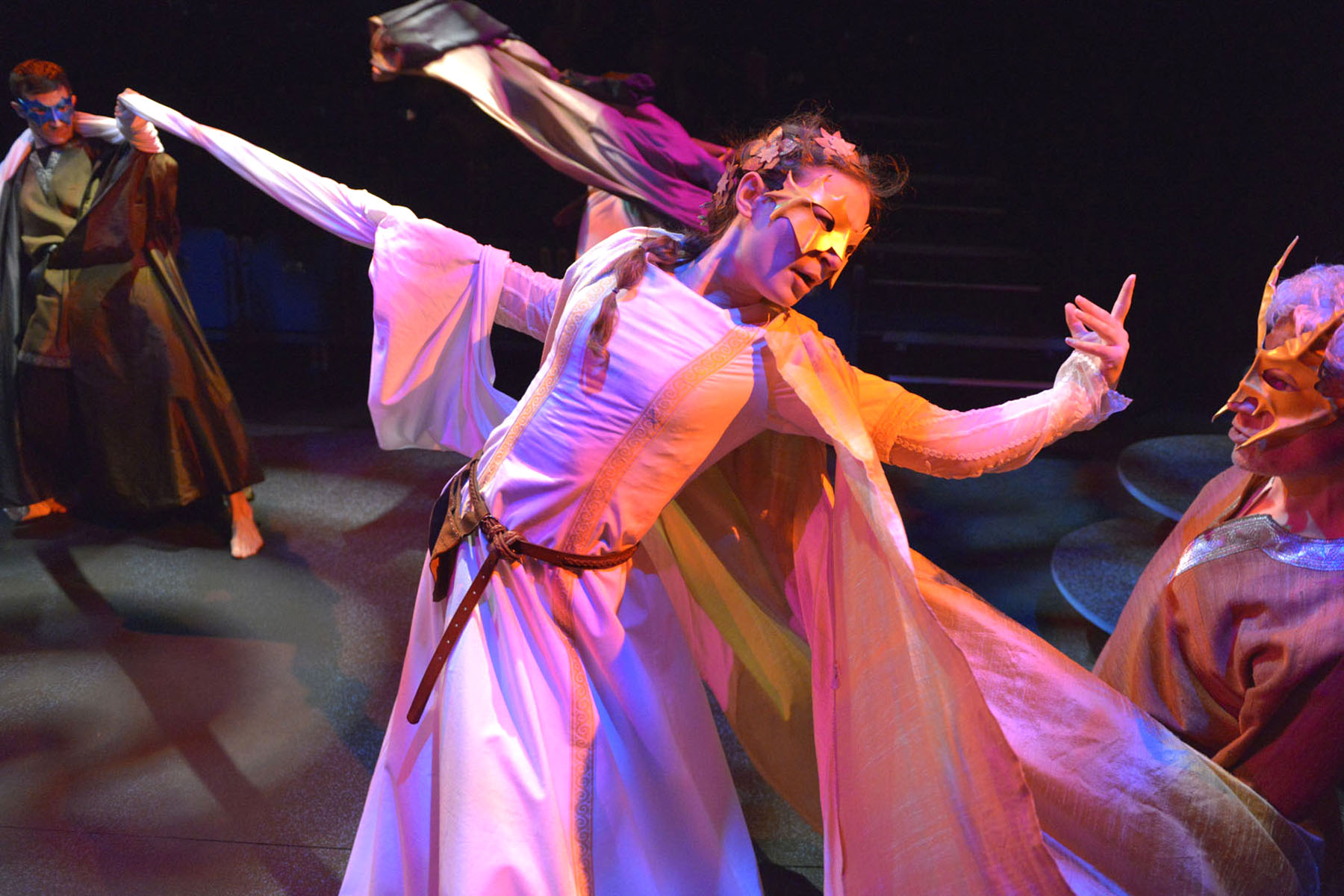
When I heard ‘new play about King Arthur written in verse’, I had mixed expectations. Although I always want poetry and verse to succeed, dealing with an established subject matter such as the legend of King Arthur, while using a more traditional form of script-writing, risks the drama feeling staid.

However, despite the play’s mythological setting, it has a contemporary feel. Benjamin Askew’s adaptation of the legend is carefully crafted and controlled, with dialogue that seems both natural and poetic at once.

The Lady of the Lake is also a play which asks big questions about narrative, authorship and autonomy. Framed in the context of a troupe of players, it becomes a play less about the story itself (although it is, of course, a riveting plot), and more about how that story is told and, more importantly, how it is remembered.

Mary Papadima’s stylised direction perfectly complements Askew’s beautiful and subtle verse, while Elizabeth Wright’s deceptively simple set creates almost a blank canvas on which any story could be told.

The integration of music and movement creates a sensory whirlwind, which at times gives the play an almost impressionistic feel – as though reminding us that the story unfolding before us is as fluid as the lake itself.

The only let-down to The Lady of the Lake is its length, occasionally slave to the richness of its intricate plot and sumptuous beauty of its dialogue. However, there is enough talent in the writing and cast to minimise this issue, with Patrick Bridgman playing an uncertain, heartfelt and sympathetic Arthur, years after his prime. Richard Keightley is a disturbingly enigmatic Taliesin, while Charlotte Mulliner and Emily Tucker channelled much of the show’s vivacious energy as Nimue and Morgan.

Benjamin Askew’s The Lady of the Lake is an ambitious play that (for the most part) carries through. In style and technique it is unlike anything I have seen at Theatre by the Lake in recent years: an intriguing piece of theatre.

Theatre by the Lake production of THE LADY OF THE LAKE by Benjamin Askew directed by Mary Papadima
~ Ben Ingles (Owain), Emily Tucker (Morgan), Patrick Bridgman (Arthur/Old Taliesin): photo by Keith Pattison ~

~

The Lady of the Lake runs in the Studio at Theatre by the Lake until Friday 6th November

Yesterday, I posted the trailer to my upcoming musical, Yesterday.

Created in collaboration with friend and composer Stephen Hyde, Yesterday is an intimate new musical telling the story of Alex: a charming, vulnerable and adulterous man. The story is told from the perspective of the three women in his life: the mother who smothers him with love, his deceived wife searching for hope in their marriage, and the the teenage girl in whom he finds solace.

Here is one of the songs from the musical, recorded by Vulture Sessions. Performed by Georgia Figgis, Jemimah Taylor and Joanna Connolly.

More about the musical here.


Mr Paradise and Suddenly Last Summer at Theatre by the Lake

Theatre by the Lake production of Mr Paradise and Suddenly Last Summer by Tennessee Williams directed by Mary Pappadima
~ Polly Lister, Kate Layden, Richard Keightley, Cate Hamer & Emily Tucker: photo by Keith Pattison ~

‘The work of a poet is the life of a poet, and vice versa, the life of a poet is the work of a poet. I mean, you can’t separate them. I mean, a poet’s life is his work, and his work is his life in a special sense.’

Suddenly Last Summer and Mister Paradise are plays about words: about their persistent endurance and the power it gives them.

Where there is power, there is usually fear, and Mary Papadima’s production of Tennessee Williams’ plays contains this fear perfectly, like a wild animal held in a cage barely strong enough. In Suddenly Last Summer, the focal point of this tenuous restraint is the conflict between Mrs Venable (Kate Layden) and Catharine (Emily Tucker). Layden beautifully conveys the desperately wielded control of a woman all too aware that control is slipping away from her, but it is Tucker who truly commands the audience’s attention. Her performance of a frantic and traumatised girl, clinging to the edge, is both powerful and moving; in the battle between dreadful truth and respectable reputation, it is undoubtedly her voice that cries the loudest and speaks the strongest.

Mister Paradise is also a conflict between two characters over the issue of truth versus reputation, although it is much quieter than that in Suddenly Last Summer. Both Peter MacQueen (as Mr Paradise) and Charlotte Mulliner (as the girl) address their sides of the question with honesty and sensitivity. Mulliner’s youthful optimism and MacQueen’s more experienced, world-weary reluctance act as two sides of the coin on which Mr Paradise’s legacy spins. The two work well together, sparking off one another so that at times, it is like watching a tennis rally, and other times, like watching a fusion of minds.

The two plays sit well together, too. By juxtaposing the two, Papadima brings out the common themes of truth and reputation, and the power of words in creating both. In doing so, she not only puts Tennessee Williams’ two plays up for comparison, but also gives added to power to the words of the plays themselves.

Manly Beach, Sydney, Australia

Last week on my travel blog, Second-Hand HedgehogI talked about the joy of doing work, and the satisfaction that comes through hard-earned achievement. Today I want to turn that on its head – sort of. Actually, I think they’re more like two sides of the same coin.

It’s all very well forcing yourself to do the work that deep down you know you need to do, but it’s quite another thing to do it constantly, and it’s easy to wear yourself out. I’ll hold up my hand as guilty to this – sometimes, I just need to learn when to stop working and rest.

This is probably partly why the travel bug first bit me so hard. I’ve always been a busy person (I was that girl at school who was in every lunchtime club and after-school group going), and I used to fill up my school holidays with camps, courses, projects and, later, with paid employment. Going away on holiday took me away from all of that, and just let me rest. I would sight-see, read books, lounge by the pool or in the sea, and not really have to think about all the things I would normally be thinking about at home.

And this has only become even more pronounced as I’ve got older. At university, I took a year out of my degree to study abroad in Melbourne: a fantastic experience that also meant I was less stressed and more prepared to take on my final year of university. (And come out with a fairly good mark – though of course I don’t like to brag…)

Now I’m working two jobs, plus the odd bit of freelance work, plus trying to find time to write, plus blogging, plus trying to run a house (though I’ll admit the housework does tend to take a back seat – as in, really far back).

Travelling to get away has become essential.

Suitcases on a boat heading for the horizon, Yasawa Islands, Fiji
~ heading for the horizon: Yasawa Islands, Fiji ~

But my problem? I can’t switch off.

This is partly literal: I have a smartphone and everywhere has wifi, so I’m constantly instagramming my travels / updating facebook / tweeting / responding to emails etc. etc. But it’s also a mental thing. I can’t seem to switch off this feverish part of my brain that always insists: you should be working, not idling about enjoying yourself, because goodness knows you’ve got SO much to do, and it isn’t going to happen by accident, you know, and what happens when you suddenly look in the mirror and realise you’ve reached your dotage and not achieved anything you wanted to achieve in life…?

Let me give you an example: a few months ago, I went down to London for a long weekend to visit some friends. I arrived in the evening, stayed overnight with one friend, and then had about 8 hours in the city before meeting up with the second friend. I planned to spend those hours in galleries and museums, soaking up some culture and and enriching my mind / soul / whatever.

This went fairly well for a few hours. I spent some time in the V&A, admiring the sculpture and following their Shakespeare Trail, then having a picnic lunch in their courtyard while watching the children playing in the fountain and splashing their parents.

Then I felt that familiar niggle at the back of my mind. Maybe it was the presence of all this great art, reminding me that I should probably be working towards creating something of my own. Maybe it was the constant bustle that a gallery (and a city) provides, reminding me that I ought to be busy. Maybe I’m just no good at stopping and relaxing.

I left the V&A to see if the National Gallery could hold my attention for longer, but no: I’d barely been in there fifteen minutes when I started to feel restless.

The result? I spent the next two hours sitting in a coffee shop overlooking Trafalgar Square, working on my writing.

Beach Cafe, St Ives, Cornwall
~ a bit more relaxing than the cafe in Trafalgar Sq: St Ives, Cornwall ~

I’m not saying that’s necessarily a bad thing. Generally, any time I spend writing I see as time well spent. It’s definitely something I’d like to do more of.

What worried me was my absolute inability to relax. It was like an addiction: twelve hours without working and I was getting withdrawal symptoms. I couldn’t concentrate on anything, I felt restless, and the weight of my notebook in my bag was like a constant pressure on my mind. As much as I promote living a life of creativity, that can’t be healthy – can it?

Probably not, but after I’d done those couple of hours of work, I felt much calmer, and enjoyed the remainder of the weekend far more.

Let’s contrast that with a slightly more recent experience.

A couple of weeks ago, I spent about ten days working intensively and (almost) solidly on a writing project with a collaborator. We created tons of material, pretty much draining ourselves of our creativity by the end of it. That’s ok – we had a limited amount of time together and needed to get the work done before we parted ways.

But at the end of it, I forced myself to take a day off from the project. It might not seem like much, but that day allowed me to recharge my creative batteries, and get the project back in perspective.

Yes, I missed the intensive writing I’d been doing on the previous days, but actually, it felt like a bit of a relief to take a day to myself. And for me, that’s where the difference lies: do I have a burning desire to create, or not?

If that burning desire is there, then maybe the break from working can be postponed. After all, nobody wants to shut the door in the face of inspiration.

But if you’ve drained yourself of all your creativity, if you’re just bashing out words for the sake of it, then that’s the time to stop. Take a break. Go for a walk and admire the landscape, or head to a coffee shop and people watch for an hour or so. Take a day to do the housework and ignore your creative projects. Spend a long weekend in a city you’ve never explored. Relax for a week or two on a tropical beach.

The most important thing I’ve learned is to listen to myself: my body / mind / soul / whatever bit of me it is that does the creative thinking. If it’s exhausted and in desperate need of a rest, I humour it. It’ll work that much better once I start again.

Sunset on the beach: Jake's Point, Western Australia
~ relaxing with a sunset on the beach: Jake’s Point, Western Australia ~

About a year ago, I discovered the work of Nina Katchadourian.

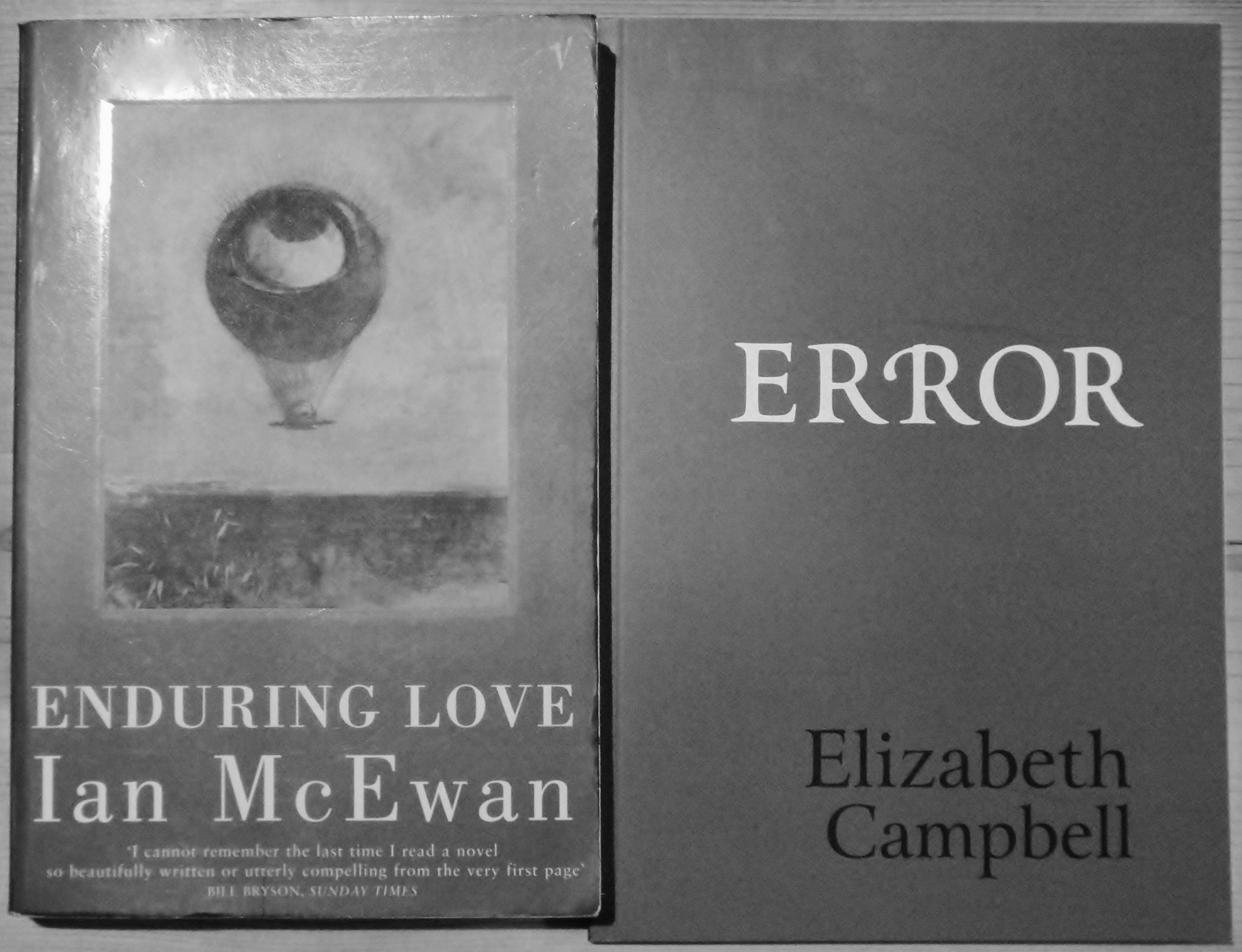
Katchadourian is a Californian artist, who has a series of ‘stacks’ or ‘spine poems’. In these works, she arranges books (usually in stacks, but occasionally side by side) so that the titles create poems.

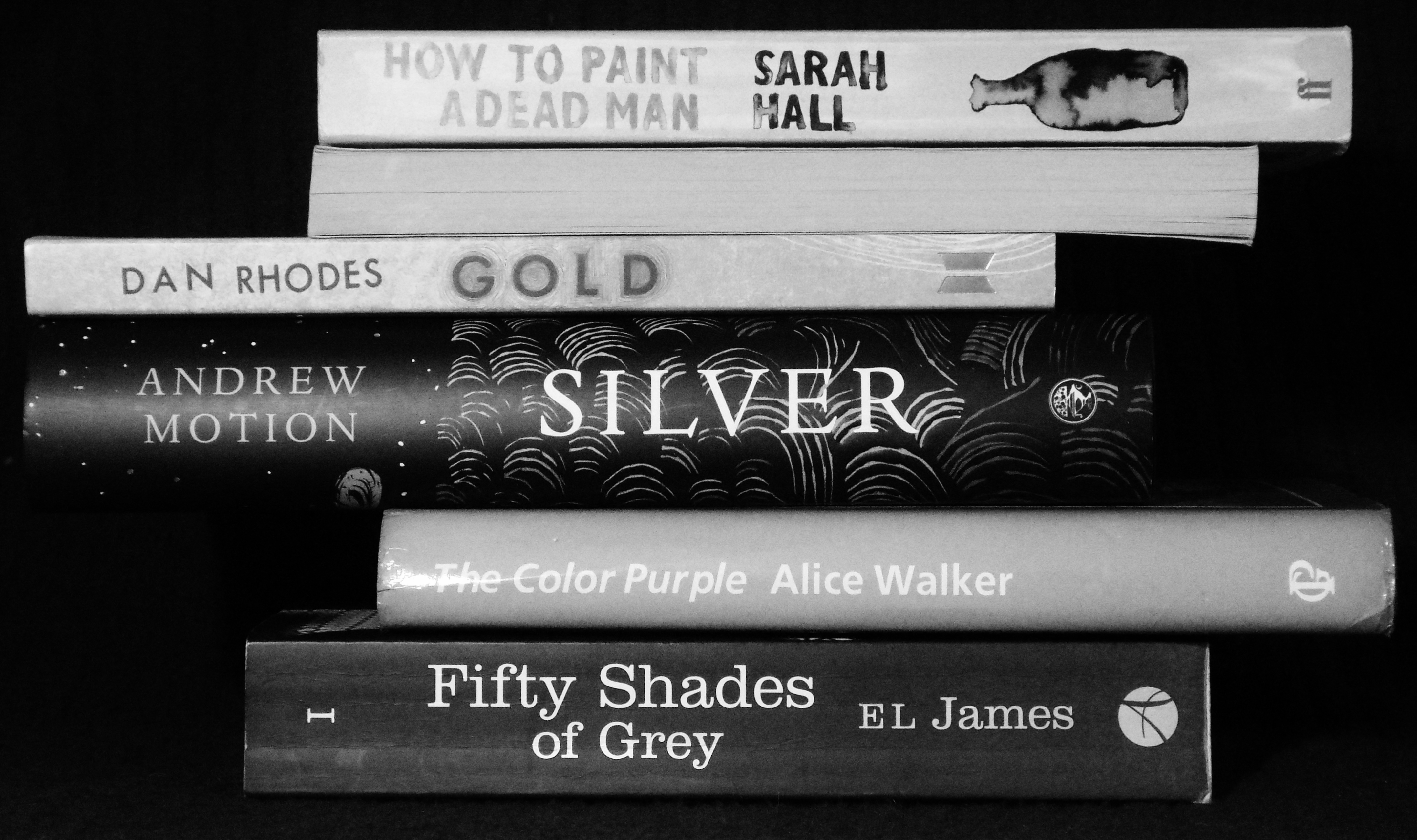
I thought I would have a go at some of my own ‘spine poetry’, just using the books on my shelves:

*

Spine poetry by Katie Hale, inspired by Nina Katchadourian

The Alchemist on Poetry:

The making of a poem
out of danger;
mining for the light
out of the blue
day.

*

Spine poetry by Katie Hale, inspired by Nina Katchadourian

Enduring Love:

Error.

*

Spine poetry by Katie Hale, inspired by Nina Katchadourian

Frankenstein:

The lovely bones;
heaven eyes;
portrait in skin:

regeneration;

talk of the town.

*

Spine poetry by Katie Hale, inspired by Nina Katchadourian

My Brilliant Career:

The accidental
strong words…

…Goodbye to all that.

*

Spine poetry by Katie Hale, inspired by Nina Katchadourian

How to Paint a Dead Man:

Gold.
Silver.
The colour purple.
Fifty shades of grey.

*

I’ve talked about my job project managing New Writing Cumbria here before.

One of the great things about it is getting to organise (and attend) events like this one, held on Valentines Day: n evening of music and spoken word, featuring Lady Layton, Les Malheureux, and a quiz. Plus, what Valentines night would be complete without a bar, a few love letters, and the chance to burn the name of your ex?

Just a few shots from the evening:

New Writing Cumbria online magazine: The Carrot

At the moment, I have a number of jobs, but one thing that I love about all of them is helping to create interesting artworks. Whether I’m helping teenagers explore the possibility that they can write poetry, or helping facilitate theatre tours and exhibitions at Prism Arts, or working on my own writing, it’s always exciting to see the seed of an idea come to fruition.

Through my job as New Writing Cumbria, I’ve been working with a group of young writers and editors to produce an online magazine of new Cumbrian writing. And I’m delighted to say that Issue #1 has now been published.

For the first issue, we chose the theme ‘Cumbria-land’. We invited anybody from or living in Cumbria to submit work on the theme – but there was also a bit of a twist. While we did want some of the more traditional types of writing (poetry / fiction / script etc.), we also wanted to explore some of the extra options that creating an online magazine provided.

So we actively encouraged people to submit something a little bit different: film / audio / visual art / crosswords / recipes / jokes…

Admittedly, we didn’t receive any crosswords, recipes or jokes (next time, please?) but we did receive a number of visual and audio pieces, as well as some video. We also used visual art from some of the 2014 Young C-Artists.

The idea was to create something that was fun and vibrant: something that didn’t look like a traditional magazine. And I have to say, I think we succeeded.

We had some excellent submissions, from a large number of writers / artists, and working with the young editors was fantastic. It was great to see them getting so passionate in their discussions over which pieces should be included, and it’s moments like that which remind me just why I love doing the jobs I do.

So don’t be shy: head on over to The Carrot and have a read / watch / listen!

One day a week (plus a bit extra), I run New Writing Cumbria for Eden Arts. We do a number of things, btu one thing we’ve just started is putting on events at Penrith Old Fire Station. The first one went down a storm!

The evening featured poet Kareem Parkins-Brown, musicians Kev Kendal and Bill Lloyd, writer Stephen Redman, and filmmaker Richie Johnston. Oh, and a bar inside a horse box, naturally.

Here are a couple of shots from the night: