

How do you support yourself as a writer? How does poetry pay the bills, or fiction keep the wolf from the door? Every year, I write a blog post about exactly that – detailing where my income has come from during the previous year.
Here’s this year’s version:
The end of the UK financial year may have been a couple of months ago already, but it’s been a heck of a couple of months! With residencies in Scotland and Spitsbergen, not to mention a new book out. But now, last year’s finances are in order, I’m getting ready to sort my tax return (I know, I know – I’m a swat, but I hate leaving it to the last minute), so I thought it was time to make some coloured graphs and share the data.
This time last year, I was talking about the end of Covid-19 support grants, and the difficulties presented by the move towards hybrid working. Covid-19 is obviously still having an impact on freelance earnings (both systemically, and on an individual basis, with so many people finding themselves working at reduced capacity due to long covid and/or burnout) – but the other big words I keep hearing this year are Cost of Living Crisis.
Back in March, I was asked to give a talk for Cumbria Arts & Culture Network, about working as a freelance writer during the Cost of Living Crisis. The main points I made were:
- in the institutional ladder, freelancers are often at the bottom, which means that any money that does come in often takes longer to trickle down to the freelancers, but also that, when there are cuts, freelance work often suffers first – and when the work does keep coming, our rates are expected to stay the same as they always have been (and so not reflective of inflation, meaning that, in real terms, we’re working for less).
- for freelancers with dependents, this is all exacerbated
- many of us are already struggling financially, following the past few years of disruptions
- in publishing, there’s been a backlog caused by Covid, and publishers (like freelancers) are exhausted and burnt out
- many freelance writers are ourselves suffering from long covid, in one form or another, which affects our capacity to work & earn
- risk of reinfection is still an issue, and for many writers, this is still a barrier to accepting in-person work
In times like these, freelancers & artists particularly are often called on to be dynamic – to find innovative ways of working that will set us apart from our so-called competitors, and help us not only to survive in a financial crisis, but to thrive. But of course, when so many of us are already burnt out, trying to cope with new levels of post-covid fatigue, and already financially struggling, the capacity for dynamism is limited.
That said, it is possible to make a living as a writer. After all, that’s the point of these posts.

Where did my income come from last year?
In 2021, I listed 5 categories:
- Funding: money from grants.
- Facilitation: both workshop facilitation and facilitation of creative projects. (These go into one category, because project money will often include funding for both the delivery and administration side, lumped together.)
- Writing: commissions, royalties, ALCS money, PLR money, prize money – anything that comes from the actual writing of the actual words
- Events: panel events, chairing and readings (in person and online and even over the phone).
- Residencies: stipends & payment from attending writing residencies, or fulfilling Writer in Residence roles.
- This year, I’ve also reinstated a 6th category: Admin. Arts administration is something I used to do a lot, earlier in my career, and something I’ve gradually moved away from (although of course, it’s always necessary as a component within all my other work) – but last year, I worked as Festival Co-ordinator for Kendal Poetry Festival, so I’ve included that work here.
As a reminder, here’s where my income came from in 2021:
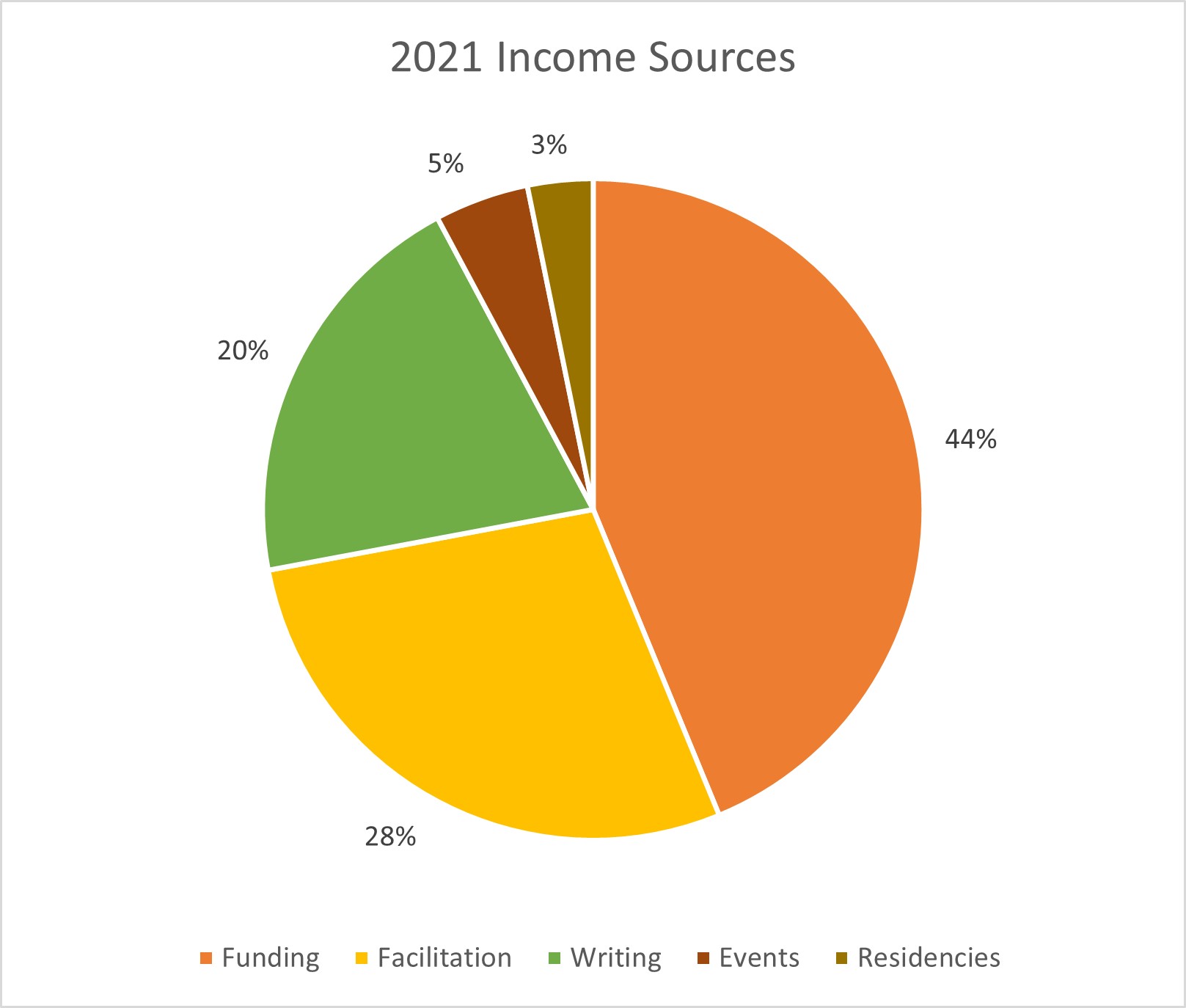
As we can see, largely that income came from grant funding and project / workshop facilitation – along with 20% coming from writing itself.
So how does that compare to this year?
(I’ve slightly changed how I measure my income this year: switching from looking at the calendar year, to looking at the financial year. This was something that just made sense to me, to tie my calculations in with the data I need to gather anyway for my tax return each year. But, since I’m still analysing a full 12 months of data in each case, the results are still comparable.)

The proportions earned from funding are actually pretty similar across both years: 44% in 2021, and 42% in 2022-23. This year, that’s taken the form of a Northern Writers’ Award for Fiction (which includes funding to work on my second novel), and a Developing Your Creative Practice Grant from Arts Council England. In some ways, the DYCP grant skews the results slightly, because while I did receive the bulk of the funding in 2022-23, much of it was to pay for work which I’m only coming to now, in the 2023-24 financial year. But then, that tends to be symptomatic of the freelance life: not only up and down between months, but also across years. But more of that later.
My other two biggest earners this year were facilitation and money from my actual writing.
So, in many ways, 2022-23 was similar to the year before, and a clear indicator that those are the three main areas of income I need to focus on: writing, funding & facilitation.
But it isn’t the only story – because this year, those other smaller earners (residencies, admin & events) constituted a full 20% of my annual income, as opposed to just 8% the year before. What does that tell me? In the first instance, it tells me not to ignore them as income streams. It also harks back to what I was saying at the start of this post: that, during a cost of living crisis, it can quite literally pay to be dynamic, and to diversify work & forms of income. It’s a balance though – spread yourself too thin, and you end up burning yourself out more than ever. What was great about these income streams, was that they were all things I’d done before (or variations on previous work); I wasn’t having to carve out an entirely new niche for myself, but instead, was leaning into things I already knew, and making the most of old connections.
What has my income looked like on a month-by-month basis?
Well, like every year, it’s been a bit up and down:

As you can see, I had a few big months last year:
- January (when my Arts Council grant came through) was easily the biggest earner – but then, as I’ve already mentioned, a lot of that money was earmarked to pay for work that would happen in the following financial year.
- June, when I got paid for all of my Kendal Poetry Festival work (which was work which had been done over several previous months).
- July, when I received the Northern Writers’ Award.
Slightly smaller were December, February & March: winning the Aesthetica Prize in December, my first payment for working with the Writing Squad in February, and just working as many hours as there are in the day during March (like I said, I had a book out).
As for the other months, these were mostly times when I either didn’t make enough to pay the bills that month, or did manage to, but barely. But that’s ok. Partly because they’re offest by those much bigger months, and partly because, every time I get paid, I put a little bit away in savings for a rainy day. The trick, or luck, or however you want to phrase it, is getting the right balance.
How is this year shaping up so far?
Only 3 months into the current financial year, and already things are looking… adequate.
As in, I’m not buying a superyacht (or even a very basic yacht) any time soon, but based on work I’m already contracted for (or can reasonably expect to be contracted / re-contracted for), I’m earning an acceptable income – a mixture of smaller one-off pieces of work, and a couple of larger payments. But hush hush for now – more on what they might be another time!
Want to keep reading? How about:
How To Make a Living as a Writer: 2021 Edition
How To Make a Living as a Writer: 2020 Edition
How To Make a Living as a Writer: 2019 Edition
How To Make a Living as a Writer: 2018 Edition
How To Make Money From Your Novel
How To Make a Living as a Poet (advice from people much better at it than me)
or check out my Resources for Writers for more tips, posts & opportunities!
 Katie Hale
Useful as ever – thank you for being so honest Katie!
Thank you so much Beth!