The Find

The day you found the seal skin on the beach,
you called to me to look. You stared
at the folded stinking mess of it:

the jilted flippers, the serrated fur, the tear
where it was pulled from its body.
You did not know my longing for the sea.

I bent to stroke it, ran my fingers
over the blooded blubber, weighing
half-human in my arms.
I wrapped myself into its comfortable wetness.

Turning to look at you with my new
black eyes, I slipped back
into the rocking waves – the way a hand
slips once, and quietly, from a sleeping form.


‘The Find’ was commended in the 2015 Ware Poets Open Poetry Competition

Happy New Year!

When I was running Rabbit Rabbit (rabbit) young writers’ group, I used to send the young writers a writing prompt every week. I missed doing it, so I’m going to share a writing prompt as part of my weekly (weekend-ly) blog posts. I’m not Jo Bell, and this isn’t 52, so I’m going to share one a month rather than one a week: the first Sunday of every month.

And because this is January and it’s the first one, I thought I’d share a prompt about beginnings.

writing prompt - Katie Hale

If you think about famous novels, there are probably at least a few whose opening lines come to mind. Which makes sense – the beginning of a book is the part that’s supposed to grab us and make us want to read further.

For me, a good opening to a book is one that draws me in. It’s one that raises questions, or suggests a struggle that needs to be resolved. Sometimes it puts us right in the middle of the drama, straight away.

Take these examples – which, because we’re still within the festive season, I’ve done as a quiz (answers at the bottom of the post):

QUIZ:

  1. ‘It was a cold day in April and the clocks were striking thirteen.’
  2. ‘Marley was dead, to begin with.’
  3. ‘When he woke in the woods in the dark and the cold of the night he’d reach out to touch the child sleeping beside him.’
  4. ‘He was an old man who fished alone in a skiff in the Gulf Stream and he had gone eighty-four days now without taking a fish.’
  5. ‘People are afraid to merge on freeways in Los Angeles.’
  6. ‘Lyra and her daemon moved through the darkening Hall, taking care to keep to one side, out of sight of the kitchen.’
  7. ‘When the doorbell rings at three in the morning, it’s never good news.’
  8. ‘It was love at first sight. The first time Yossarian saw the chaplain he fell madly in love with him.’
  9. ‘He was afraid to go to sleep. For three weeks, he had been afraid of going to sleep.’
  10. ‘The boys, as they talked to the girls from Marcia Blaine School, stood on the far side of their bicycles holding the handlebars, which established a protective fence of bicycle between the sexes, and the impression that at any moment the boys were likely to be away.’
  11. ‘It was the best of times. It was the worst of times.’
  12. ‘The boy with fair hair lowered himself down the last few feet of rock and began to pick his way towards the lagoon.’
  13. ‘They say it came first from Africa, carried in the screams of the enslaved.’
  14. ‘In my younger and more vulnerable years my father gave me some advice that I’ve been turning over in my mind ever since.’
  15. ‘Like most people I lived a long time with my mother and father. My father liked to watch the wrestling, my mother liked to wrestle.’

How many did you get? Answers at the bottom of the post…

*

Writing a gripping first sentence is all very well for the opening of a novel, which sets up plot and conflict and character and story. But what about poetry?

I wonder how many of us think about setting up conflict and character and story in the opening of a poem? I wonder how many of us write opening lines to grip people with the drama of the poem, the way we might in a novel?

So that’s my prompt:

Write an opening line for a poem, which sets up drama and / or mystery, and whose sole purpose is to grip the reader.

Then, and only then, you can try writing the rest of the poem.

Here are a few poems that I think grip the reader really well:

‘Here, Bullet’, by Brian Turner

‘Bird’, by Liz Berry

‘Kiss’, by Ruth Padel

Happy writing!


ANSWERS:

  1. Nineteen Eighty-Four, George Orwell
  2. A Christmas Carol, Charles Dickens
  3. The Road, Cormac McCarthy
  4. The Old Man and the Sea, Ernest Hemmingway
  5. Less Than Zero, Bret Easton Ellis
  6. Northern Lights, Philip Pullman
  7. Stormbreaker, Anthony Horowitz
  8. Catch 22, Joseph Heller
  9. Strange Meeting, Susan Hill
  10. The Prime of Miss Jean Brodie, Muriel Spark
  11. A Tale of Two Cities, Charles Dickens
  12. Lord of the Flies, William Golding
  13. The Brief Wondrous Life of Oscar Wao, Junot Diaz
  14. The Great Gatsby, F Scott Fitzgerald
  15. Oranges are not the Only Fruit, Jeanette Winterson

I’ve never been very good at new year’s resolutions. Or rather, I think I’m good at them in the same way that everyone else is good at them: for about 3 weeks in January, and then letting them fall by the wayside for the rest of the year.

But this year, I’m making a number of them, and I’m determined to still remember what they were this time next year. Even more, I’m determined to achieve them, so that next year I have to come up with some new ones.

poetry definitions - Katie Hale
^ I guess I could aim not to be a ‘poetaster’…?

If 2016 has been the year of celebrity deaths & surprise election results, then I’m intending to make 2017 the year of writing-in-numbers (as distinct from writing-by-numbers, which is not to be encouraged).

And those numbers are: 100, 50 and 1

*

RESOLUTION NUMBER 1:

Inspired by Kim Liao’s article back in June, I’m aiming for 100 literary rejections.

This is the one resolution that I actually don’t mind whether I achieve it or not. The idea is that aiming for rejections is less daunting than aiming for acceptances, so you’re more likely to bite the bullet and submit in the first place.

And 100 is such a big number that it forces you to think outside the box and submit to opportunities that you wouldn’t normally consider inside your comfort zone. Given that this is exactly how I got my place on Penguin’s WriteNow insight day in Manchester for February 2017, it’s something I already believe in: apply for opportunities, as you never know where that opportunity may lead.

(Obviously, if I somehow miraculously achieve 100 acceptances instead of 100 rejections, I think I’ll get over the fact that I didn’t tick off the resolution itself.)

new year writing resolutions: Katie Hale

RESOLUTION NUMBER 2:

As always, I’m aiming to read 50 books in 2017.

This is always my resolution (at roughly one a week, I see no reason why I shouldn’t be able to achieve this). In 2016 I read 57 books, and I’d quite like to read more this coming year. After all, reading is the key to writing.

As for what I’ll be reading, I already have a few books lined up – thanks in part to a late December splurge at the New Hedgehog Bookshop in Penrith. And then I’d like to read some of the poetry & fiction that’s been waiting patiently on my shelves, as well as building a bigger library of contemporary plays. And with StAnza in March and Kendal Poetry Festival in June, I’m pretty sure there’ll be plenty of new poetry to tempt me.

*

RESOLUTION NUMBER 3:

To write 50 blog posts for this blog.

Really, I’m going for one a week, but 50 is a nicer number than 52, and it gives me a little bit of wiggle room.

Some of these will be writing updates, some will be actualy pieces of writing (from me and hopefully also from some of my schools workshops), and some will probably just be a bit of fun.

I’m also planning to post a monthly writing prompt, on the first Sunday of every month. When I was running my young writers’ group, I used to email the young writers a prompt every week – so I thought I’d continue the tradition, but on a slightly less frequent basis. After all, I’m not Jo Bell.

script writing for theatre - Katie Hale

RESOLUTION NUMBER 4:

To take 1 show to the Fringe.

But more on that in the new year, hopefully. Spoilers!

*

RESOLUTION NUMBER 5:

To finish at least 1 draft of the novella.

1 draft. 1 very very rough and probably unfit-for-human-consumption draft.

Actually, I’m hoping to have this completed by the end of February, so really there’s no reason not to complete several drafts of it in the months that follow. At least, that’s the plan. But other things always crop up – and yes, Stephen, if you’re reading this, don’t worry: I will also be working on the rewrite of Yesterday during this time. Just hoping that old stereotype about women being good at multi-tasking proves to be true!

typewriter - Katie Hale

So there are my 5 new year’s resolutions for 2017.

2016 has felt a lot like finding my feet as a full-time writer. I’m hoping that 2017 is when I’ll really start to run.

*

Happy New Year!  🙂

Save

The end of another year, and a whole 12 months since I gave up my main source of income in order to focus more on my writing. A whole 5 months since I went completely freelance. I don’t think it’s any less scary than it was back in January, but it’s a funny thing, looking back on a year. In some ways it seems like forever, and at the same time it feels like no time at all.

For instance, I feel a little bit like I’m still taking baby steps; I’m definitely still an ’emerging’ writer, though I’m not sure how I’ll know when I’ve actually ’emerged’. But then when I sit and list everything I’ve done this year, it feels like much more than a year’s worth of work.
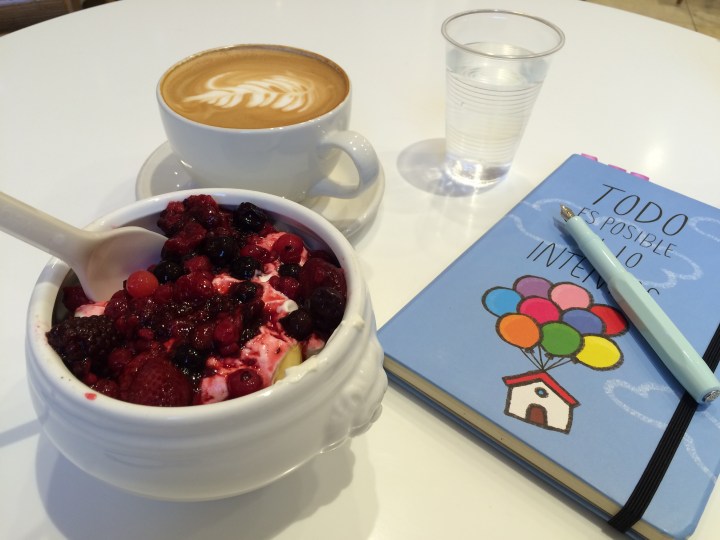
Writing at the Wellcome Collection

Poetry

Most of my focus this year (as always) has been on poetry, and writing as much of it as I can. I’ve started going to Kim Moore’s Barrow poetry writing workshops, and Brewery Poets writing group, and a monthly poetry sharing evening in Shap, which have all been great for making me write more. So great, in fact, that I’ve started writing a new long poetry sequence (so a huge thanks to the Poetry Business workshop at Kendal Poetry Festival, for the spark which set that sequence off for me in June).

As if that wasn’t enough, I’ve also started a monthly wordy open mic night in Penrith. Word Mess takes place on the 3rd Tuesday of every month (except December & August) in the old mess hall at Penrith Old Fire Station (Eden Arts). Attendance has been building steadily, and we now have a lovely little group of regulars, and a slightly bigger group of occasional-ers – though whether they come because of the quality of writing or the quality of the bar is anyone’s guess! Maybe for both.

In terms of my own poetry, it hasn’t gone badly: a couple of poems in magazines, including one that’ll be in The North in January; a commended poem in York Poetry Competition; and being shortlisted for the Jane Martin Poetry Prize.

Not bad – but it isn’t all about poetry.

I don’t know how other people work, but I meet a lot of people who categorise themselves. ‘I’m a novelist’, or ‘I’m a poet’, or ‘I write for theatre’. Obviously there are people who pick a form and stick to it, which is fine if that works for them – but I used to think that was the only ‘correct’ way to do things. In fact, I spent a couple of years actively not writing anything but poetry, because I had this bizarre notion in my head that writing prose or script would somehow make me a lesser poet.
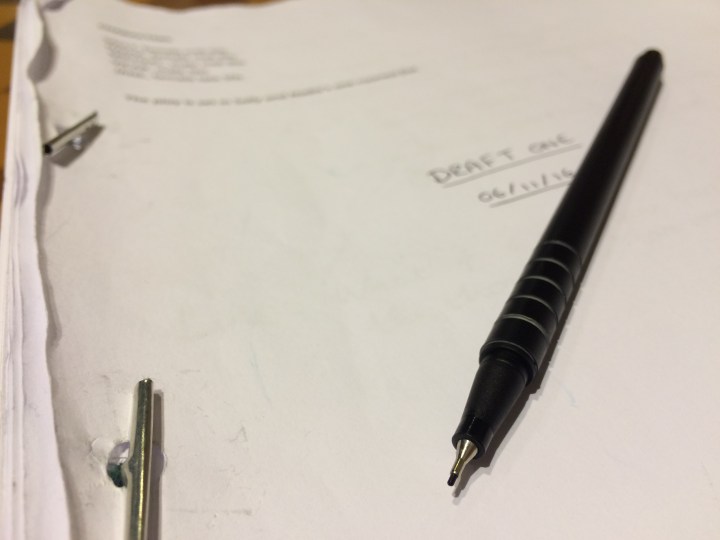
script writing for theatre - Katie Hale

Theatre

Writing Yesterday with Stephen Hyde last year, the theatre bug bit me again, and those play ideas that had been simmering under the surface kept nudging at me – so this year, when I suddenly had more time on my hands, I decided to let them out.

This year I’ve drafted two play scripts – both of which are currently both sitting in a drawer fermenting, until enough time has passed for me to look at them with fresh enough eyes to give them a proper redraft. It’s been so great to get back into playwriting, that I almost don’t mind whether anything happens to them or not. The feeling of exercising those script-writing / dialogue / plot muscles was satisfying enough in itself. Like when you go for a run after a long period of inactivity, and you feel a kind of glorious ache in all the muscles you haven’t used for ages.

Then, while I was stuck in Tulsa airport for 24 hours as a storm raged in Chicago and the UK voted to leave the EU, I wrote the lyrics for a new song (also by Stephen Hyde), for the Three Inch Fools’ touring production of Macbeth. I think there may be a recording of this surfacing at some point in the new year, but for now, if you’re not already a Fools fan, you should definitely check them out.

I’m also getting stuck back into the rewriting process of Yesterday, working with Stephen. After a few months working very solidly on my own, it’s good to get back to collaborating again, and to remember that excitement of bouncing ideas back and forth between two people until they become something much bigger than either of you could access alone, and neither of you can quite say who came up with what. Much more of this to follow in the new year…

New York - writing in a cafe, Katie Hale

Fiction

Ok, so I haven’t really been a fiction writer for about half a decade. Like most writers, I guess, I started out writing fiction, because stories are the first creative thing you’re taught to write in school. But my poetry, and even my theatre, has superceded my fiction for the last ten years, and the fiction has been basically absent for around half that time.

And yet… Like a lot of people, I had a novel lurking. You know the one, swimming in the depths of your brain – the one that floats to the surface when you feel particularly inspired by a good book you’ve read, or when you’re trying to get to sleep, or doing the dishes.

This year, I decided to give it a go. So far, I’m only about half way through the initial drafting stage, so there’s no knowing whether anything will come of it, or whether (perhaps like the play scripts) it will just sit in my desk drawer. But already it’s looking hopeful.

Over the summer, Penguin Random House put out a call for submissions from minority writers, to receive a place on one of their WriteNow insight days, which includes a 20-minute one-to-one with an editor. Having submitted an application & 1000-word extract with my ‘I’m not really a fiction writer but I’ll give this a go’ hat on, I couldn’t really believe it when I heard I’d got a place on the Manchester insight day in February 2017 – especially when I heard that there were over 2000 applications for just 150 places. Talk about a confidence boost!

Even if nothing else comes of this, that acceptance email has given me the confidence to write a novel (well, novella) that otherwise would have remained unwritten.

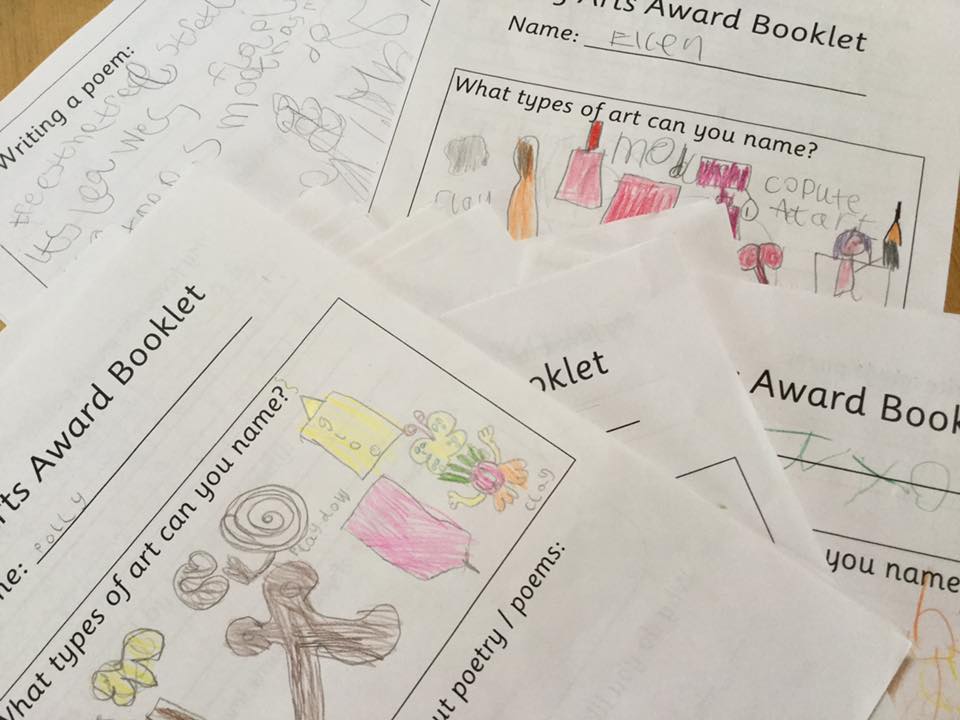
Arts Award Discover workshops

Projects

Work-wise, my main project this year has been running schools workshops and delivering Arts Award Discover. I delivered I-can’t-quite-remember-how-many workshops in schools for the Wordsworth Trust, to tie in with their Arts Award Discover project, where the children wrote poems about places that meant something to them. I also ran Arts Award in Shap and Clifton Primary Schools, which was great fun – especially in Shap School, which was my alma mater. (Can you call it an alma mater for a primary school, or is that just for universities?)

As always, the children blew me away with the quality of work they produced. One particular phrase that I wished I’d written myself came from an 8-year-old, who wrote, ‘I am as shy as a funeral.’ I think I was too gobsmacked to think clearly for about 5 whole minutes. So that night I shared the simile on facebook, and got a whole host of gobsmacked reactions from other people, too.

Oh, and speaking of sharing…

This year I created Poetry Plaster Packs. The idea was to share little packets around Penrith on Valentine’s Day. Each one contains: a plaster (for the literal cuts and scrapes), a cheerful little poem (for the figurative ones), and a little gift – because let’s face it, who doesn’t love a present? I shared about 40 on Valentine’s Day, and a few more since. I suspect I may be distributing a few more in the new year, too.

I’ve also had 3 online projects this year:

The Sam Thorpe Trust Fund: I put together the website for this earlier in the year, and it’s worth checking out, especially if you’re in the Penrith area. The Fund gives grants to young people who want to do something extraordinary, and to schools / organisations that work with young people.

#SomethingGood: On Wednesday 9th November, I was sitting on my sofa in a state of shock, having spent an almost-sleepless night watching America elect a future president with no history of government but a long history of racism, misogyny, and abuse of power. I wanted to do something, but I wasn’t sure what. Some of my American friends were posting on social media about how to contact your senator to raise protests, but I’m not American; I don’t have a senator. Instead, I decided to do something quieter, but hopefully also positive:

The Tea Break Project: And speaking of America, I’ve also started a new travel blog this year. Some of you might remember my first travel blog, Second-Hand Hedgehog. I’ve now moved to a new online home: www.teabreakproject.com – with (hopefully) better content, better design, and better stories from life on and off the road. This year, my travels have included Portugal, Marrakech, Kansas, a massive road trip up the west coast of America and into Canada, and a week in New York.

*

The Year in Books

Every year I make it my goal to read at least 50 books. This year I’ve read 57, which isn’t bad – although I haven’t read as much poetry as I’d have liked. Something to make sure I work on next year.

I have, however, read a lot of plays, thanks to my rekindled interest in theatre and writing for the stage.

I’ve also read a lot of contemporary literary fiction written in the first person, to try to get my head in the right place for drafting the novella. Among these, I’ve discovered Margaret Atwood. How it’s taken me till age 26 to read any Margaret Atwood, I have no idea, but I’m buzzing with that exciting feeling that comes when you fall in love with an author’s writing style. I have to physically prevent myself from running to the till every time I see one of her books in a bookshop.

As well as new discoveries, I’ve made a great rediscovery this year: The Little House on the Prairie. I re-read this in preparation for my trip to Kansas (and the real-life little house on the prairie just outside my great aunt’s home town of Independence). I thought I knew the story. What I hadn’t realised was that I’d only ever read that one book in the series, and that they were a fascinating insight into American history and culture, and why the middle of the country is the way it is.

My top 10 books this year (in alphabetical order):

  • Margaret Atwood, The Blind Assassin
  • Zinnie Harris, How to Hold Your Breath
  • Laura Ingalls Wilder, The Little House on the Prairie (series)
  • Helen Mort, No Map Could Show Them
  • Rory Mullarkey, The Wolf from the Door
  • Max Porter, Grief Is the Thing with Feathers
  • James Rebanks, The Shepherd’s Life
  • Warsan Shire, Teaching My Mother How To Give Birth
  • Em Strang, Stone
  • Elizabeth Strout, My Name is Lucy Barton

*

The Year in Pictures

Save

Save

Remember back in January, when I said I would write a blog post every week this year, about my life as a writer? Yeah…

Oops.

One of the hardest things to adjust to this year has been introducing myself as a writer. I think this is something that all writers struggle with at some point: we spend so long cramming our writing time in alongside other jobs, that when we’re asked the inevitable, ‘So what do you do…?’ our first answer is rarely, ‘I’m a writer.’ At what point do you become a writer? Is it when you start writing (or are you still a waitress / teacher / administrator / whatever your day job is)? Is it when you get something published? Maybe it’s when you first earn money from your writing, or when someone else first introduces you as a writer.

When I quit one of my jobs at the end of 2015, to free up more time for my writing, I was faced with this problem: do I put ‘writer’ on official forms, in the little box marked ‘occupation’?

Previously, I’d always put my official Prism Arts job title (‘Creative Programme Administrator’), as my other part-time job had a much less fixed title. But then when that was gone, what to call myself? I wasn’t making a living from my writing – could I still get away with calling myself a writer, or was that some kind of fraudulent optimism?

The first time I had to actually make this decision was in Marrakech airport in January, filling out a landing card. I put ‘writer’, mainly because I didn’t know what else to put – and let’s face it, partly because I just liked the idea of calling myself a writer.

So I got into the (constantly morphing, incredibly haphazard) queue for passport control, clutching my little landing card. After 45 minutes of navigating a queue that kept merging and changing direction and disappearing altogether, I finally made it to the desk. I handed over my passport and landing card.

The customs officer checked them against each other: ‘Writer?’

‘Yes.’

‘What kind of writer?’

I was struck by the suspicion and antagonism in his voice.

Looking back, I think he thought I might be a journalist or professional blogger, and that I might be in Morocco to work, which would be a problem on my tourist visa. But it made me think: writers have a lot of influence – just look at the new ‘post-truth’ world we apparently live in following the American elections. Being a writer is a powerful and dangerous thing – no wonder he questioned me.

‘Poetry,’ I told him.

At that his expression cleared, he stamped my passport, and he waved me on my merry way without a so much as a second glance. Apparently, Moroccan border control doesn’t consider poetry a particularly dangerous form of writing – rightly or wrongly.

So when do you get to call yourself a writer?

This year, I’ve decided that it’s all about approach. For me, it’s about how serious you are about your writing. Is it something you strive towards on a daily basis, or is it something you turn to every once in a while when the inspiration strikes? For instance, I take a lot of photos, but I would never call myself a photographer. I just don’t work at it enough, and photography will never be the number one priority in my life.

Writing, however, is. And I intend to keep calling myself a writer, regardless of how much money my writing is (or isn’t) making me.

Save

Save

Save

Save

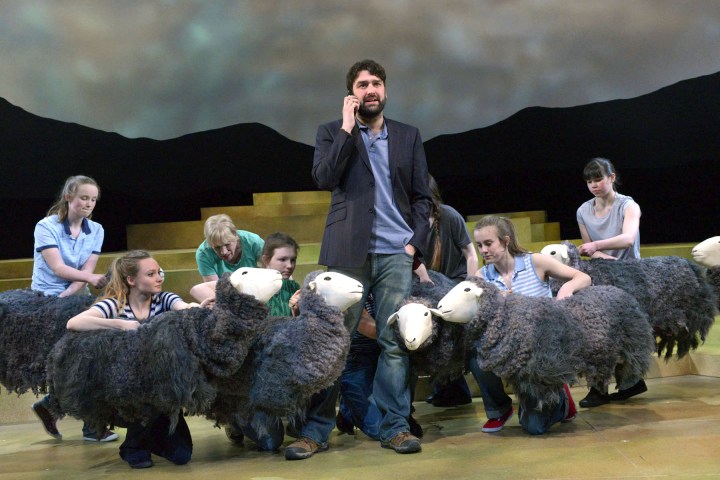
Sheep and sheepdog puppets, a trip to Beatrix Potter’s farm, and an old shepherd arguing with Wordsworth and Wainwright: next time somebody asks me about Cumbria, I will direct them to The Shepherd’s Life

~ Dominic Houareau (community cast), Janine Birkett (Jill / Jean / Mrs Heelis), Joseph Richardson (Pupeteer / Joe / Ronnie / Ewan Goode); photo by Keith Pattison ~


‘The past and the present live alongside each other in our working lives.’ This is certainly true of The Shepherd’s Life, which combines traditional theatrical devices (with some of Kieran Hill’s speeches almost having the tenure of Shakespearean soliloquies) with what feels overall like a thoroughly modern play.  Chris Monks’ adaptation of James Rebanks’ bestseller is not only a successful adaptation of the book, but also a deservedly ambitious play in its own right.

Although Rebanks’ book was only published last year, the play had the feeling of a folk tale.

Monks’ adaptation beautifully encapsulated that sense of a past stretching back through the generations, and the deep connection to the land that it brings.

But watching the play also felt like I was participating in a communal oral history, perhaps because of a shared contemporary knowledge of Cumbria, and because of shared memory.

This is a play on home turf, where the field of theatre extends from the stage into the auditorium, and then out of the doors and up onto the fells. Consequently, the laughter that rippled through the audience was often a knowing laughter, born of experience, and there was an audible collective shudder at the mention of Foot and Mouth.

But it was not just the Cumbrian element of the story that made this play relatable. At its heart, The Shepherd’s Life is a story of family, of love for life, and of home; like all good theatre, the story it tells is at once unique and universal.

All members of the cast were strong and versatile (with nearly all taking three roles), and were supported by a fantastic community cast. Particular mention goes to the three children, who held their own alongside some outstanding professional actors.

Kieran Hill (as James) was the backbone of the production, bearing the narrative of the show with ease. It was through the development of James’ relationships with his father Tom (Martin Barrass) and grandfather Hughie (David Fielder), that the depth of family history was felt, and the true importance of the farm was conveyed, while Martin Johns’ set and Andrew J Lindsay’s lighting design brought the vast expanse of fells and sky into the main auditorium.

During a memorable scene at school, James talks about the dangers of seeming too clever, and the importance of being ‘quietly smart’. This may be all well and good or the young James, but Theatre by the Lake should definitely not be ‘quietly smart’ about The Shepherd’s Life; instead, their cleverness should be shouted from the mountaintops, because they have produced a truly remarkable show.

~ Herdwick Flock operated by community cast, Kieran Hill (James); photo by Keith Pattison ~


My Writing Life: Week 9

Posting a day later than usual this week, due to a slightly hectic Sunday. (For ‘hectic’, read: writing a scene of a play, completing two funding applications and working on the bar at Box of Tricks’ Theatre Company’s show, Chip Shop Chips.)

IMG_0095

Which pretty much sums up the whole week, really. In the best possible way.

As well as the Sunday madness mentioned above, this week has seen: a meeting in Kendal for some work I’m doing with Curious Minds (through New Writing Cumbria) – followed by a chai latte at one of my favourite Kendal Coffee shops, Brew Brothers; a comedy night at Penrith Old Fire Station to raise money for Cumbria Flood Appeal, ft. Rory Bremner, Justin Moorhouse, Fred MacAulay and Wendy Wason; a trip to Penrith’s independent cinema to see the NT Live broadcast of the National Theatre’s As You Like It; a very successful meeting at Clifton Primary School to talk about Arts Award; a trip to Carlisle to visit Prism Arts’ Creative Arts & Conversation group; cooking this week’s communal lunch at Eden Arts; writing a couple of new scenes of a play; and another funding application.

Phew!

And you know what it’s made me realise? That I don’t do enough.

No, I don’t mean that in terms of work. In terms of work, I don’t really stop. This is because I’ve spent several years cramming all of my writing and my freelance work into my spare time. So now, having freed up a lot more time for writing and freelance work, I should have lots more spare time. All that time that used to be writing time should now be free.

But there’s a problem: I no longer know how to spend free time.

I know that sounds stupid. But seriously: I had a couple of hours the other day and I seriously couldn’t work out what to do with them. It’s like I’ve forgotten what to do with time that isn’t spent reading or writing.

So that’s one of my targets: to reclaim my free time. More particularly, to reclaim my weekends. (Getting out of bed on a Monday morning is so much harder when you’ve just spent the whole of Sunday working flat out.)

I’m not quite sure what I’m going to do with this free time that I’m determined to make. Something non-word-based. Maybe something outdoors-based? I think I’d like to get back into photography. And maybe do more crafting as well – something I’ve done very little of so far in 2016.

But something that doesn’t let me suffer from creative burnout.

Watch this space!

The week in pictures:

My Writing Life: Week 7

You know those weeks where you think you’ll take it easy and focus on one thing, then by the end of it, you’ve created two new arts projects, drafted three new poems, written 25% of a play, read four books, kept up to date with all your admin, and somehow managed to find time for a bit of a social life as well?

No?

Well this week has been one of those.

The ‘one thing’ I was planning to focus on was the play, so actually 25% is slightly (though only slighlty) under what I wanted to write of it this week.

But, as seems to be my new norm, I’ve been slightly distracted by the poems clamouring for space in my head. I tried (not entirely successfully) to save up the poetic energy till yesterday – when I took part in Kim Moore‘s Barrow Poetry Workshop. As always, I came away from the workshop with something that I want to work on. Poetic energies = successfully channelled.

As for my other artistic energies?

As I was driving home from a busy day at Eden Arts on Tuesday, I started thinking how it was over 2 years since I’d done any guerrilla poetry style projects (the last one being Beneath The Boughs at Lowther Castle in 2013), and how I should probably think about doing another one in the next year or so. By the time I pulled into my drive, I had fully planned not one, but two, new arts projects. By the time I’d made and drunk a cup of tea, I’d ordered all the materials for one of them.

Project 2 is still under wraps for now (though if you have an unloved teddy bear you want to donate to it, drop me a line), but I launched the first project today:

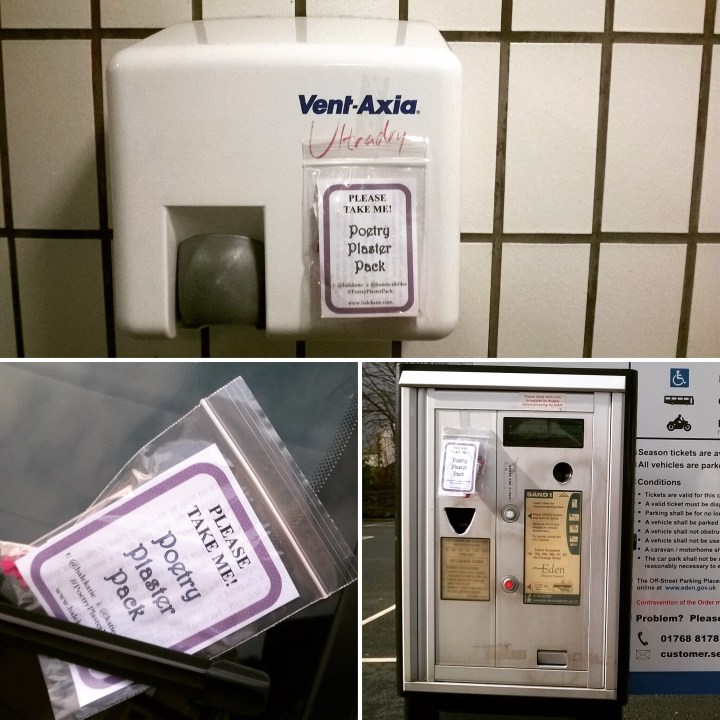
Poetry Plaster Packs aim to spread a little poetry, joy and healing. Each one contains:

  • a plaster (for the literal cuts and scrapes)
  • a cheerful little poem (for the figurative ones)
  • a little gift – because let’s face it, who doesn’t love a present?

Today, I left 40 little Valentine’s Poetry Plaster Packs around Penrith: under car window wipers, stuck to ATMs and inside phone boxes, on dryers in public toilets, and stuck to parking meters.

img_0084

I’ve already had a couple of lovely comment from people. One recipient tweeted this:

While someone else emailed me via my website: ‘With my 3 year old daughter and locked my keys in the car.. your little plaster pack brightened up my day.. and the sweets kept my daughter entertained until the spare set got to me about 40 minutes later. So thank you.’

So far a success! Definitely more Poetry Plaster Packs to follow…

In other news, the Cumbrian weather finally feels like it’s turned (though I’ll say that cautiously, because I don’t want to jinx it). At least, it’s currently snowing, which makes a change from rain, and we’ve had a couple of sunny days, which have meant I’ve been able to go for little strolls along the lanes whenever I’m struggling with a piece of writing: something that never fails to help me find a solution.

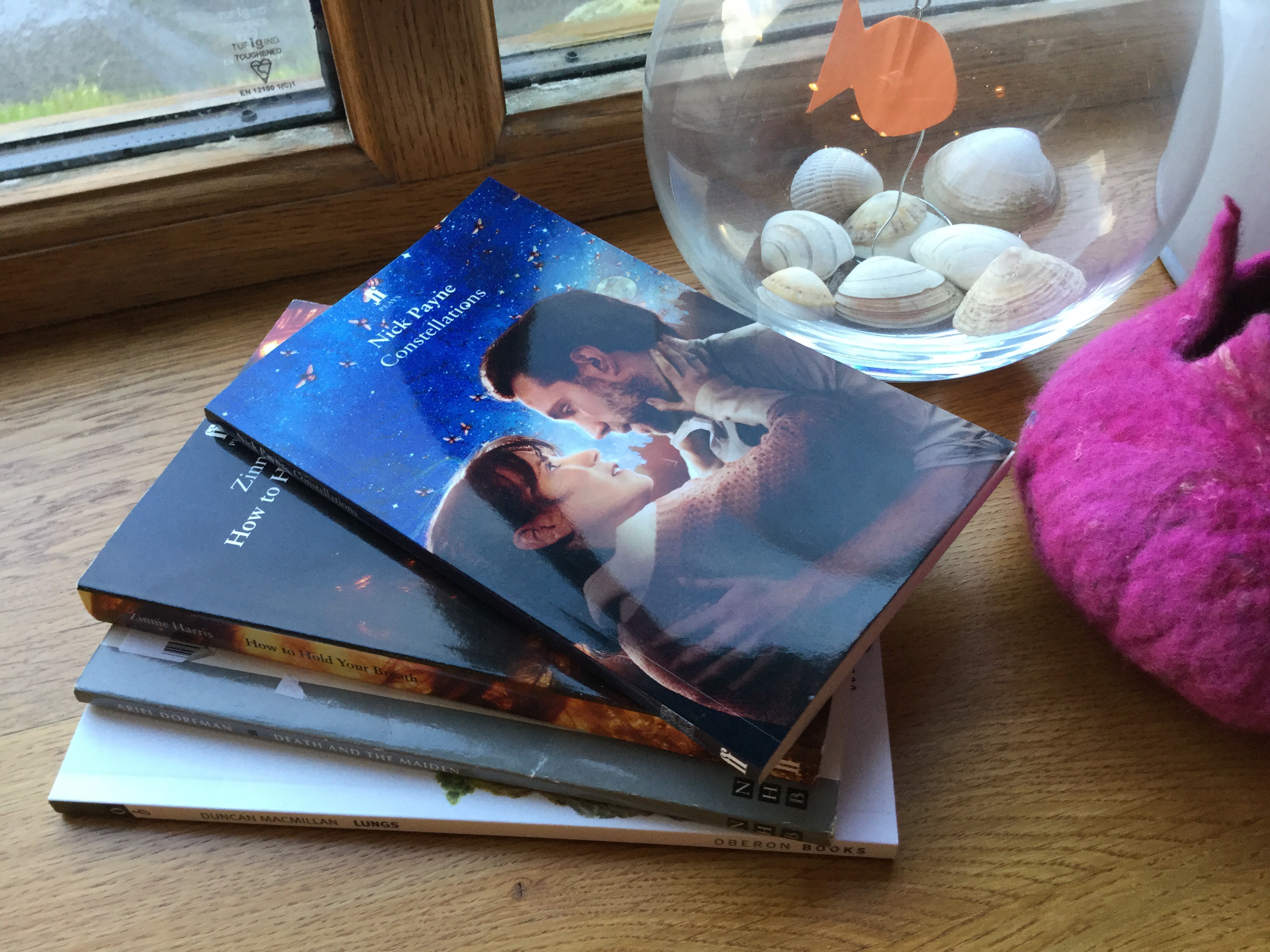
The week in books:

  •  Duncan MacMillan, Lungs
  • Nick Payne, Constellations
  • Zinne Harris, How to Hold Your Breath
  • Ariel Dorfman, Death and the Maiden

A week of theatre this week, in an attempt to keep myself in the playwriting zone. Death and the Maiden has been sitting on my bookshelf for sometime, just waiting to be read, so I figured it was probably about time to give it a whirl. Definitely a good decision to read it.

The other three are more recent plays, and are the three that I (perhaps rather extravagantly) bought last week at the National Theatre bookshop. But money spent on books is never a bad thing, and these three were all such great plays that I’m not sorry at all. How to Hold Your Breath is particularly one that stayed with me; after I read it on Tuesday night, I had a really unproductive morning on Wednesday, as I just couldn’t stop thinking about it! Definitely the mark of a good play.

The week in pictures:

My Writing Life: Week 6

It only feels like a day ago that I was writing last weekend’s blog post, and yet, it also feels like months ago… One of the sure signs of a busy week.

Busy, yes, but also satisfying, hugely enjoyable, and out of the ordinary. In fact, I’m beginning to think that this new life doesn’t have an ‘ordinary’ at all…

InstagramCapture_c173e0cd-542c-4a3d-98d9-6f4bc78f6eea

It’s been quite exciting admin-wise. During my day a week at Eden Arts, we set up and organised a monthly wordy open mic night, Word Mess, which will start in March. I’ve also been handing out leaflets and posters for the Three Inch Fools’ Easter Shakespeare workshops.

Aside from that, it’s been almost a direct split between writing and relaxation.

I spent a couple of days in London, staying with the lovely Supal for a much-needed catch-up and a wander round the capital. We spent a good deal of time in independent book and coffee shops – including the delightful Primrose Hill Books, where I impulse bought a book called The Penguin Lessons (about a teacher at an Argentinian boarding school who rescues a penguin from an oil spill and takes it to live on his terrace at the school). Because let’s face it: who can resist a book about a penguin…? Certainly not me!

I also finally made it to the Attendant Cafe. Attendant is an underground cafe, created in an old public toilet. I’d heard about it ages ago on a couple of travel blogs, and couldn’t wait to visit for myself. (I have a bit of an obsession with toilets; when I was travel blogging I used to publish a ‘Loo witha View’ series, of unusually beautiful views from toilets from my travels). Fittingly, then, this trip to Attendant also doubled up as a chance to chat about blogging and travelling with Supal, who runs chevrons & eclairs.

But London wasn’t all coffee and sightseeing. I also spent some time sitting in one of the work spaces in the National Theatre, via spending a little more money than intended at the National Theatre Bookshop. As you may guess from this week’s reading list (below), I’m currently in playwriting mode. I couldn’t think of a better place to work on a play than in a quiet corner of the National Theatre itself.

Back up north, I spent a day at a poetry workshop at Tullie House Museum & Art Gallery. Tullie House are currently hosting the National Portrait Gallery’s Picture the Poet exhibition. As part of the exhibition’s outreach programme, they’re working with Apples & Snakes to run poetry workshops (leading to a showcase) for groups around Cumbria. One of these groups consists of Tullie House Youth Panel, along with one of my young writers from New Writing Cumbria’s Rabbit Rabbit (rabbit) group. They’re working with poet Jenny Lindsay, who ran a fantastic worksop, as part of a series that will eventually lead to all of the young people writing an individual poem and a group piece.

Needless to say, I took advantage of the workshop and drafted a poem of my own. I may be attempting to focus on playwriting, but somehow poems just keep popping up in my head – and who am I to deny them their existence?

The week in books:

The week in books

  • Sarah Corbett, And She Was
  • Mark Ravenhill, Shopping and F***ing
  • Sarah Kane, Blasted
  • Tom Michell, The Penguin Lessons
  • April de Angelis, Plays: 1 [Ironmistress; Hush; Playhouse Creatures; The Positive Hour]

This week has been largely about drama. It’s been a mixture of re-reads (Blasted, Shopping and F***ing and Hush) and new reads (Ironmistress, Playhouse Creatures and The Positive Hour), which has been both fun and refreshing.

I also read Sarah Corbett’s And She Was, which has been sitting in my car for the past few months, begging to be taken inside / into a coffee shop and read. I saw Sarah perform at Ilkley Literature Festival, and got her book (along with Mona Arshi’s Small Hands, also published by Pavillion Poetry) shortly afterwards.

There was also, of course, the book about a penguin that I picked up in Primrose Hill. Because, once I’d bought it, I could hardly resist reading it, now, could I?

The week in pictures:

A little bit of everyday life this week, from insightful passages in books, to cafes, to birthday cake:


My writing life: week 2

Writing poetry with a cup of tea. Katie Hale, Cumbrian poet / writer etc
Poetry & a cuppa

Confession: at the time of writing, the week is not yet over. I wrote and scheduled this post on Friday. Why? I’m currently in Marrakesh.

Bearing that in mind, it’s been a much shorter-than-usual week for writing, truncated even further by the fact that I’ve spent two days at the New Writing Cumbria office, rather than the usual one. I’ve also been delving into the joys of my tax return.

But even despite all that, I’ve been loving the writing time.

I wrote a poem about a whale, which I think is already very close to the final draft stage. I also discovered a very old draft of a very old poem (well, 3 years old), which I had completely forgotten about, and was able to rework into a completed piece. To make matters even better, it became a gogyoshi-ku. Thanks, BAR poets and Jacob Sam-La Rose, for introducing me to that particular poet form. Oh, in case you were wondering, a gogyoshi-ku consist of a gogyoshi (5-line poem that otherwise has no formal structure) followed by a haiku.

I also did something faintly amazing, and organised my computer filing system for my poetry. Whereas before I had one folder called ‘Poetry’, full of everything from finished pieces to brief jottings that should probably never be revisited, I now have a beautifully streamlined system of folders that gives me a geeky little tingle every time I think about it.

For the organisation geeks among you, my ‘Poetry’ folder is now organised like this:

  • Finished Poems
    • Published poems
    • Waiting for news [submitted to magazines]
    • Other poems
  • Poems to work on
  • Misc. documents
    • [archived drafts and jottings, filed by year]

And, inspired by the wonderful Kim Moore, I’ve now also created an Excel poetry submission spreadsheet, with a list of poems down the side, a list of magazines & journals to submit to across the top, and colour-coded boxes according to whether the poems have been accepted or rejected, or are waiting a response.

Now it’s just a case of making those systems work!


The week in books:

  • [still reading] Sebastian Faulks, Birdsong

(Though in fairness, it is a long book. And with the train ride to the airport and the long-ish flight to Marrakesh, I may have finished it and be onto something else by the time this post goes live.)

The week in pictures:

Photos of Marrakesh to follow next week!


A couple of months ago, I was running a poetry workshop in a small Cumbrian primary school on behalf of the Wordsworth Trust. At the start of the session, I asked the children whether they had any questions about poetry or about being a poet. One boy put up his hand and asked, ‘Are you on medication?’

As if that wasn’t enough, this then shaped the questions from the other children, such as: ‘Do you have any allergies?’ I then had a sensible one (‘How long have you been writing poetry?’), but it was instantly followed by, ‘How old are you?’ and several minutes in which the children frantically tried to guess my age. (If you were wondering, by primary school calculations I could apparently be anywhere between 19 and 43.)

I then started asking around, to see if other poets had similar stories of being asked interesting questions. Turns out, they do – particularly when children are involved.

Some of my favourites came from Helen Mort: ‘You’re the Derbyshire Poet Laureate, so does that mean you write poems about cats?’ Another child asked her, ‘Have you written any poems about sparkly fairies?’ – rounded off by a small yr 3 boy in a primary school workshop, who asked her what was in her handbag and if he could have a look.

Another question, which seems universal, is: ‘What do you write about?’

Universal it may be, but it’s still nearly impossibly to answer – so much so that Alex Bertulis-Fernandes described it as an ‘odd question’, despite the fact that it’s annoyingly common: ‘I’m not quite sure why I find it so strange, and I’m sure I’ve asked others the same – my answers to the question always feel unimpressive though.’

Polly Atkin agreed: ‘I hate being asked ‘what kind of poetry do you write’ as though there is an answer to that.’

She also ventured a couple of things she’d been told as a poet, as well as questions she’d been asked, such as a suggestion that she should use her 3rd place competition prize money buy a notebook so she could ‘keep practising’, as well as the cheek of a male poet who told her she should ‘stick to the women’s magazines’.

Another writer who had been told where he should publish his poetry was Owen Collins: ‘my Mum, when struggling to get her head round my ambitions, once told me that she thought I’d be very good at writing the poems for inside birthday cards…’

I’ve experienced this one myself. When I showed people the first good poem that I wrote (well, I thought it was good; it won a prize, so that’s something), one of my parent’s friends told me it was so good, it should go on the inside of a greetings card. I’m pretty sure he meant it as a compliment, but as it was a poem about dissatisfaction with a dying relationship, I’m not sure what kind of card it would be appropriate for. Maybe some kind of ironic Valentine…?

But I think my favourite contribution came from Lindsey Holland, who was asked: ‘If I write about breasts as hills, from a microscopic perspective, is that landscape poetry?’ And I desperately hope she answered yes.

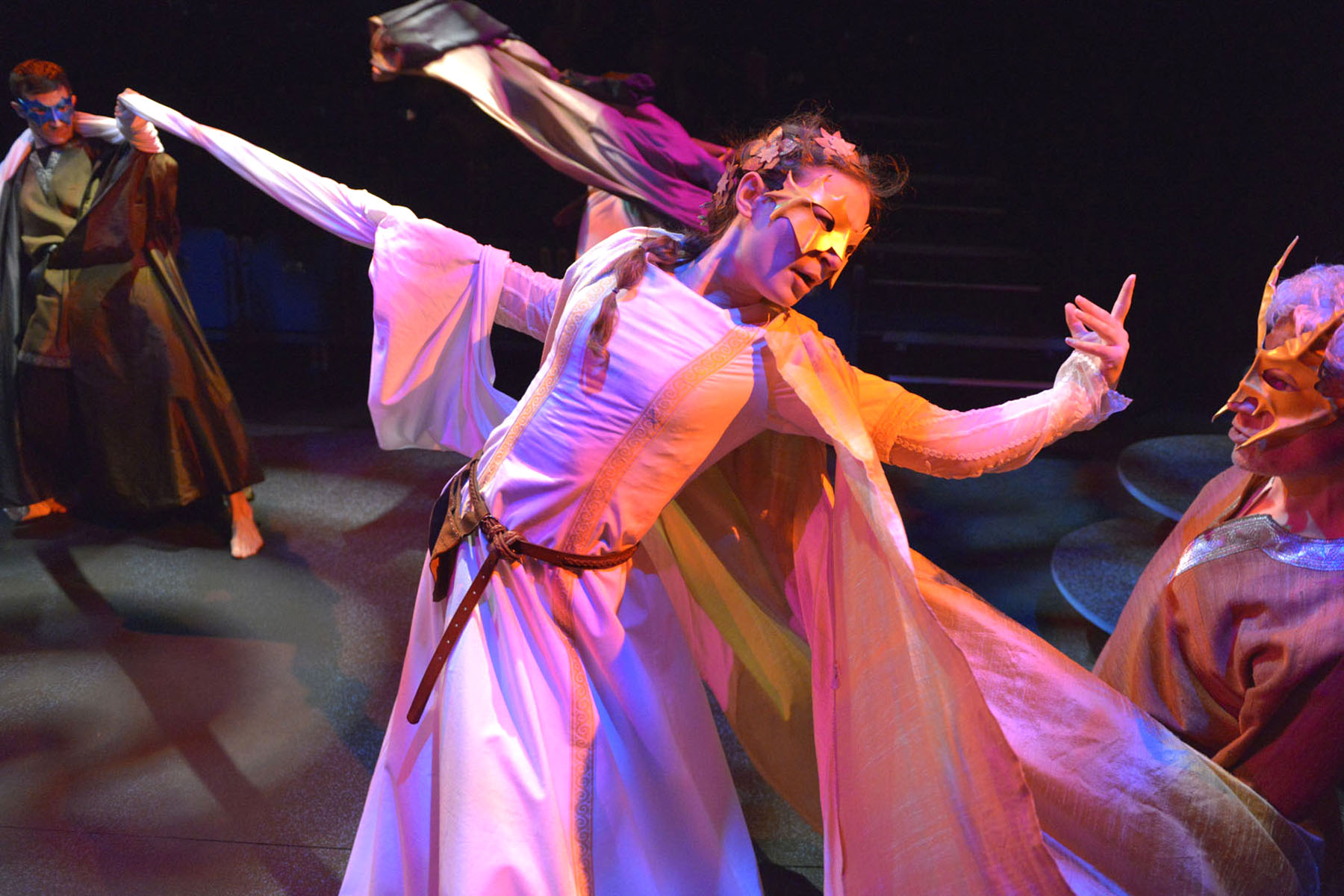
The Lady of the Lake, by Benjamin Askew: Theatre by the Lake, Keswick

Theatre by the Lake production of THE LADY OF THE LAKE by Benjamin Askew directed by Mary Papadima. Review by Katie Hale.
~ Emily Tucker (Morgan), Charlotte Mulliner (Nimue): photo by Keith Pattison ~

When I heard ‘new play about King Arthur written in verse’, I had mixed expectations. Although I always want poetry and verse to succeed, dealing with an established subject matter such as the legend of King Arthur, while using a more traditional form of script-writing, risks the drama feeling staid.

However, despite the play’s mythological setting, it has a contemporary feel. Benjamin Askew’s adaptation of the legend is carefully crafted and controlled, with dialogue that seems both natural and poetic at once.

The Lady of the Lake is also a play which asks big questions about narrative, authorship and autonomy. Framed in the context of a troupe of players, it becomes a play less about the story itself (although it is, of course, a riveting plot), and more about how that story is told and, more importantly, how it is remembered.

Mary Papadima’s stylised direction perfectly complements Askew’s beautiful and subtle verse, while Elizabeth Wright’s deceptively simple set creates almost a blank canvas on which any story could be told.

The integration of music and movement creates a sensory whirlwind, which at times gives the play an almost impressionistic feel – as though reminding us that the story unfolding before us is as fluid as the lake itself.

The only let-down to The Lady of the Lake is its length, occasionally slave to the richness of its intricate plot and sumptuous beauty of its dialogue. However, there is enough talent in the writing and cast to minimise this issue, with Patrick Bridgman playing an uncertain, heartfelt and sympathetic Arthur, years after his prime. Richard Keightley is a disturbingly enigmatic Taliesin, while Charlotte Mulliner and Emily Tucker channelled much of the show’s vivacious energy as Nimue and Morgan.

Benjamin Askew’s The Lady of the Lake is an ambitious play that (for the most part) carries through. In style and technique it is unlike anything I have seen at Theatre by the Lake in recent years: an intriguing piece of theatre.

Theatre by the Lake production of THE LADY OF THE LAKE by Benjamin Askew directed by Mary Papadima
~ Ben Ingles (Owain), Emily Tucker (Morgan), Patrick Bridgman (Arthur/Old Taliesin): photo by Keith Pattison ~

~

The Lady of the Lake runs in the Studio at Theatre by the Lake until Friday 6th November

Yesterday, I posted the trailer to my upcoming musical, Yesterday.

Created in collaboration with friend and composer Stephen Hyde, Yesterday is an intimate new musical telling the story of Alex: a charming, vulnerable and adulterous man. The story is told from the perspective of the three women in his life: the mother who smothers him with love, his deceived wife searching for hope in their marriage, and the the teenage girl in whom he finds solace.

Here is one of the songs from the musical, recorded by Vulture Sessions. Performed by Georgia Figgis, Jemimah Taylor and Joanna Connolly.

More about the musical here.