My Writing Life: Week 7

You know those weeks where you think you’ll take it easy and focus on one thing, then by the end of it, you’ve created two new arts projects, drafted three new poems, written 25% of a play, read four books, kept up to date with all your admin, and somehow managed to find time for a bit of a social life as well?

No?

Well this week has been one of those.

The ‘one thing’ I was planning to focus on was the play, so actually 25% is slightly (though only slighlty) under what I wanted to write of it this week.

But, as seems to be my new norm, I’ve been slightly distracted by the poems clamouring for space in my head. I tried (not entirely successfully) to save up the poetic energy till yesterday – when I took part in Kim Moore‘s Barrow Poetry Workshop. As always, I came away from the workshop with something that I want to work on. Poetic energies = successfully channelled.

As for my other artistic energies?

As I was driving home from a busy day at Eden Arts on Tuesday, I started thinking how it was over 2 years since I’d done any guerrilla poetry style projects (the last one being Beneath The Boughs at Lowther Castle in 2013), and how I should probably think about doing another one in the next year or so. By the time I pulled into my drive, I had fully planned not one, but two, new arts projects. By the time I’d made and drunk a cup of tea, I’d ordered all the materials for one of them.

Project 2 is still under wraps for now (though if you have an unloved teddy bear you want to donate to it, drop me a line), but I launched the first project today:

Poetry Plaster Packs aim to spread a little poetry, joy and healing. Each one contains:

  • a plaster (for the literal cuts and scrapes)
  • a cheerful little poem (for the figurative ones)
  • a little gift – because let’s face it, who doesn’t love a present?

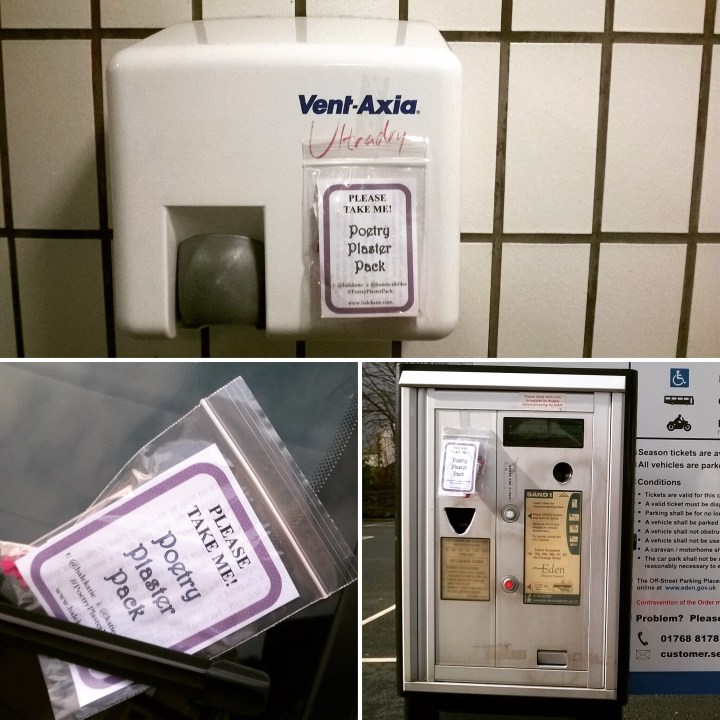
Today, I left 40 little Valentine’s Poetry Plaster Packs around Penrith: under car window wipers, stuck to ATMs and inside phone boxes, on dryers in public toilets, and stuck to parking meters.
img_0084

I’ve already had a couple of lovely comment from people. One recipient tweeted this:

While someone else emailed me via my website: ‘With my 3 year old daughter and locked my keys in the car.. your little plaster pack brightened up my day.. and the sweets kept my daughter entertained until the spare set got to me about 40 minutes later. So thank you.’

So far a success! Definitely more Poetry Plaster Packs to follow…

In other news, the Cumbrian weather finally feels like it’s turned (though I’ll say that cautiously, because I don’t want to jinx it). At least, it’s currently snowing, which makes a change from rain, and we’ve had a couple of sunny days, which have meant I’ve been able to go for little strolls along the lanes whenever I’m struggling with a piece of writing: something that never fails to help me find a solution.

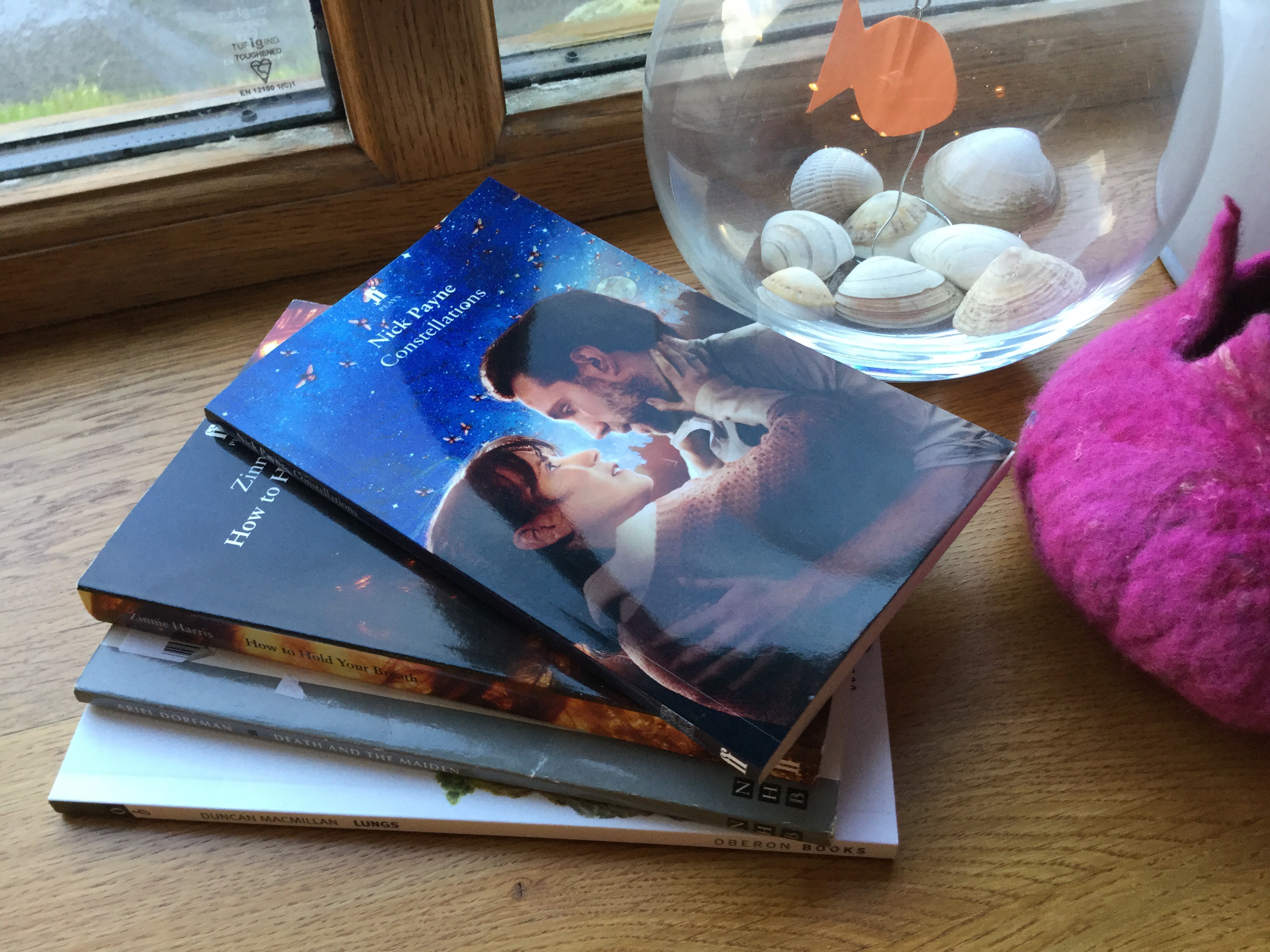
The week in books:

  •  Duncan MacMillan, Lungs
  • Nick Payne, Constellations
  • Zinne Harris, How to Hold Your Breath
  • Ariel Dorfman, Death and the Maiden

A week of theatre this week, in an attempt to keep myself in the playwriting zone. Death and the Maiden has been sitting on my bookshelf for sometime, just waiting to be read, so I figured it was probably about time to give it a whirl. Definitely a good decision to read it.

The other three are more recent plays, and are the three that I (perhaps rather extravagantly) bought last week at the National Theatre bookshop. But money spent on books is never a bad thing, and these three were all such great plays that I’m not sorry at all. How to Hold Your Breath is particularly one that stayed with me; after I read it on Tuesday night, I had a really unproductive morning on Wednesday, as I just couldn’t stop thinking about it! Definitely the mark of a good play.

The week in pictures:

My Writing Life: Week 6

It only feels like a day ago that I was writing last weekend’s blog post, and yet, it also feels like months ago… One of the sure signs of a busy week.

Busy, yes, but also satisfying, hugely enjoyable, and out of the ordinary. In fact, I’m beginning to think that this new life doesn’t have an ‘ordinary’ at all…

InstagramCapture_c173e0cd-542c-4a3d-98d9-6f4bc78f6eea

It’s been quite exciting admin-wise. During my day a week at Eden Arts, we set up and organised a monthly wordy open mic night, Word Mess, which will start in March. I’ve also been handing out leaflets and posters for the Three Inch Fools’ Easter Shakespeare workshops.

Aside from that, it’s been almost a direct split between writing and relaxation.

I spent a couple of days in London, staying with the lovely Supal for a much-needed catch-up and a wander round the capital. We spent a good deal of time in independent book and coffee shops – including the delightful Primrose Hill Books, where I impulse bought a book called The Penguin Lessons (about a teacher at an Argentinian boarding school who rescues a penguin from an oil spill and takes it to live on his terrace at the school). Because let’s face it: who can resist a book about a penguin…? Certainly not me!

I also finally made it to the Attendant Cafe. Attendant is an underground cafe, created in an old public toilet. I’d heard about it ages ago on a couple of travel blogs, and couldn’t wait to visit for myself. (I have a bit of an obsession with toilets; when I was travel blogging I used to publish a ‘Loo witha View’ series, of unusually beautiful views from toilets from my travels). Fittingly, then, this trip to Attendant also doubled up as a chance to chat about blogging and travelling with Supal, who runs chevrons & eclairs.

But London wasn’t all coffee and sightseeing. I also spent some time sitting in one of the work spaces in the National Theatre, via spending a little more money than intended at the National Theatre Bookshop. As you may guess from this week’s reading list (below), I’m currently in playwriting mode. I couldn’t think of a better place to work on a play than in a quiet corner of the National Theatre itself.

Back up north, I spent a day at a poetry workshop at Tullie House Museum & Art Gallery. Tullie House are currently hosting the National Portrait Gallery’s Picture the Poet exhibition. As part of the exhibition’s outreach programme, they’re working with Apples & Snakes to run poetry workshops (leading to a showcase) for groups around Cumbria. One of these groups consists of Tullie House Youth Panel, along with one of my young writers from New Writing Cumbria’s Rabbit Rabbit (rabbit) group. They’re working with poet Jenny Lindsay, who ran a fantastic worksop, as part of a series that will eventually lead to all of the young people writing an individual poem and a group piece.

Needless to say, I took advantage of the workshop and drafted a poem of my own. I may be attempting to focus on playwriting, but somehow poems just keep popping up in my head – and who am I to deny them their existence?

The week in books:

The week in books

  • Sarah Corbett, And She Was
  • Mark Ravenhill, Shopping and F***ing
  • Sarah Kane, Blasted
  • Tom Michell, The Penguin Lessons
  • April de Angelis, Plays: 1 [Ironmistress; Hush; Playhouse Creatures; The Positive Hour]

This week has been largely about drama. It’s been a mixture of re-reads (Blasted, Shopping and F***ing and Hush) and new reads (Ironmistress, Playhouse Creatures and The Positive Hour), which has been both fun and refreshing.

I also read Sarah Corbett’s And She Was, which has been sitting in my car for the past few months, begging to be taken inside / into a coffee shop and read. I saw Sarah perform at Ilkley Literature Festival, and got her book (along with Mona Arshi’s Small Hands, also published by Pavillion Poetry) shortly afterwards.

There was also, of course, the book about a penguin that I picked up in Primrose Hill. Because, once I’d bought it, I could hardly resist reading it, now, could I?

The week in pictures:

A little bit of everyday life this week, from insightful passages in books, to cafes, to birthday cake:


My Writing Life: Week 4

I’ve always been a bit contrary. Even when I was at school, I never wanted to do the thing I was supposed to be doing – but in my own special geeky little way. I still worked hard, but I did French homework when I should have been concentrating on maths revision, and then maths homework when I should have been learning French vocabulary.

This week has been a little bit like that.

Recently, I’ve been thinking in plays. I firmly believe that different ideas come in different shapes: some are poem-shaped, some feel like pieces of drama, and some are undoubtedly novels. Recently, I’ve been having a lot of play-shaped thoughts, so at the start of the week, I decided to focus on playwriting and start drafting a piece of theatre that’s been gestating in the recesses of my brain for the past few months.

But, in typical me fashion, no sooner had I started getting words on the page, than my brain started firing off poems with all the frequency and urgency of a machine gun. Which is wonderful! But also slightly irritates the planner in me.

But the plus side of all this is that this has been my most productive week for poetry in over a year, which is wonderful.

It’s also been a week of meetings, starting with a very positive meeting at Shap School, about the prospect of running some workshops there, followed by the lovely weekly informal over-lunch meeting at Eden Arts (the first I’ve been able to make in a long time), and rounded off with a great meeting with James of Three Inch Fools (touring Shakespeare) to talk about marketing for their Easter workshops and performances.

It’s also been a week of flooding and books…

The week in books:

  • Angela Carter, The Bloody Chamber
  • A S Byatt, The Djinn in the Nightingale’s Eye: Five Fairy Stories

This week has been a week of modern fairy tales. (I was tempted to add Gail Carson Levine’s Ella Enchanted to the list, but I figured I should probably spend the time writing instead.) On Tuesday, I’d planned to pop into Prism Arts in Carlisle for a catch-up, but the wind and rain were so wild that I decided it was safer staying at home. As the river crept further and further back up the road, I snuggled up in front of the fire and read a book that’s been on my to-read list (and on my bookshelf) for years: Angela Carter’s The Bloody Chamber. After that, I was on such a roll with fairy tales, that I decided to also read A S Byatt’s The Djinn in the Nightingale’s Eye: Five Fairy Stories. Not only were these great reads, but I think they maybe had a slight influence on my wrting this week, too:


Not really any pictures from this week, but I did make a little for-fun video of last week’s trip to Morocco. The main outcome of this was my realising that I need to take much more video footage when I travel somewhere:


72 hours in Marrakesh from Katie Hale on Vimeo.

My Writing Life: Week 3

Three weeks into my new writing life, and I finally feel like I’m getting into some sort of rhythm. Which is strange, when you think that I haven’t yet had a ‘normal’ week. Take this week, for instance, where I spent the first two days of it in Marrakesh, bartering, discovering and soaking up the sun instead of writing. (Don’t worry, though – I’ve had a few very productive days to make up for it.)

InstagramCapture_0ba2f985-4c15-4dc8-94b2-0427c5598c19

But it hasn’t just been poetry I’ve been writing this week, though I have written and edited a good deal of that. I’ve written a little bit of drama. I’ve also been writing tweets.

Yes, this is the week that I created a trending hashtag on twitter.

For those of you who saw it, I’m talking about the #derangedpoetess controversy. For those of you who didn’t see it, let me give you a brief bit of background:

In last week’s Sunday Times, journalist Oliver Thring published an article about recent T S Eliot Award-winner Sarah Howe. On Friday, sparked by a tweet from Amy Key, a number of poets accused the article of being sexist.

I saw Amy’s initial tweet, followed her link to the article, and watched the responses begin to unfold. To be honest, my opinion was that the article probably wasn’t intentionally sexist; it was just bad writing. But you can read the original article here and decide for yourself.

If you ask me, the really unforgivable sexism set in when Oliver Thring, rather than holding his hands up and apologising for any accidental offence, tweeted this:

Well, it isn’t every day you get to respond to a term like ‘deranged poetess’! I tweeted a photo of myself writing, looking very calm and serious, and captioned it as a ‘definitely deranged’ poetess. Then I made it a hashtag.

The hashtag then began trending, and was even written about in a Guardian article! The rest, as they say, is history.

It hasn’t all been social media controversy this week, though. Aside from writing in my now Moroccan-goods-filled house, I’ve also been getting over a cold – aided by some medicine I picked up in a Berber pharmacy in Marrakesh. It’s a black powder, which you wrap in a hankie and inhale the scent, a bit like an olbas inhaler. It instantly clears the sinuses – like a miracle cure! Though I would quite like to know what it is that I’m inhaling… Anyone have any ideas…?

It’s also been a week of reading (though not quite as much as I’d have liked), arranging meetings and organising some volunteering work. And socialising! I know – very unlike me… Apparently writing and having a social life actually can go together!

img_0028

The week in books:

  • Sebastian Faulks, Birdsong
  • Ella Hickson, Eight
  • Mona Arshi, Small Hands

A novel, a play and a collection of poetry: feeling pretty well-rounded in my reading this week. I actually bought Small Hands way back in October at Ilkley Literature Festival, and it’s been sitting in my car ever since, waiting for me to take it into a cafe and start reading it. Unfortunately, my cafe time has been a bit limited since then. But I must say, the little book has waited very patiently, and was well worth it. Some beautiful poems, and also a couple that I could use for teaching, which is always a bonus.

The week in pictures:

As promised last week, this week I’m sharing my photos from Marrakesh. Not necessarily very writer-ly, but full of beautiful bright colours and gorgeous blue skies.

My writing life: week 2

Writing poetry with a cup of tea. Katie Hale, Cumbrian poet / writer etc
Poetry & a cuppa

Confession: at the time of writing, the week is not yet over. I wrote and scheduled this post on Friday. Why? I’m currently in Marrakesh.

Bearing that in mind, it’s been a much shorter-than-usual week for writing, truncated even further by the fact that I’ve spent two days at the New Writing Cumbria office, rather than the usual one. I’ve also been delving into the joys of my tax return.

But even despite all that, I’ve been loving the writing time.

I wrote a poem about a whale, which I think is already very close to the final draft stage. I also discovered a very old draft of a very old poem (well, 3 years old), which I had completely forgotten about, and was able to rework into a completed piece. To make matters even better, it became a gogyoshi-ku. Thanks, BAR poets and Jacob Sam-La Rose, for introducing me to that particular poet form. Oh, in case you were wondering, a gogyoshi-ku consist of a gogyoshi (5-line poem that otherwise has no formal structure) followed by a haiku.

I also did something faintly amazing, and organised my computer filing system for my poetry. Whereas before I had one folder called ‘Poetry’, full of everything from finished pieces to brief jottings that should probably never be revisited, I now have a beautifully streamlined system of folders that gives me a geeky little tingle every time I think about it.

For the organisation geeks among you, my ‘Poetry’ folder is now organised like this:

  • Finished Poems
    • Published poems
    • Waiting for news [submitted to magazines]
    • Other poems
  • Poems to work on
  • Misc. documents
    • [archived drafts and jottings, filed by year]

And, inspired by the wonderful Kim Moore, I’ve now also created an Excel poetry submission spreadsheet, with a list of poems down the side, a list of magazines & journals to submit to across the top, and colour-coded boxes according to whether the poems have been accepted or rejected, or are waiting a response.

Now it’s just a case of making those systems work!


The week in books:

  • [still reading] Sebastian Faulks, Birdsong

(Though in fairness, it is a long book. And with the train ride to the airport and the long-ish flight to Marrakesh, I may have finished it and be onto something else by the time this post goes live.)

The week in pictures:

Photos of Marrakesh to follow next week!


My writing life: week 1

InstagramCapture_9fd867f9-2bde-45e0-bb61-2780dce46999

One week into my new life as a real life writer (!) and it’s time to take stock and see how it’s treating me. Admittedly, it hasn’t exactly been an average week…

I spent most of it in Portugal, thanks to my lovely parents, who decided that after the stress of leaving a job, I needed to relax before really knuckling down to any hard-core writing. So it’s been a week of sun (in small quantities), sand and seafood.

Not working and relaxing abroad means plenty of time for reading, and some time for writing thrown in. Having half-heartedly resolved to write a limerick a day in 2016, this week I’ve managed to write five. (5/7 is pretty good, right?) It’s a great way of practising rhyme without embarking on anything too serious, and a fun way to start the writing day. Here’s my favourite from the week:

There once was a high-handed billy goat
who purchased an outmoded frilly coat.
He thought it looked neat
as he flounced down the street,
but really he looked quite the silly goat!

Naturally, I’m not expecting quite so many late lunches and walks along the beach next week – especially with two days away from the writing desk and in the New Writing Cumria office, and a tax return to complete (joy of joys…)

But I’m definitely aiming for another 5 or so limericks, and plenty other writing besides.

The game, as Mr Holmes would say, is afoot!

The week in books:

  • E. Nesbit, The Enchanted Castle
  • H. G. Wells, The Island of Doctor Moreau
  • William Carlos Williams, Selected Poems
  • Claire Gaskin, a bud
  • [currently reading] Sebastian Faulks, Birdsong

This week has mostly been about novels and imagist poetry.

I started off with The Enchanted Castle, which is a classic Nesbit story about a princess (sort of) and a magic ring, and four children who have a magical adventure – and just what I needed to carry the Christmas childhood feeling forward into the new year. Then, shattering that childhood magic into a thousand sharp-edged pieces, I read The Island of Doctor Moreau, which I can only describe as Animal Farm meets Frankenstein meets Lord of the Flies.

William Carlos Williams is an interesting one – largely because he’s really not my cup of tea. Other than the two poems I knew before reading the collection (think: red wheelbarrow and plums in the icebox), there were only two poems in the whole book that I really, really liked – and they came within the last 5 pages. I’m chalking it up to 230 pages of perseverance.

Currently reading: Birdsong, by Sebastian Faulks

The week in pictures:

A late summer evening: a glass of Pimms in your hand and an open picnic hamper at your feet. Enter the Three Inch Fools.

The Three Inch Fools: outdoor touring Shakespeare (outdoor theatre) performing 'The Tempest'On the surface, director James Hyde’s production of The Tempest appears simple: touring Shakespeare returning to its roots, performed by a small company in the open air, with minimal set and few elaborate props or costumes.

As Shakespeare’s most temporally and geographically contained play, The Tempest suits this pared down treatment, and it takes very little for the Three Inch Fools to transform the performance space into Prospero’s magical island, with clever use of parts of a tepee to create the storm-tossed ship.

In fact, the whole performance is filled with similarly clever use of space, and a complex weaving together of actors, music and song, to give an overall illusion of simplicity.

Composer Stephen Hyde’s music certainly added to this illusion. His beautiful melodies haunt the play, infusing the drama with a pagan, ethereal feel. This is Shakespeare meets The Wicker Man, as Ariel’s unsettling lullabies draw the characters further into Prospero’s net. The lingering and evocative score is one of the strongest elements of this memorable production.

The production is also not without a very talented cast. Joe Skelton’s Prospero holds both characters and audience alike under his spell, commanding his scenes with palpable stage presence. With the help of Nat Spence, a powerful and yet beautifully vulnerable Ariel, his control over the other characters becomes utterly believable – particularly when he stands in the wings, confidently observing the blossoming tender relationship between Miranda (Emma Hewitt) and Ferdinand (Josh Maddison).

However, as in any good production of Shakespeare, plenty is made of the play’s rogue elements, too: the drunken sailors and their adoption of the island’s only native, Caliban (Wilson Smith). Smith adopts a fantastic physicality that utterly transforms him, into a piteous and occasionally disturbing Caliban.

This is one of a number of well-executed physical aspects in the play, including Ferdinand’s rescue from the shipwreck, and, of course, the antics of the two drunks: Stephano (Richard Leeming) and Trinculo (Stephen Hyde). Hyde’s more sombre drunken behaviour superbly complemented Leeming’s wild and elaborate gestures, spreading hilarity throughout the audience. In fact, both actors were so convincing that is was as though they and Smith had been swigging from a real bottle backstage.

Throughout the production, light summer comedy (as well as the play’s darker comedy) was perfectly pitched against the play’s more sinister back story. Under Hyde’s direction, both elements earned their place entirely, to create an entertaining and moving piece of theatre.

This is definitely a company to watch – and then to keep watching, again and again.

*

More about the Three Inch Fools on their website.

The Three Inch Fools: outdoor touring theatre performing Shakespeare's The Tempest

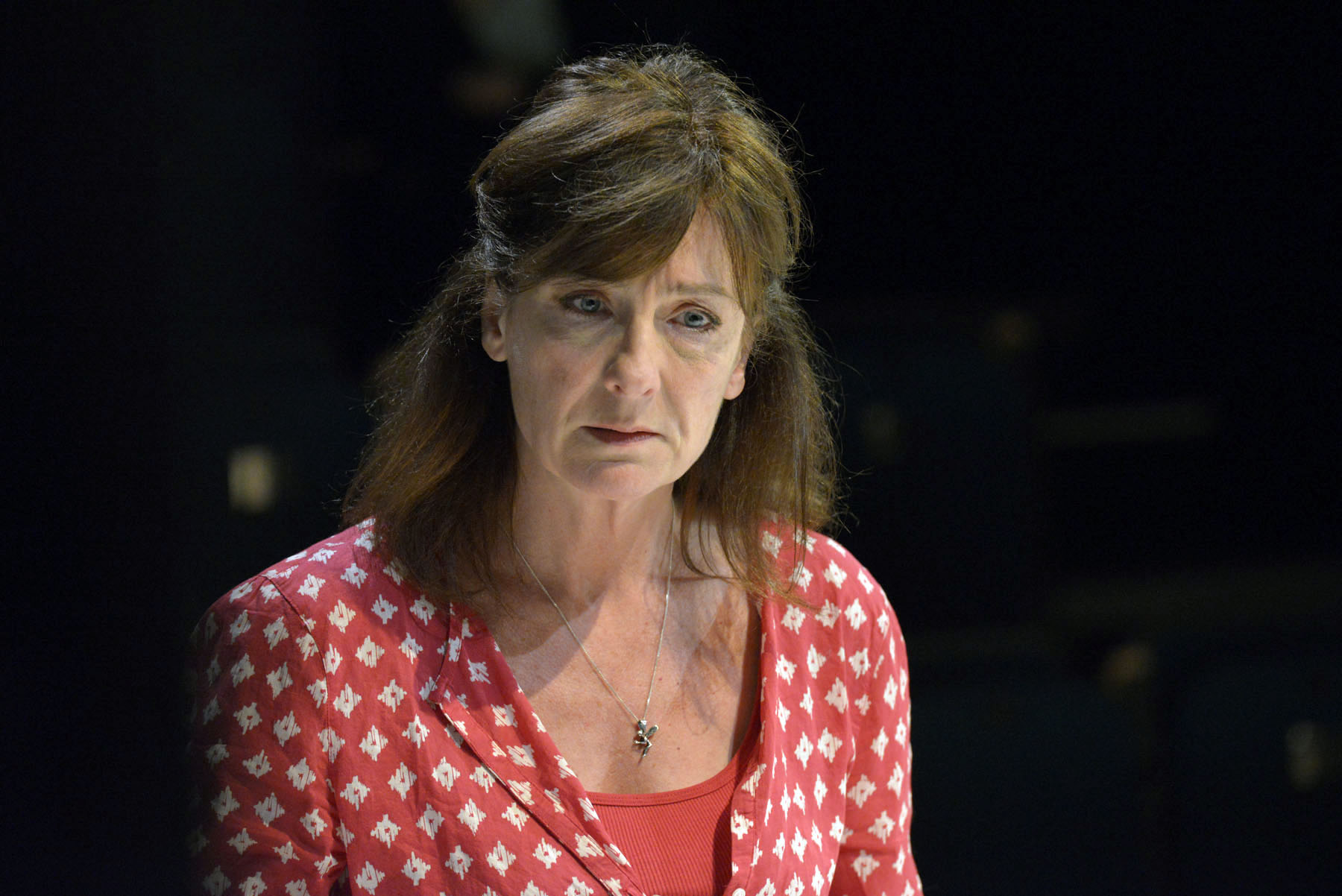
Shelagh Stephenson’s Enlightenment is an unsettling play – one which works on the fears of our imaginations, and the terror of our own smallness in an increasingly global world.

~ Cate Hamer (Lia): photo by Keith Pattison ~

It is this sense of individual insignificance that gives Zoë Waterman’s production such a powerful and contemporary feel – this could be anyone’s house, anyone’s family. In a world where solutions are always just a phone call or the touch of a button away, the sense of these characters’ helplessness pervades the play like a bad dream.

Cate Hamer is a strong central figure as Lia, the mother desperately trying to hold onto herself in her search for answers about her missing son. Through her powerful portrayal of a woman on the edge, we see the struggle for control that plagues all of the play’s characters, from the belligerent Gordon (Peter MacQueen) to Joanna, the ambitious media woman, played by Charlotte Mulliner. Mulliner perhaps best represents the precariously balanced nature of control; she is the character who has most of it at the start of the play, and the only one to bow out as soon as she feels it slipping. Her smart heels and slick performance throw Hamer’s portrayal of a frayed and despairing Lia into sharp relief.

Meanwhile, Patrick Bridgman excels in the role of Lia’s partner, Nick, whose cynical retorts provide much of the play’s humour – a humour that teeters on the edge of hopelessness; Bridgman perfectly balances the two, a master at straddling the line between the emotions he exposes and those he withholds.

However, it is Richard Keightley’s Adam who makes the play a truly disturbing piece. His entrance at the end of the first half is a wave of uncertainty in an already turbulent drama – a wave which becomes a tsunami by the end of the play, as his Machiavellian power games seek to twist the characters against one another with a ferocity that would make Pinter proud. Keightley creates a character with so many layers of manipulation and vulnerability that it becomes impossible to know when (or even if) he ever lays bare this complex character’s troubled core.

Even in such an exceptionally strong season comprising outstanding productions like The 39 Steps and Suddenly Last Summer, Theatre by the Lake’s Enlightenment shines out: a gripping piece of contemporary theatre that seeks to unhinge our sense of control and safety in our own fragile lives.

~ Enlightenment runs at Theatre by the Lake, Keswick, until 7th November 2015 ~

~ Richard Keightley (Adam): photo by Keith Pattison ~

Noël Coward’s Fallen Angels is a play about two spirited women, who, while their more pedestrian husbands are away playing golf, drink themselves into a comical hysteria in anticipation of a visit from their former lover.

Theatre by the Lake production of FALLEN ANGELS by Noel Coward directed by Ian Forrest
~ Polly Lister (Julia), Emily Tucker (Saunders) & Frances Marshall (Jane): photo by Keith Pattison ~

Ian Forrest’s production at Theatre by the Lake delivers both of those things: hysteria on-stage, and comedy off-stage. Despite a slightly slower start, the production picked up in pace and energy with every glass of wine that Jane (Frances Marshall) and Julia (Polly Lister) drank, leading to some all-too-recognisable moments of inebriation and alcohol-induced feuding.

With such comical portrayal of female drunkenness, it is easy to see how Fallen Angels was such a scandalous success when first performed in the 1920s. However, the play’s dramatic impact is perhaps weakened in a society which has (thankfully) moved beyond finding perverse and mildly horrified entertainment in the idea that women, as well as men, might get drunk or have sexual urges. Despite its light entertainment value, it has perhaps become a play with little cultural relevance in our post-sexual revolution, post-Lady Chatterley, post-TOWIE world.

Despite the dated feel of the script, the play was produced and performed to the high standard that one should expect from Theatre by the Lake.

This was a play in which the women (perhaps quite deliberately) outshone the men – though a special mention has to be made of Ben Ingles’ exaggerated suave accent. Emily Tucker gave a strong performance as the self-important maid, Saunders, while Lister and Marshall carried the show brilliantly as the quarrelling best friends, Julia and Jane.

In both Fallen Angels and Abigail’s Party (also part of Theatre by the Lake Summer 2015 season), Lister’s ability to carry a scene and to hold an audience for long periods while alone on stage stood out as impressive, with excellent comic timing and a stage presence that absorbs an audience’s attention. Marshall provided the perfect foil to Lister’s Julia, with an almost immature gaiety that made her a delight to watch.

As with the Theatre by the Lake’s production of Abigail’s Party this season (to which it is quite similar in a number of respects), Fallen Angels may not be an example of thought-provoking contemporary theatre, but it does provide an entertaining evening out.

Theatre by the Lake production of FALLEN ANGELS by Noel Coward directed by Ian Forrest
~ Frances Marshall (Jane) & Polly Lister (Julia): photo by Keith Pattison ~

 ~

Fallen Angels runs in the main house at Theatre by the Lake until 7th November 2015.

A couple of months ago, I was running a poetry workshop in a small Cumbrian primary school on behalf of the Wordsworth Trust. At the start of the session, I asked the children whether they had any questions about poetry or about being a poet. One boy put up his hand and asked, ‘Are you on medication?’

As if that wasn’t enough, this then shaped the questions from the other children, such as: ‘Do you have any allergies?’ I then had a sensible one (‘How long have you been writing poetry?’), but it was instantly followed by, ‘How old are you?’ and several minutes in which the children frantically tried to guess my age. (If you were wondering, by primary school calculations I could apparently be anywhere between 19 and 43.)

I then started asking around, to see if other poets had similar stories of being asked interesting questions. Turns out, they do – particularly when children are involved.

Some of my favourites came from Helen Mort: ‘You’re the Derbyshire Poet Laureate, so does that mean you write poems about cats?’ Another child asked her, ‘Have you written any poems about sparkly fairies?’ – rounded off by a small yr 3 boy in a primary school workshop, who asked her what was in her handbag and if he could have a look.

Another question, which seems universal, is: ‘What do you write about?’

Universal it may be, but it’s still nearly impossibly to answer – so much so that Alex Bertulis-Fernandes described it as an ‘odd question’, despite the fact that it’s annoyingly common: ‘I’m not quite sure why I find it so strange, and I’m sure I’ve asked others the same – my answers to the question always feel unimpressive though.’

Polly Atkin agreed: ‘I hate being asked ‘what kind of poetry do you write’ as though there is an answer to that.’

She also ventured a couple of things she’d been told as a poet, as well as questions she’d been asked, such as a suggestion that she should use her 3rd place competition prize money buy a notebook so she could ‘keep practising’, as well as the cheek of a male poet who told her she should ‘stick to the women’s magazines’.

Another writer who had been told where he should publish his poetry was Owen Collins: ‘my Mum, when struggling to get her head round my ambitions, once told me that she thought I’d be very good at writing the poems for inside birthday cards…’

I’ve experienced this one myself. When I showed people the first good poem that I wrote (well, I thought it was good; it won a prize, so that’s something), one of my parent’s friends told me it was so good, it should go on the inside of a greetings card. I’m pretty sure he meant it as a compliment, but as it was a poem about dissatisfaction with a dying relationship, I’m not sure what kind of card it would be appropriate for. Maybe some kind of ironic Valentine…?

But I think my favourite contribution came from Lindsey Holland, who was asked: ‘If I write about breasts as hills, from a microscopic perspective, is that landscape poetry?’ And I desperately hope she answered yes.

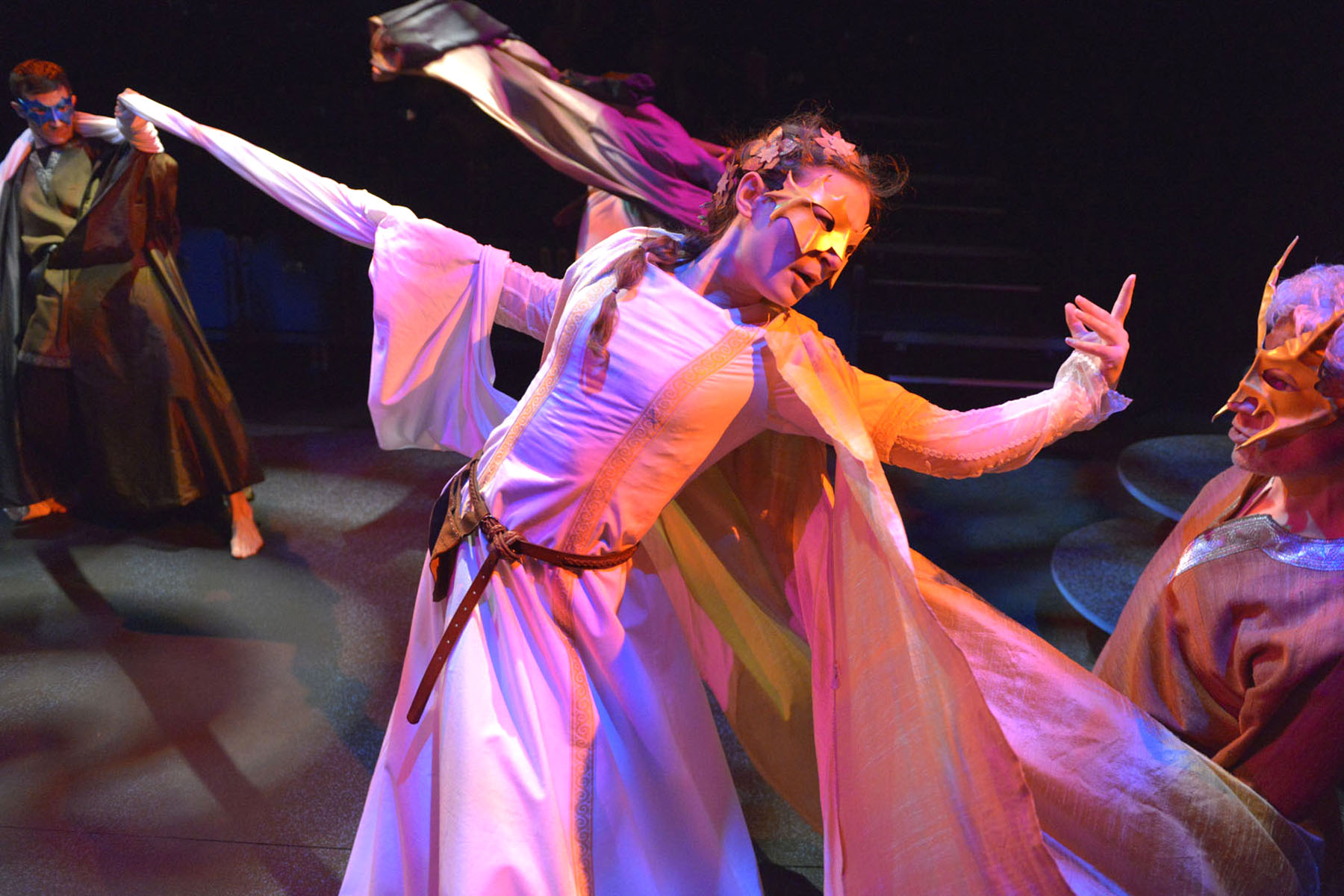
The Lady of the Lake, by Benjamin Askew: Theatre by the Lake, Keswick

Theatre by the Lake production of THE LADY OF THE LAKE by Benjamin Askew directed by Mary Papadima. Review by Katie Hale.
~ Emily Tucker (Morgan), Charlotte Mulliner (Nimue): photo by Keith Pattison ~

When I heard ‘new play about King Arthur written in verse’, I had mixed expectations. Although I always want poetry and verse to succeed, dealing with an established subject matter such as the legend of King Arthur, while using a more traditional form of script-writing, risks the drama feeling staid.

However, despite the play’s mythological setting, it has a contemporary feel. Benjamin Askew’s adaptation of the legend is carefully crafted and controlled, with dialogue that seems both natural and poetic at once.

The Lady of the Lake is also a play which asks big questions about narrative, authorship and autonomy. Framed in the context of a troupe of players, it becomes a play less about the story itself (although it is, of course, a riveting plot), and more about how that story is told and, more importantly, how it is remembered.

Mary Papadima’s stylised direction perfectly complements Askew’s beautiful and subtle verse, while Elizabeth Wright’s deceptively simple set creates almost a blank canvas on which any story could be told.

The integration of music and movement creates a sensory whirlwind, which at times gives the play an almost impressionistic feel – as though reminding us that the story unfolding before us is as fluid as the lake itself.

The only let-down to The Lady of the Lake is its length, occasionally slave to the richness of its intricate plot and sumptuous beauty of its dialogue. However, there is enough talent in the writing and cast to minimise this issue, with Patrick Bridgman playing an uncertain, heartfelt and sympathetic Arthur, years after his prime. Richard Keightley is a disturbingly enigmatic Taliesin, while Charlotte Mulliner and Emily Tucker channelled much of the show’s vivacious energy as Nimue and Morgan.

Benjamin Askew’s The Lady of the Lake is an ambitious play that (for the most part) carries through. In style and technique it is unlike anything I have seen at Theatre by the Lake in recent years: an intriguing piece of theatre.

Theatre by the Lake production of THE LADY OF THE LAKE by Benjamin Askew directed by Mary Papadima
~ Ben Ingles (Owain), Emily Tucker (Morgan), Patrick Bridgman (Arthur/Old Taliesin): photo by Keith Pattison ~

~

The Lady of the Lake runs in the Studio at Theatre by the Lake until Friday 6th November

Yesterday, I posted the trailer to my upcoming musical, Yesterday.

Created in collaboration with friend and composer Stephen Hyde, Yesterday is an intimate new musical telling the story of Alex: a charming, vulnerable and adulterous man. The story is told from the perspective of the three women in his life: the mother who smothers him with love, his deceived wife searching for hope in their marriage, and the the teenage girl in whom he finds solace.

Here is one of the songs from the musical, recorded by Vulture Sessions. Performed by Georgia Figgis, Jemimah Taylor and Joanna Connolly.

More about the musical here.


It’s always exciting as a project races towards its conclusion, seeing all the various strands coming together, slotting into place one after another, often surprising quickly. It’s like solving a rubix cube: one moment it’s a jumble of colours, then suddenly it’s organised and complete. (Or rather, it’s like watching someone else solve a rubix cube – I’ve never been very good at them…)

That’s how it’s been with Yesterday, the musical I’ve written with friend and composer Stephen Hyde. It feels like only yesterday (sorry!) that it was a vague idea we were discussing on afternoon walks in the countryside – and suddenly, it’s complete, cast and in rehearsal.

And to prove it, there’s a trailer:

Yesterday premieres in Oxford, at the Burton Taylor Studio, 16th – 20th June 2015. Tickets available here.

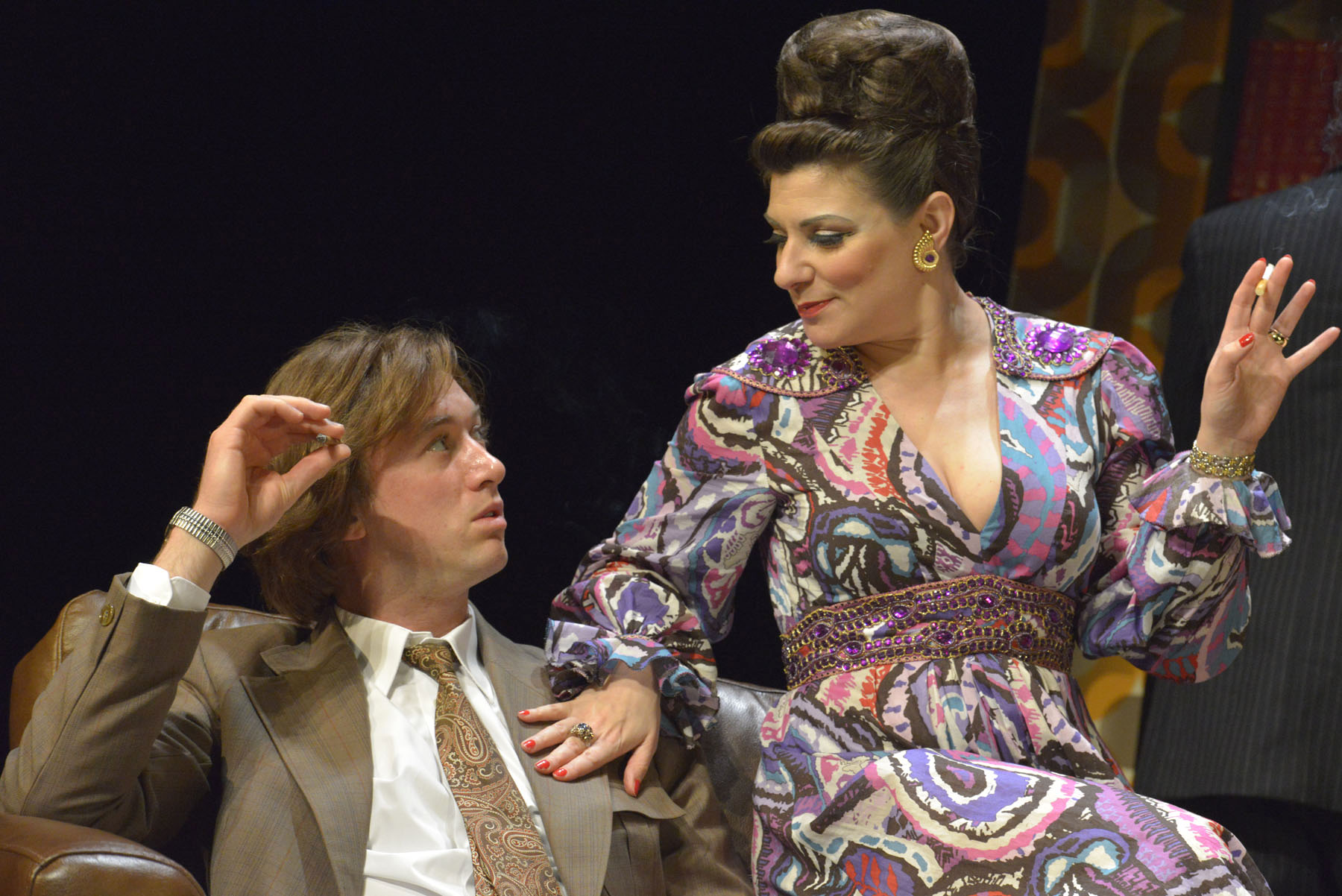
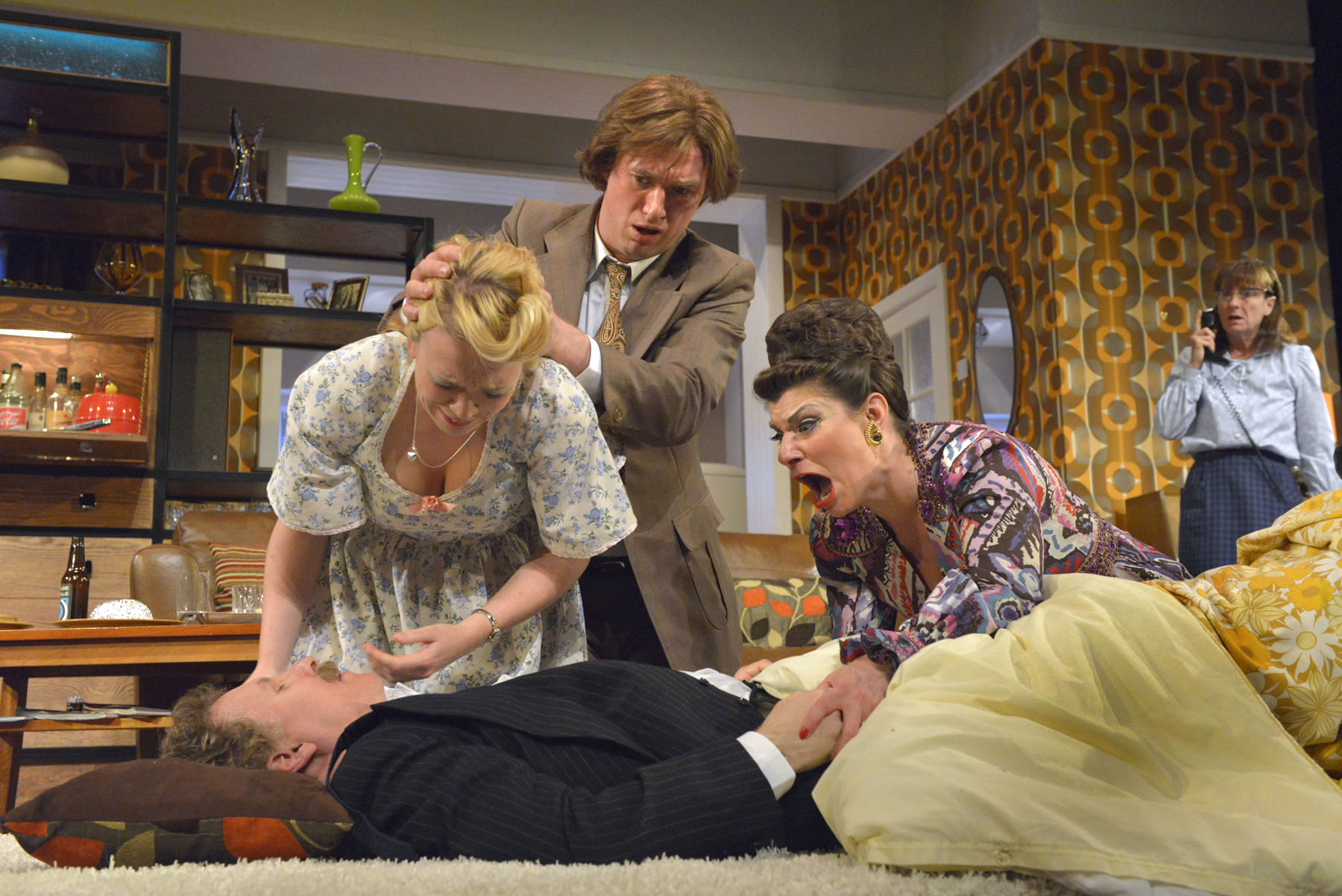
If you’re a fan of the inexplicable style of the 1970s, then Theatre by the Lake’s production of Abigail’s Party, directed by Ian Forrest, could be just what the doctor ordered. If not, then maybe this isn’t the play for you.

Theatre by the Lake production of ABIGAIL'S PARTY by Mike Leigh directed by Ian Forrest - review by Katie Hale
~ Johnny McPherson & Polly Lister: photo by Keith Pattison ~

From the moment you enter the auditorium, there can be no doubt about the era of the play: from the orange and brown wallpaper, to the light-up bar and brown leather sofa, Martin Johns’ set feels like a time machine – something the light-humoured production adds to with an announcement to turn off all mobile phones, pagers and polaroids.

But the period style excels itself with the entrance of Beverly (Polly Lister): a 70s vision in a lurid maxi dress and elaborate hairpiece. With her loud costume and character to match, Lister quickly claims the stage, drawing the audience into the tension of the character, as Beverly fights to retain control of this territory throughout the play.

This struggle for control is apparent in all the actors’ portrayals, from anxious, respectable Susan (Cate Hamer), to likeably naïve Angela (Frances Marshall), to Beverly’s condescending but put-upon husband, Laurence (Richard Earl) – perhaps the ultimate victor in the struggle for centre-stage attention.

However, particular credit has to go to Jonny McPherson as Tony, who, alongside Lister, provided most of the performance’s comedic moments – despite the fact most of his lines consisted only of ‘yeah’ and ‘ta’. With perfect comic timing, deadpan expressions, and silences as loud as Lister’s dialogue and costume, McPherson is easily one of the stars of the show.

As with the actors, every aspect of the production was of the high quality that I’ve come to expect from the Theatre by the Lake. But as a whole, Abigail’s Party left me uninspired, despite the obvious quality of the production values. Mike Leigh’s play feels dated, and the stilted dialogue (although comic in its awkward competitiveness) often feels relevant only to the play’s period setting, and without resonance in the modern world.

For those who miss the 70s, or those who want a light-hearted glimpse of them, Forrest’s vision of Abigail’s Party is an entertaining homage to the decade, which seems to exist as an island from the world of 2015 outside the theatre doors. For those searching for a more contemporary theatre experience, however, Abigail’s Party falls short.


~ runs until Friday 6th November ~

Theatre by the Lake production of ABIGAIL'S PARTY by Mike Leigh directed by Ian Forrest - review by Katie Hale
~ Richard Earl, Frances Marshall, Jonny McPherson, Polly Lister: photo by Keith Pattison ~


[Theatre by the Lake: Keswick]

Theatre by the Lake production of John Buchan and Alfred Hitchcock's  The 39 STEPS adapted by Patrick Barlow directed by Abigail Anderson
~ Frances Marshall, Jonny McPherson, Patrick Bridgman & Richard Earl: photo by Keith Pattison ~

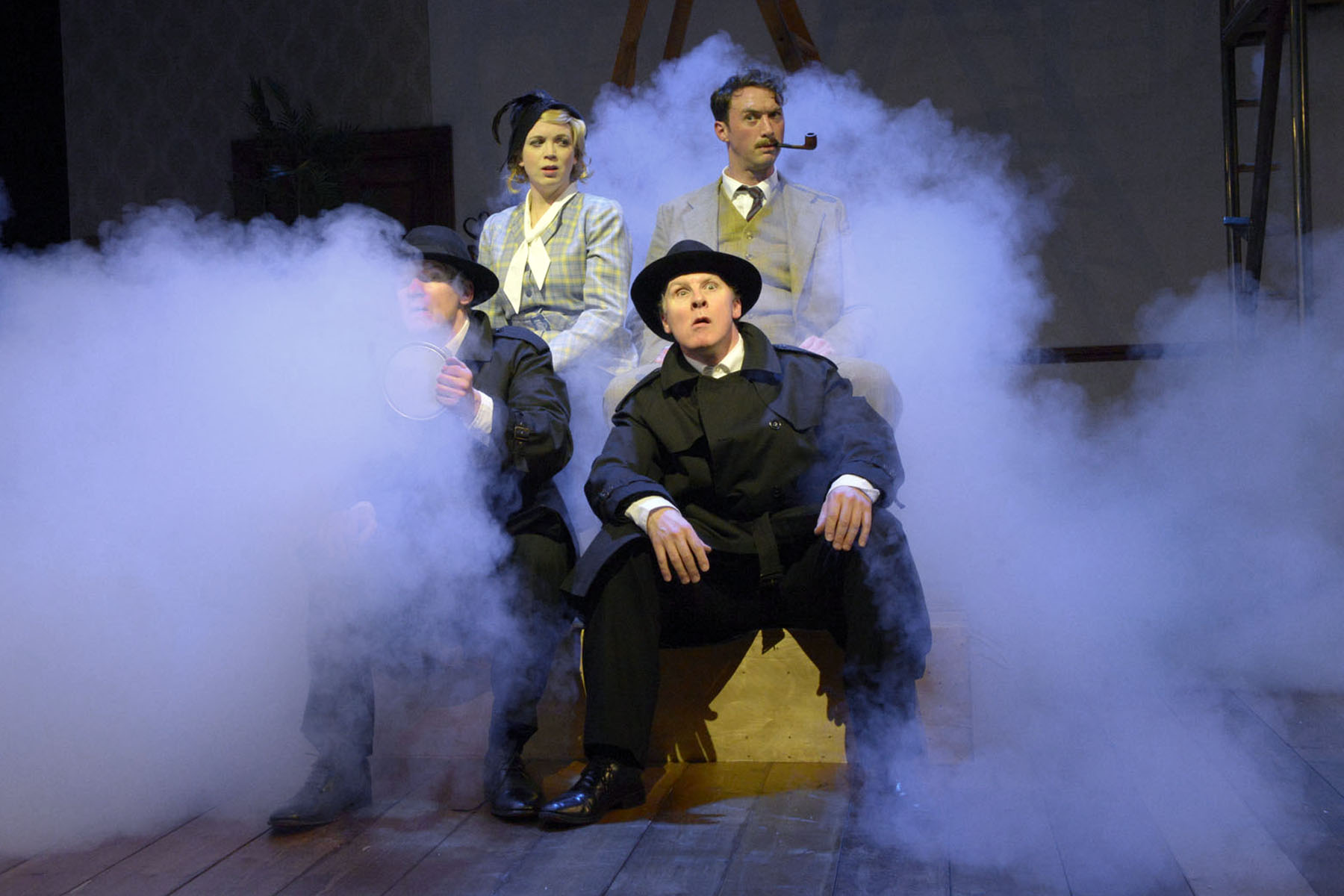
As a general rule, Theatre by the Lake does big melodramatic comedy well. With a string of successful farces under their belt, and the well-executed vibrant chaos of last season’s Comedy of Errors still in mind, it would have been easy for the theatre to get comfortable.

However, Abigail Anderson’s production of The 39 Steps takes Theatre by the Lake comedy to a new level. It was fast-paced, lively, and witty in its execution. The use Martin Johns’ set was imaginative and entertaining, and added to the quirky success of the play. (In fact, I think this may be the only occasion where I have witnessed a piece of set receive its own round of applause during a scene.)

All four cast members carried the play with seemingly endless amounts of energy. Jonny McPherson’s was a comical mix of inconvenienced English gentleman and dashing, devil-may-care spy, while Frances Marshall transformed with apparent ease from cunning secret agent to innocent and proper love interest , playing all three of her roles with a humour and energy that sparked off McPherson’s own.

Especially brilliant were the two clowns: Patrick Bridgman and Richard Earl. I quickly lost count of the number of characters they each played (often playing multiple characters within the same scene), but each one was unique and entertaining in its own right, and every change was done with superb comic timing.

Special mention, though, has to go to the unseen (but not unheard) star of the show: Sound Designer, Maura Guthrie. Every sound effect (and there were many) furthered the comedy of the play, and helped (along with ladders, a few boxes, some scaffolding and a lamp) to bring the world of The 39 Steps to vibrant and hilarious life.

Abigail Anderson’s The 39 Steps is the best thing I’ve seen in the Theatre by the Lake’s main house in years – and the funniest. We laughed out loud from beginning to end, and would happily go back to see it again. It just proves: you don’t need to go to London to see West End-quality theatre.

~ runs until Wednesday 4th November 2015 ~

Theatre by the Lake production of John Buchan and Alfred Hitchcock's  The 39 STEPS adapted by Patrick Barlow directed by Abigail Anderson
~ Patrick Bridgman & Richard Earl: photo by Keith Pattison ~

Mr Paradise and Suddenly Last Summer at Theatre by the Lake

Theatre by the Lake production of Mr Paradise and Suddenly Last Summer by Tennessee Williams directed by Mary Pappadima
~ Polly Lister, Kate Layden, Richard Keightley, Cate Hamer & Emily Tucker: photo by Keith Pattison ~

‘The work of a poet is the life of a poet, and vice versa, the life of a poet is the work of a poet. I mean, you can’t separate them. I mean, a poet’s life is his work, and his work is his life in a special sense.’

Suddenly Last Summer and Mister Paradise are plays about words: about their persistent endurance and the power it gives them.

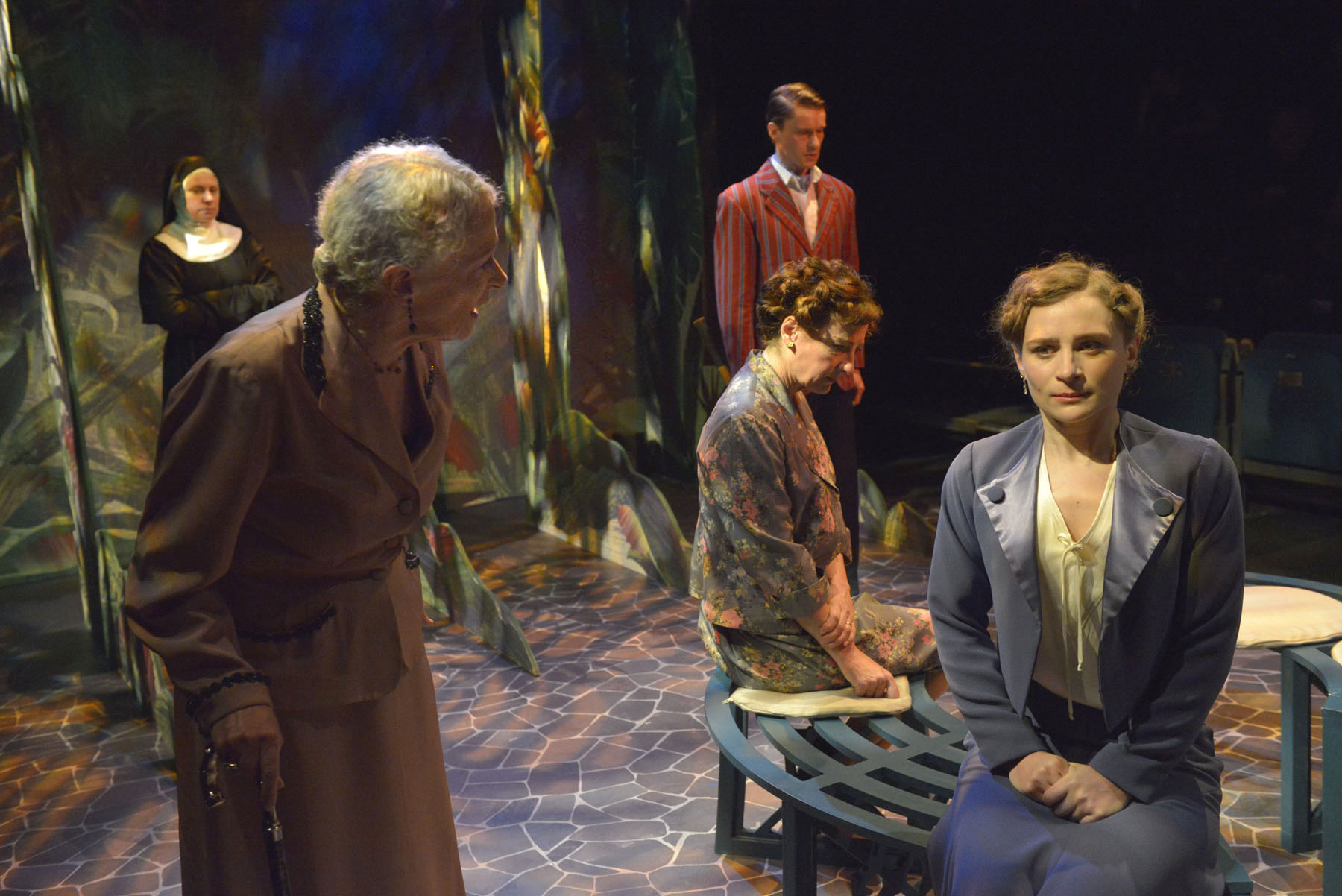
Where there is power, there is usually fear, and Mary Papadima’s production of Tennessee Williams’ plays contains this fear perfectly, like a wild animal held in a cage barely strong enough. In Suddenly Last Summer, the focal point of this tenuous restraint is the conflict between Mrs Venable (Kate Layden) and Catharine (Emily Tucker). Layden beautifully conveys the desperately wielded control of a woman all too aware that control is slipping away from her, but it is Tucker who truly commands the audience’s attention. Her performance of a frantic and traumatised girl, clinging to the edge, is both powerful and moving; in the battle between dreadful truth and respectable reputation, it is undoubtedly her voice that cries the loudest and speaks the strongest.

Mister Paradise is also a conflict between two characters over the issue of truth versus reputation, although it is much quieter than that in Suddenly Last Summer. Both Peter MacQueen (as Mr Paradise) and Charlotte Mulliner (as the girl) address their sides of the question with honesty and sensitivity. Mulliner’s youthful optimism and MacQueen’s more experienced, world-weary reluctance act as two sides of the coin on which Mr Paradise’s legacy spins. The two work well together, sparking off one another so that at times, it is like watching a tennis rally, and other times, like watching a fusion of minds.

The two plays sit well together, too. By juxtaposing the two, Papadima brings out the common themes of truth and reputation, and the power of words in creating both. In doing so, she not only puts Tennessee Williams’ two plays up for comparison, but also gives added to power to the words of the plays themselves.

About a year ago, I discovered the work of Nina Katchadourian.

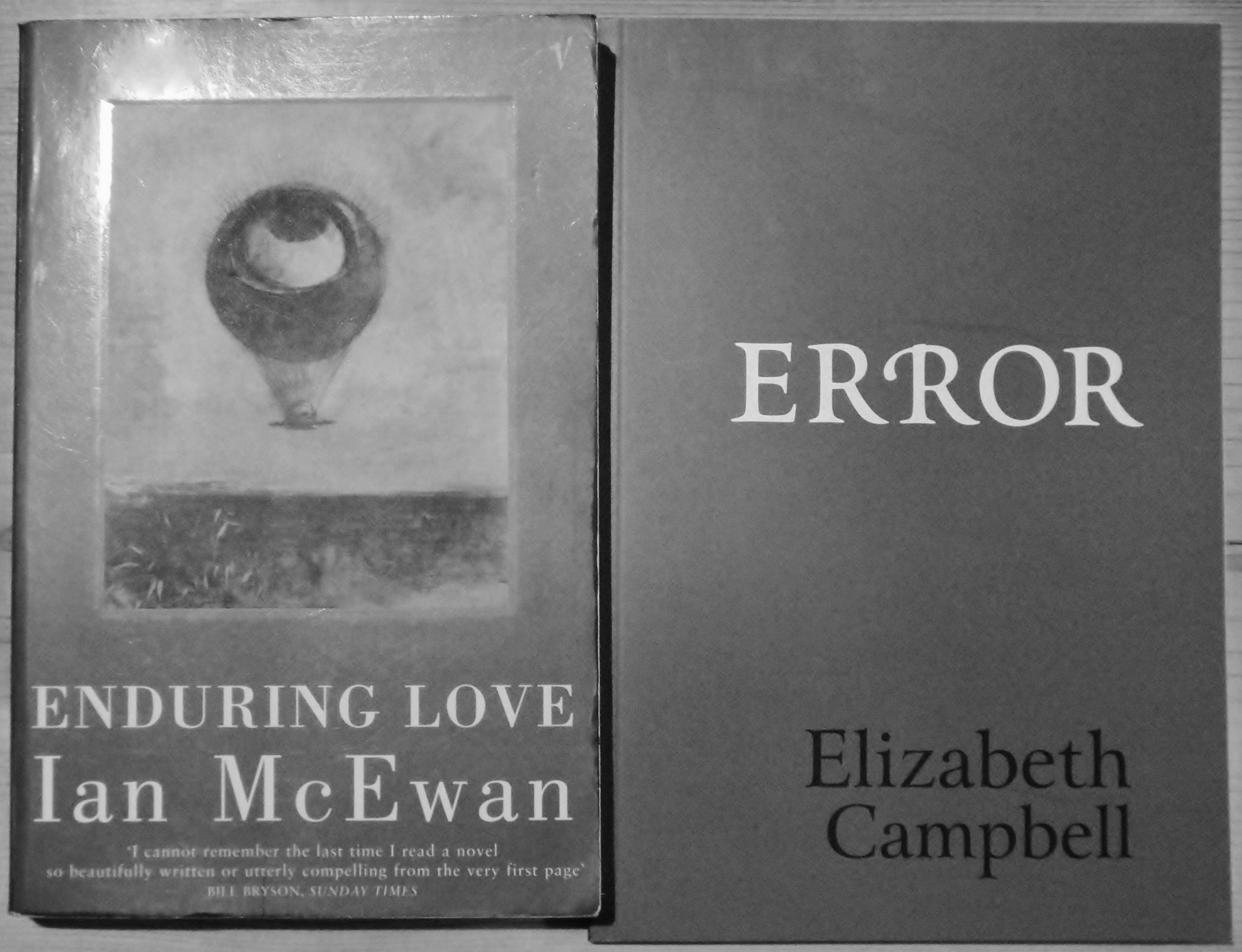
Katchadourian is a Californian artist, who has a series of ‘stacks’ or ‘spine poems’. In these works, she arranges books (usually in stacks, but occasionally side by side) so that the titles create poems.

I thought I would have a go at some of my own ‘spine poetry’, just using the books on my shelves:

*

Spine poetry by Katie Hale, inspired by Nina Katchadourian

The Alchemist on Poetry:

The making of a poem
out of danger;
mining for the light
out of the blue
day.

*

Spine poetry by Katie Hale, inspired by Nina Katchadourian

Enduring Love:

Error.

*

Spine poetry by Katie Hale, inspired by Nina Katchadourian

Frankenstein:

The lovely bones;
heaven eyes;
portrait in skin:

regeneration;

talk of the town.

*

Spine poetry by Katie Hale, inspired by Nina Katchadourian

My Brilliant Career:

The accidental
strong words…

…Goodbye to all that.

*

Spine poetry by Katie Hale, inspired by Nina Katchadourian

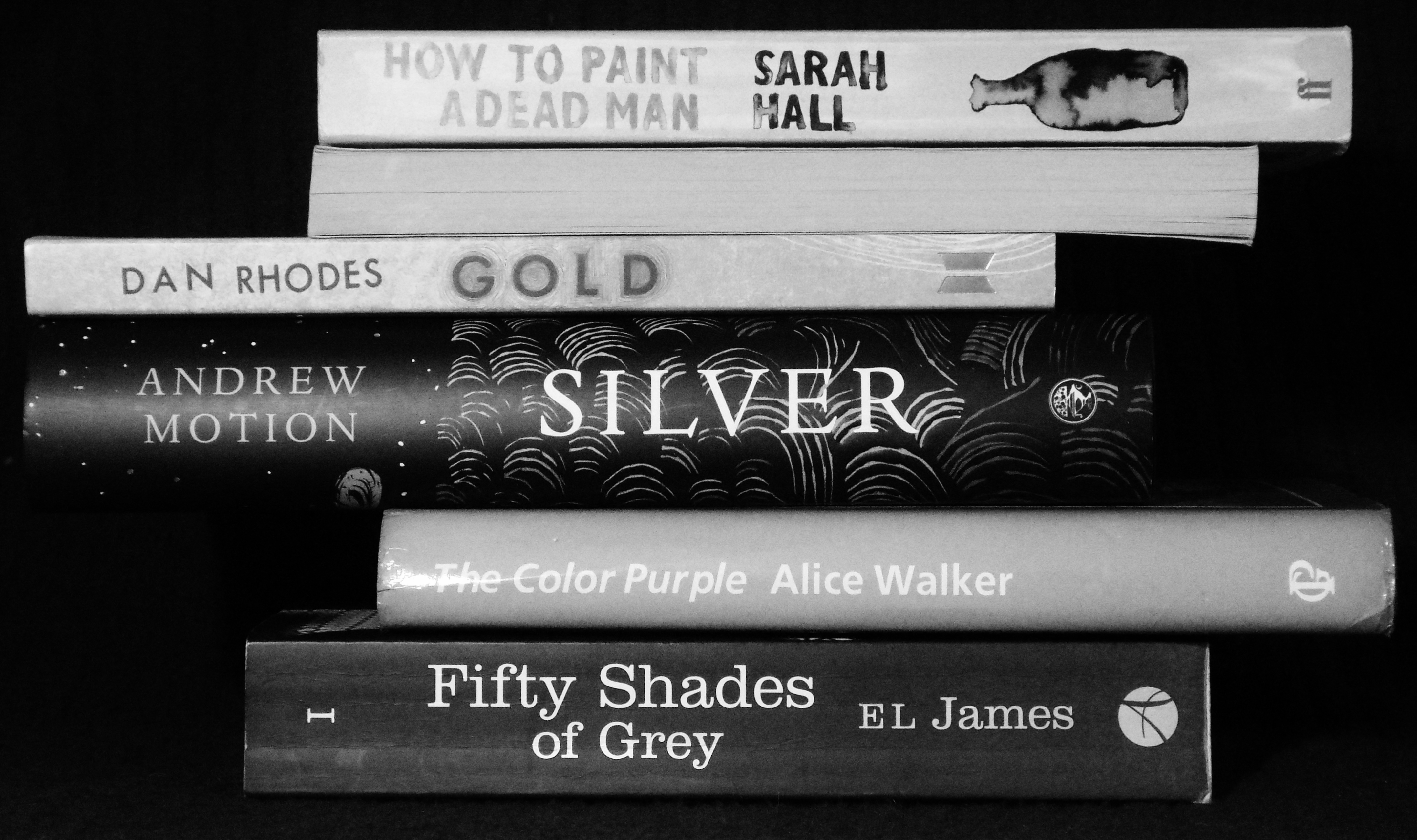
How to Paint a Dead Man:

Gold.
Silver.
The colour purple.
Fifty shades of grey.

*

I’ve talked about my job project managing New Writing Cumbria here before.

One of the great things about it is getting to organise (and attend) events like this one, held on Valentines Day: n evening of music and spoken word, featuring Lady Layton, Les Malheureux, and a quiz. Plus, what Valentines night would be complete without a bar, a few love letters, and the chance to burn the name of your ex?

Just a few shots from the evening:

New Writing Cumbria online magazine: The Carrot

At the moment, I have a number of jobs, but one thing that I love about all of them is helping to create interesting artworks. Whether I’m helping teenagers explore the possibility that they can write poetry, or helping facilitate theatre tours and exhibitions at Prism Arts, or working on my own writing, it’s always exciting to see the seed of an idea come to fruition.

Through my job as New Writing Cumbria, I’ve been working with a group of young writers and editors to produce an online magazine of new Cumbrian writing. And I’m delighted to say that Issue #1 has now been published.

For the first issue, we chose the theme ‘Cumbria-land’. We invited anybody from or living in Cumbria to submit work on the theme – but there was also a bit of a twist. While we did want some of the more traditional types of writing (poetry / fiction / script etc.), we also wanted to explore some of the extra options that creating an online magazine provided.

So we actively encouraged people to submit something a little bit different: film / audio / visual art / crosswords / recipes / jokes…

Admittedly, we didn’t receive any crosswords, recipes or jokes (next time, please?) but we did receive a number of visual and audio pieces, as well as some video. We also used visual art from some of the 2014 Young C-Artists.

The idea was to create something that was fun and vibrant: something that didn’t look like a traditional magazine. And I have to say, I think we succeeded.

We had some excellent submissions, from a large number of writers / artists, and working with the young editors was fantastic. It was great to see them getting so passionate in their discussions over which pieces should be included, and it’s moments like that which remind me just why I love doing the jobs I do.

So don’t be shy: head on over to The Carrot and have a read / watch / listen!

One day a week (plus a bit extra), I run New Writing Cumbria for Eden Arts. We do a number of things, btu one thing we’ve just started is putting on events at Penrith Old Fire Station. The first one went down a storm!

The evening featured poet Kareem Parkins-Brown, musicians Kev Kendal and Bill Lloyd, writer Stephen Redman, and filmmaker Richie Johnston. Oh, and a bar inside a horse box, naturally.

Here are a couple of shots from the night: